
Medical Physics Graduate Programs
UT Southwestern’s Department of Radiation Oncology, comprised of clinical radiation oncology, medical physics and engineering, and molecular medicine, is a leader in the development and clinical implementation of innovative treatment strategies in radiation therapies. We provide exceptional opportunities for translation of laboratory science into clinical trials and an integrated program of medical, radiation, and surgical oncology.
The Division of Medical Physics and Engineering in UT Southwestern’s Department of Radiation Oncology is a leader in clinical care, research, and education. With more than 90 faculty and staff—including medical physicists, dosimetrists, engineers, programmers, residents, fellows, postdoctoral researchers, and graduate students—the division advances radiation oncology through innovation, collaboration, and discovery.
Working alongside experts in clinical radiation oncology and molecular medicine, the division develops and implements advanced technologies and treatment strategies that improve the precision, safety, and effectiveness of radiation therapy.
Our educational programs prepare the next generation of medical physicists and researchers by integrating engineering, physics, computational science, and biology. Master’s and doctoral degrees, residency training, and postgraduate certificate programs combine rigorous research with hands-on clinical education. Admission to these programs is highly competitive.
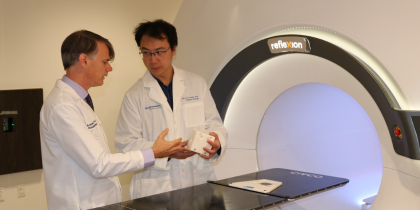
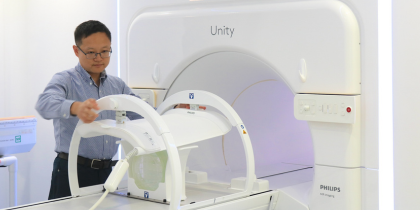
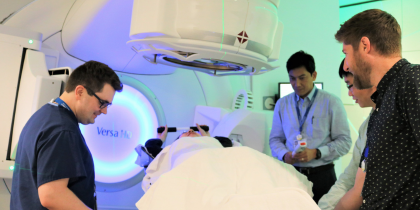
Research conducted by our faculty spans a wide range of areas at the forefront of medical physics and radiation oncology, including cloud- and GPU-based high-performance computing, automated radiotherapy treatment planning, image-guided radiotherapy, 3D/4D, low-dose, and dynamic cone beam computed tomography, Monte Carlo simulation, and real-time tumor tracking and motion compensation.
Specialized Physics
The MAIA Lab was established by Steve Jiang, Ph.D., to solve clinical and biomedical research problems using artificial intelligence (AI) technology. The MAIA Lab develops and applies innovative AI tools to improve aspects of cancer radiation therapy. PEIM serves as a collaborative education resource to promote AI research in precision medicine, diagnosis, medical error detection, quality assurance, as well as other related fields.