
From classroom to clinic: UTSW students match to top residency programs
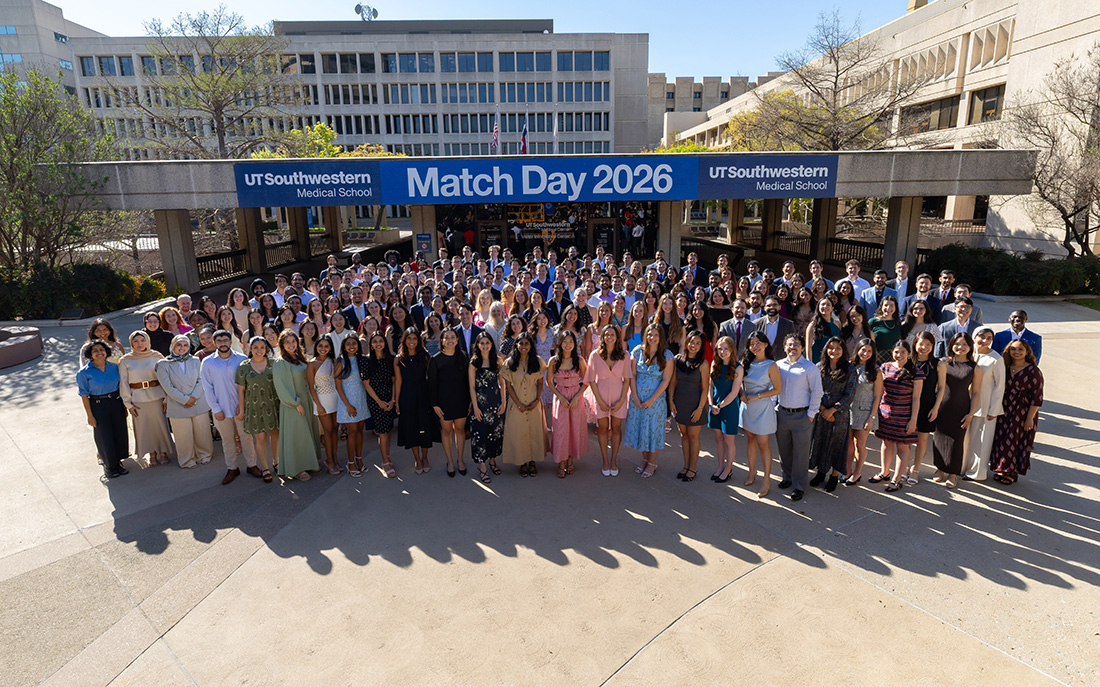
DALLAS – March 20, 2026 – On Friday morning, UT Southwestern Medical School’s Class of 2026 crowded inside the Bryan Williams, M.D. Student Center gymnasium for the time-honored tradition of National Match Day. At precisely 11 a.m., the soon-to-be graduates – along with thousands of other medical students nationwide – tore open the envelopes revealing where they will begin the next phase of their training as resident physicians.
In total, 239 UT Southwestern students matched with more than 80 residency programs across the U.S. Cheers erupted as the aspiring doctors discovered they would be heading to prestigious medical centers such as those at Duke, Johns Hopkins, and Stanford universities after graduating in May. Eighty-one students will continue their training at UTSW-affiliated programs, which rank among the top in the country.
U.S. News & World Report named UT Southwestern among its Best Medical Schools for 2024-2025 – Tier 1 (top 16) for research and Tier 2 (top 50) for primary care. UTSW has the largest graduate medical education training program in Texas, with more than 1,400 clinical residents completing their medical education with postgraduate specialty and subspecialty training.
“Match Day is a momentous milestone in every physician’s journey, and as an educator, it is immensely gratifying to stand beside our students as they prepare to take the next step toward their future,” said Angela Mihalic, M.D., Dean of Medical Students and Associate Dean for Student Affairs at UT Southwestern Medical School, Professor of Pediatrics, and a Distinguished Teaching Professor.
“We are confident that the time and effort they have invested here will lead them to achieve great things in this next phase of their medical training,” she said. “To answer the call of this vocation is no small thing, and I see the boundless potential in each and every one of these future physicians. I have no doubt that the values instilled in them at UT Southwestern will serve as a guiding light to treat their patients with competence and compassion.”
This year, the National Resident Matching Program matched more than 41,000 medical students to institutions across the country. Top specialty selections for UT Southwestern students include Internal Medicine, Pediatrics, and Psychiatry.
“Growing up in East Texas, I viewed UT Southwestern as the pinnacle of cutting-edge medicine, a perception that was reinforced throughout my undergraduate education,” said Michael Pitonak, who hails from Tyler and will train in internal medicine at Duke University Medical Center in North Carolina. “During that time, I came to understand why UT Southwestern holds this reputation.”
Today, this reflection is echoed by many others in the graduating class.
“I was first exposed to medicine through my dad, a physician, as I watched him save lives,” said Zuhair Hawa, who will train in neurosurgery at University of Pittsburgh Medical Center in Pennsylvania. “After gaining more experience at UT Southwestern, I discovered a deep appreciation for the direct interactions we have with patients each day. I enjoy learning their stories and making all patients feel safe and heard during their most vulnerable moments. As a physician, I aspire to comfort patients through these experiences and guide them toward healing.”
UTSW training opportunities, rankings, distinctions
UT Southwestern’s training facilities include William P. Clements Jr. University Hospital, ranked by U.S. News & World Report as the No. 1 hospital in Dallas-Fort Worth for nine consecutive years; Parkland Memorial Hospital, one of the nation’s busiest public hospitals; and Children’s Medical Center Dallas, one of the largest children’s hospitals in the country and the only hospital in North Texas to be ranked in all pediatric specialties in U.S. News’ annual Best Children’s Hospitals report. UT Southwestern also houses a 49,000-square-foot Simulation Center – one of the largest of its kind.
UT Southwestern is nationally ranked by U.S. News in 12 specialties, the most of any in Texas: Cancer; Cardiology, Heart, and Vascular Surgery; Diabetes and Endocrinology; Ear, Nose, and Throat; Gastroenterology and Gastrointestinal Surgery; Geriatrics; Neurology and Neurosurgery; Obstetrics and Gynecology; Orthopedics; Pulmonology and Lung Surgery; Rehabilitation; and Urology. It is also rated “High Performing” in the great majority of evaluated conditions and procedures, from aortic valve surgery and hip fracture to back surgery (spinal fusion) and stroke care.
Other key distinctions
- UTSW’s Harold C. Simmons Comprehensive Cancer Center is the first and only National Cancer Institute-designated comprehensive cancer center in North Texas – one of only 57 across the U.S.
- UTSW is designated as an Advanced Comprehensive Stroke Center by The Joint Commission and the American Heart Association/American Stroke Association and has a Level 4 Epilepsy Center, the highest possible rating awarded by the National Association of Epilepsy Centers.
- UTSW scientists currently lead more than 6,200 research projects, supported by more than $816 million in funding.
- The Perot Family Scholars Medical Scientist Training Program, one of only 56 M.D./Ph.D. training programs in the country supported by the National Institutes of Health (NIH), offers a dual degree to strengthen the advancement of laboratory discoveries into the clinical arena.
- UTSW is ranked No. 1 globally among health care institutions by Nature Index for publishing high-quality scientific research.
- UTSW was awarded Press Ganey’s 2025 Guardian of Excellence Award, which recognizes the top 5% of health care organizations in delivering patient experience.
About UT Southwestern Medical Center
UT Southwestern, one of the nation’s premier academic medical centers, integrates pioneering biomedical research with exceptional clinical care and education. The institution’s faculty members have received six Nobel Prizes and include 24 members of the National Academy of Sciences, 25 members of the National Academy of Medicine, and 13 Howard Hughes Medical Institute Investigators. The full-time faculty of more than 3,300 is responsible for groundbreaking medical advances and is committed to translating science-driven research quickly to new clinical treatments. UT Southwestern physicians in more than 80 specialties care for more than 143,000 hospitalized patients, attend to more than 470,000 emergency room cases, and oversee nearly 5.3 million outpatient visits a year.