
Targeted radiation shows promise for life-threatening kidney cancer complication
UTSW trial meets recurrence-free survival goal, providing a foundation to study less invasive treatment
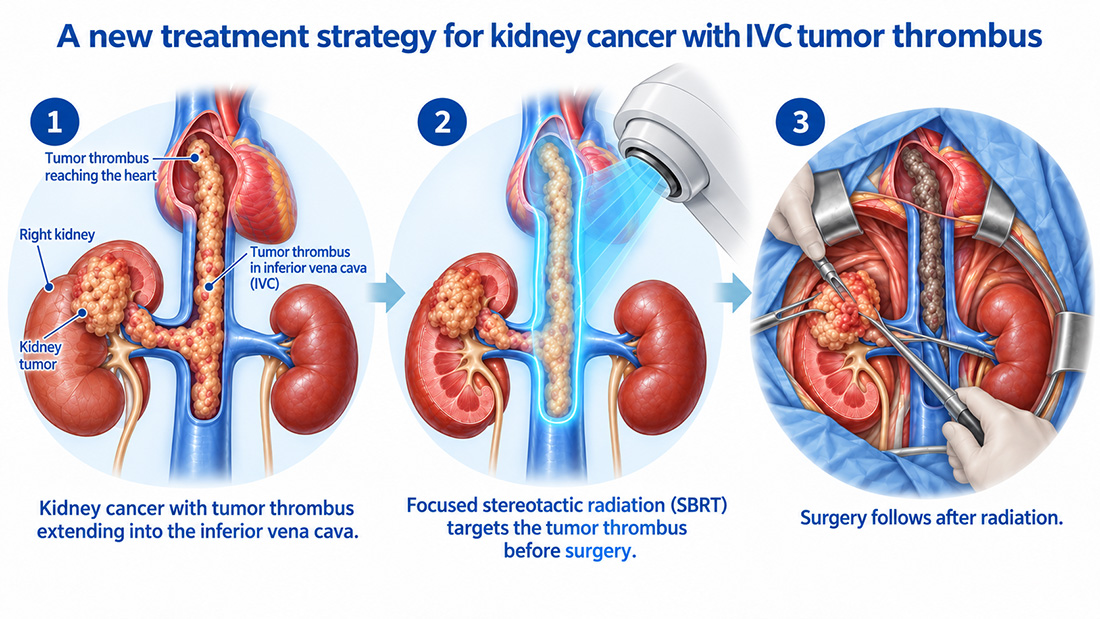
DALLAS – Oct. 15, 2026 – When Diane Gentry, a 71-year-old retiree from Watauga, Texas, was diagnosed with stage 4 kidney cancer in 2015, she learned the tumor had grown into her inferior vena cava, the body’s largest vein. This potentially life-threatening complication can require extensive surgery and carries a high risk of cancer recurrence.
As part of a phase two clinical trial at UT Southwestern Medical Center, Ms. Gentry received targeted radiation followed by surgery that not only reduced her risks but also eliminated her disease. The findings from the trial, published in JAMA Oncology, support further testing to determine whether the strategy can reduce the burden of treatment and lower the risk of recurrence.
“This approach provides a potential pathway to meaningfully improve the outcome for patients with kidney cancer and inferior vena cava tumor thrombus (IVC-TT),” said Raquibul Hannan, M.D., Ph.D., Professor of Radiation Oncology, Immunology, and Urology, and Chief of the Genitourinary Radiation Oncology Service at UT Southwestern. Dr. Hannan co-led the trial with Vitaly Margulis, M.D., Professor of Urology. Both are members of the Experimental Therapeutics Research Program in the Harold C. Simmons Comprehensive Cancer Center at UT Southwestern.
It’s estimated that about 4% to 10% of kidney cancer patients develop IVC-TT, in which cancer grows inside the vein. The condition can interfere with blood flow and sometimes extend into the heart.
Treatment typically involves removing the affected kidney and performing a thrombectomy to remove the tumor from the vein. The operation can be especially difficult when tumor thrombus goes past the liver or is attached to the vein wall and requires specialized expertise. For some medically frail patients, the risks are prohibitive; other treatment options are noncurative and include immunotherapy and targeted drugs.
The UTSW team’s 2015 case study of two patients treated with stereotactic ablative radiotherapy (SABR) for recurrent or unresectable IVC-TT provided the foundation for the most recent trial. The technique, also known as stereotactic body radiation therapy (SBRT), delivers precisely focused, high-dose radiation.
Between July 2015 and January 2024, 23 patients from UT Southwestern and Parkland Health received radiation in three or five sessions. Twenty-two completed kidney removal and thrombectomy four to 14 days later. Median follow-up was about nine years.
Results showed that 71.4% of patients remained free of recurrence one year after treatment, exceeding the study’s prespecified historical benchmark of 55.7%.
In two out of three patients whose cancer had already spread before they received treatment – including Ms. Gentry – researchers observed a rare phenomenon known as the abscopal effect. In this type of immune response, localized radiotherapy appears to help the body recognize and attack tumor cells elsewhere in the body.
Ms. Gentry’s kidney tumor and thrombus were removed surgically, while tumors that spread into her lungs regressed without direct treatment with radiation or any other drug therapy. Today, she is living cancer-free and is engaged to her fiance, who was by her side throughout her treatment.
“This treatment saved my life, and I feel very blessed,” she said.
“What surprised us was seeing tumors outside the radiation field regress without systemic therapy, which is fairly rare,” Dr. Hannan said. “We suspect the location matters: Blood continually brings immune cells into a tumor growing inside a vein. By damaging that tumor, radiation may help teach the immune system to recognize cancer elsewhere, the so-called abscopal effect. That possibility is exciting and deserves further study.”
The team is proposing a national randomized trial to test whether radiation alone can control the thrombus while surgery removes the kidney, potentially allowing laparoscopic or robotic surgery with fewer complications.
“Combining radiation and surgery gives us a new way to approach one of the most challenging complications of kidney cancer,” Dr. Margulis said. “Our goal is to determine whether this strategy can reduce the burden of treatment and expand options for patients who face substantial risks from extensive surgery.”
Other UTSW researchers who contributed to this study are Robert Timmerman, M.D., Chair and Professor of Radiation Oncology and Professor of Neurological Surgery; Payal Kapur, M.D., Professor of Pathology and Urology; Chul Ahn, Ph.D., Professor of Health Data Science and Biostatistics in the Peter O’Donnell Jr. School of Public Health; Aurelie Garant, M.D., Associate Professor of Radiation Oncology; Daniel Yang, M.D., and Laurentiu M. Pop, M.D., Assistant Professors of Radiation Oncology; Lin Lin, M.D., Assistant Instructor of Urology; Lily Robles, B.A., Senior Program Coordinator, Simmons Cancer Center; Faya Zhang, Ph.D., Research Scientist; Ang Gao, M.S., Biostatistical Consultant; and Oscar Mulvaney, B.A., Graduate Student Researcher.
Dr. Margulis holds the Paul C. Peters, M.D., Chair in Urology.
Drs. Timmerman, Kapur, Ahn, Garant, and Yang are also members of Simmons Cancer Center.
The clinical trial was supported by the Department of Radiation Oncology at UTSW and a National Cancer Institute Cancer Center Support Grant (P30CA142543). The Cancer Prevention and Research Institute of Texas supported correlative analyses, and Myriad Genetics performed circulating tumor DNA testing.
About UT Southwestern Medical Center
UT Southwestern, one of the nation’s premier academic medical centers, integrates pioneering biomedical research with exceptional clinical care and education. The institution’s faculty members have received six Nobel Prizes and include 28 members of the National Academy of Sciences, 26 members of the National Academy of Medicine, and 14 Howard Hughes Medical Institute Investigators. The full-time faculty of nearly 3,400 is responsible for groundbreaking medical advances and is committed to translating science-driven research quickly to new clinical treatments. UT Southwestern physicians in more than 80 specialties care for more than 143,000 hospitalized patients, attend to more than 470,000 emergency room cases, and oversee nearly 5.3 million outpatient visits a year.
About Parkland Health
Parkland Health is one of the largest public hospital systems in the country. Premier services at the state-of-the-art Parkland Memorial Hospital include the Level I Rees-Jones Trauma Center, the only burn center in North Texas verified by the American Burn Association for adult and pediatric patients, and a Level III Neonatal Intensive Care Unit. The system also includes two on-campus outpatient clinics – the Ron J. Anderson, MD Clinic and the Moody Outpatient Center, as well as more than 30 community-based clinics and numerous outreach and education programs. For more information, visit parklandhealth.org.