
UTSW Research: T cells, lung health, cash support for heart patients
Studies investigate immune cells’ movement, complications for children with heart failure, and a boost for medication adherence
Jump to:
New tool maps how T cells move within tumors
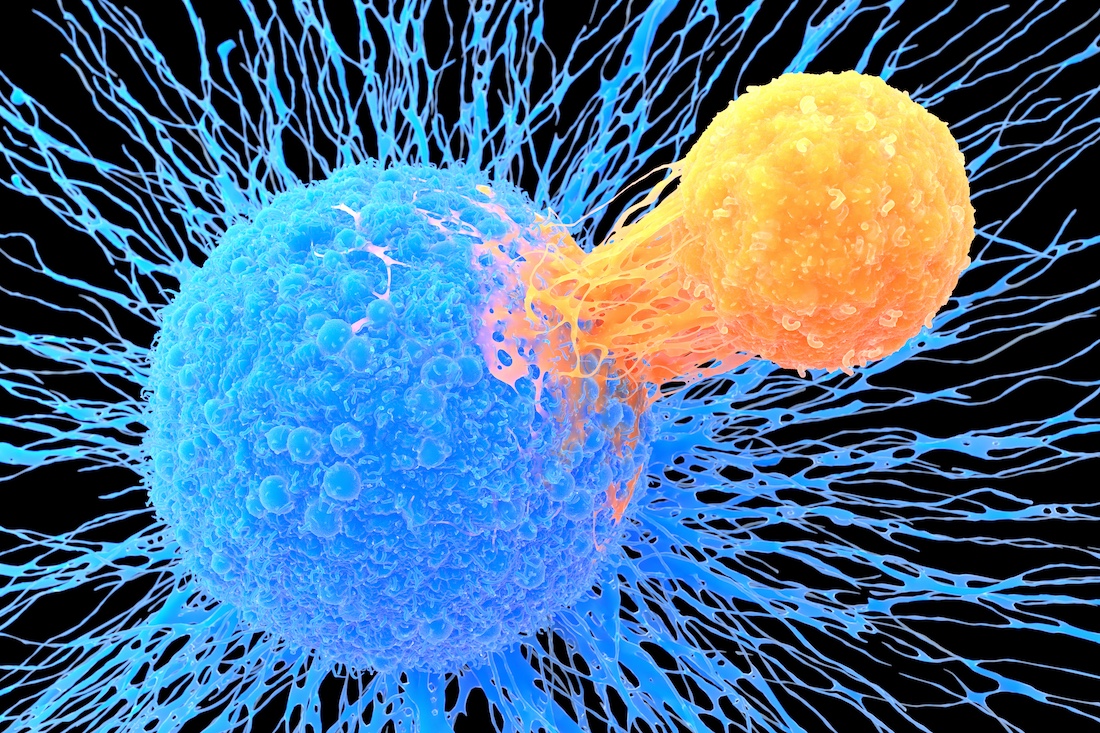
Researchers at UT Southwestern Medical Center led a study to develop a computational method that reveals how immune cells navigate the complex environment inside tumors, offering insights that could inform future cancer therapies. T cells are key players in the body’s defense against cancer, but many tumors create barriers that limit their ability to enter and function effectively.
In a study published in JCI Insight, investigators introduced a tool called ReMiTT that uses spatial gene data to identify “migration trails” showing where T cells travel within tumor tissue. Using this approach, they found that specific signaling molecules increase along these pathways, suggesting they help guide T cells into and through tumors. They also identified genes and biological processes linked to cell movement, adhesion, and tissue remodeling – factors that appear to support immune cell activity in these environments.
The findings provide a new way to study how tumors evade immune defense and could help guide strategies to improve immunotherapy by enhancing T cell movement and function within tumors, the researchers said.
UTSW scientists who contributed to this study are first author Lin Zhong, Ph.D., former graduate student; co-corresponding authors Qiwei Li, Ph.D., Adjunct Associate Professor of Health Data Science and Biostatistics in the Peter O’Donnell Jr. School of Public Health and Associate Professor of Mathematical Sciences at The University of Texas at Dallas; and Guanghua Xiao, Ph.D., Professor of Health Data Science and Biostatistics, of Biomedical Engineering, and in the Lyda Hill Department of Bioinformatics; and Zhikai Chi, M.D., Ph.D., and Siyuan Zhang, M.D., Ph.D., Associate Professors of Pathology.
Blood flow shapes lung health in children with heart disease
A study led by UTSW sheds light on why children with certain complex congenital heart defects are at risk for long-term lung complications – and points to a potential path for improving outcomes.
Children born with single-ventricle congenital heart disease often undergo the Glenn procedure, a lifesaving surgery that reroutes blood flow to the lungs. However, this procedure eliminates the natural “pulsing” of pulmonary blood flow, and clinicians have long observed that many patients later develop abnormalities in the blood vessels of the lungs.
In research published in JCI Insight, investigators found that pulsatility is not just a byproduct of normal circulation – it plays a critical role in keeping pulmonary arteries healthy. Investigation involving patient data, lab-grown cells, and animal models showed that pulsatile flow triggers signals that help maintain the structure and strength of blood vessel walls. When that pulsing force is lost, key molecular signals are reduced, leading to thinner vessel walls and impaired communication among cells.
The findings suggest that restoring or mimicking pulsatile blood flow could help preserve lung blood vessel health in children with congenital heart disease, offering a potential new strategy to reduce complications and improve long-term outcomes.
UTSW researchers who contributed to this study are first author Stephen Spurgin, M.D., Assistant Professor of Pediatrics; Lauren Thai, M.D., Assistant Professor of Pediatrics; Christopher Chaney, M.D., Associate Professor of Internal Medicine; Surendranath Veeram Reddy, M.D., Professor of Pediatrics; M. Tarique Hussain, M.D., Ph.D., Professor of Pediatrics and Radiology; Thomas Carroll, Ph.D., Professor of Internal Medicine and Molecular Biology; and Ondine Cleaver, Ph.D., Professor of Molecular Biology.
Cash support may help heart patients stay on medications
A pilot study led by UTSW researchers suggests modest financial support may help low-income heart failure (HF) patients stay on their medications after leaving the hospital. The study, published in the Journal of the American College of Cardiology, enrolled 153 patients at Parkland Memorial Hospital within two weeks of HF hospitalization and randomized them to receive either usual care or a one-time $500 payment.
One month later, 140 patients completed follow-ups, and those who received the payment were more likely to have taken their medications, with about a 20% higher adherence rate. The findings highlight the potential impact of addressing basic economic needs as part of medical care, the authors said.
Unlike prior programs that focused narrowly on copay assistance or care coordination, this study allowed patients to use the funds as needed, potentially easing broader financial stress that can interfere with recovery. The study found no differences between the groups in symptoms, quality of life, or hospital readmissions. Because this was a small trial with short follow-up, larger, longer studies will be needed to determine whether financial support can improve outcomes, the authors said.
UTSW researchers who contributed to this study are first author Neil Keshvani, M.D., Adjunct Assistant Professor of Internal Medicine; Syed Rizvi, M.D., Cardiology fellow; Anand Jain, B.S., Clinical Research Assistant; Myriam Bustillo-Rubio, M.D., and Juan David Coellar, M.D., postdoctoral researchers; James Miller, M.D., resident; Eric Peterson, M.D., M.P.H., Professor of Internal Medicine, Vice Provost, and Senior Associate Dean for Clinical Research; and Ambarish Pandey, M.D., Associate Professor of Internal Medicine in the Division of Cardiology and the Division of Geriatric Medicine.
About UT Southwestern Medical Center
UT Southwestern, one of the nation’s premier academic medical centers, integrates pioneering biomedical research with exceptional clinical care and education. The institution’s faculty members have received six Nobel Prizes and include 27 members of the National Academy of Sciences, 25 members of the National Academy of Medicine, and 13 Howard Hughes Medical Institute Investigators. The full-time faculty of nearly 3,400 is responsible for groundbreaking medical advances and is committed to translating science-driven research quickly to new clinical treatments. UT Southwestern physicians in more than 80 specialties care for more than 143,000 hospitalized patients, attend to more than 470,000 emergency room cases, and oversee nearly 5.3 million outpatient visits a year.
About Parkland Health
Parkland Health is one of the largest public hospital systems in the country. Premier services at the state-of-the-art Parkland Memorial Hospital include the Level I Rees-Jones Trauma Center, the only burn center in North Texas verified by the American Burn Association for adult and pediatric patients, and a Level III Neonatal Intensive Care Unit. The system also includes two on-campus outpatient clinics – the Ron J. Anderson, MD Clinic and the Moody Outpatient Center, as well as more than 30 community-based clinics and numerous outreach and education programs. By cultivating its diversity, inclusion, and health equity efforts, Parkland enriches the health and wellness of the communities it serves. For more information, visit parklandhealth.org.