
Scientists discover metabolite fueling aggressive brain tumor growth
Study from Children’s Medical Center Research Institute at UT Southwestern shows brain tumors exploit metabolite to activate nearby neurons
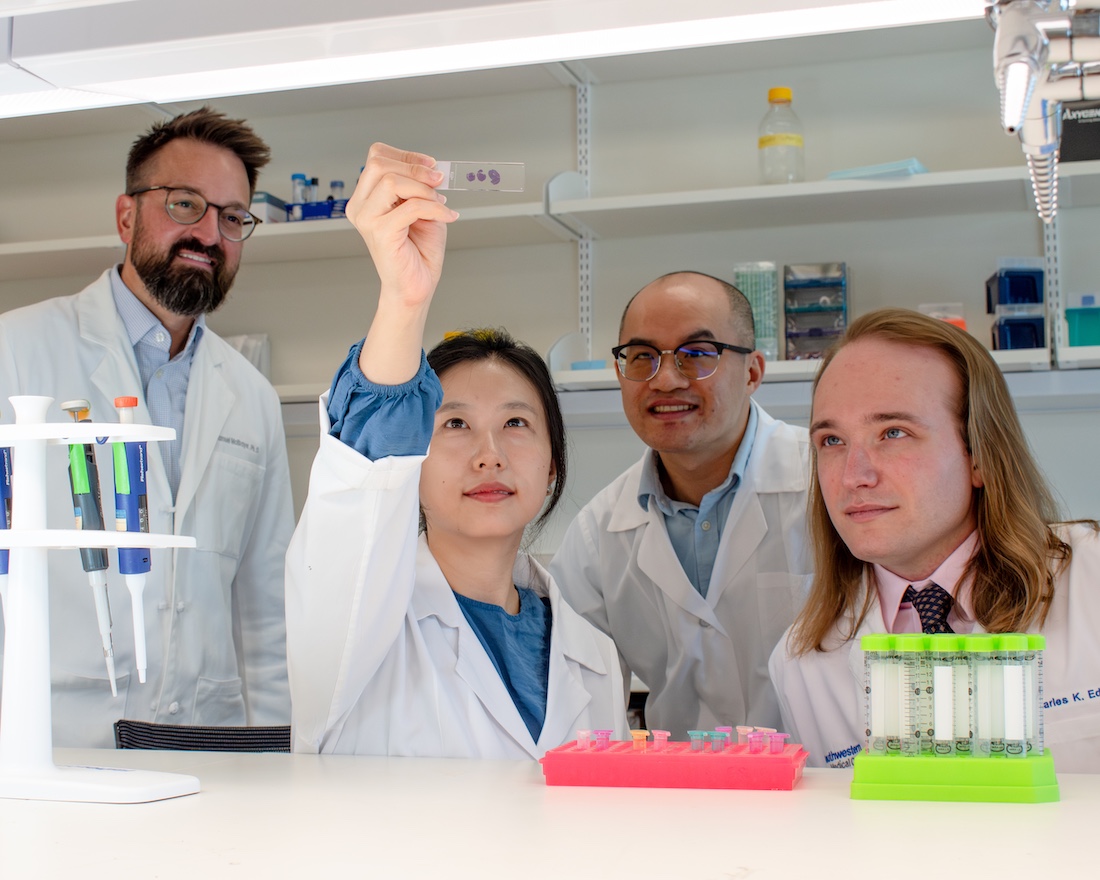
DALLAS – Sept. 16, 2026 – Virtually all high-grade, aggressive gliomas in adults accumulate massive amounts of a metabolite called guanidinoacetate (GAA) that overstimulates nearby neurons and promotes tumor growth, according to new research from scientists at Children’s Medical Center Research Institute at UT Southwestern (CRI) published in Cell.
Researchers discovered the 100-fold accumulation of GAA happens when tumors hyperactivate the enzyme that creates GAA. With cancer cells oversaturated, the GAMT enzyme can’t convert the extra GAA into creatine. Excess GAA is released into the tumor microenvironment and stimulates neurons that promote tumor growth.
GAA accumulation in these tumors mimics a known inborn error of metabolism called GAMT deficiency which – just like high-grade gliomas – results in seizures and neurological symptoms.
“Our work addresses a long-standing question in cancer neuroscience. We knew there is increased activity of neurons in brain tumors, but we had an incomplete understanding of how brain tumors cause that increase in activity,” said study leader Samuel McBrayer, Ph.D., Assistant Professor in CRI and of Pediatrics.
Following this discovery, researchers will test whether a clinically approved dietary therapy for GAMT deficiency could block GAA accumulation in patients with high-grade glioma.
“We are going to take these laboratory findings and immediately see how to benefit patients,” said Kalil G. Abdullah, M.D., study first author, System Director for Central Nervous System Cancer at Northwell Health and former UT Southwestern faculty member. “Our trial will modify the diets of patients before they undergo surgery for a glioma, and we will know very quickly how the diet changes the tumor itself by analyzing brain tumor tissue from their surgery.”
If the dietary modification successfully reduces GAA levels in tumors, Dr. McBrayer said, subsequent studies could test whether dietary change improves therapy responsiveness and survival in patients.
Scientists discovered that when GAA seeps out of cancer cells, it binds to and activates receptors on neurons near the tumor. In response, neurons are stimulated, causing them to release chemical and electrical signals that drive glioma cell proliferation.
In the study, researchers used multiple experiments to show GAA promotes the growth of brain tumors by activating adjacent neurons. When scientists blocked the enzyme making GAA in glioma cells, GAA levels fell, neuronal activity dropped, and tumor growth slowed. If neurons adjacent to brain tumors were activated by other means, neurons promoted tumor growth even in the absence of GAA. Also, when cancer cells were grown in the absence of adjacent neurons, depleting GAA did not slow the proliferation of cancer cells.
“A major benefit of doing research as part of the CRI Genetic and Metabolic Disease Program is that we are able to leverage insights from well-characterized inborn errors of metabolism to understand how metabolism goes awry in brain tumors,” Dr. McBrayer said. “By comparing these diseases, we are better able to pinpoint the causes and consequences of metabolic changes in glioma, ultimately informing new ways to treat these cancers.”
Dr. McBrayer is an Investigator in the Peter O’Donnell Jr. Brain Institute and a member of the Cellular Networks in Cancer Research Program at the Harold C. Simmons Comprehensive Cancer Center at
UT Southwestern. He is also a Cancer Prevention and Research Institute of Texas (CPRIT) Scholar. He was honored with a Distinguished Scientist Award in 2021 from the Sontag Foundation for his work on brain tumors.
Additional first authors include Charles K. Edgar, Ph.D., Perot Family Scholars Medical Scientist Training Program graduate student at UT Southwestern, Shuangcheng Alivia Wu, Ph.D., CRI postdoctoral fellow, and Yi Xiao, Ph.D., National Institutes of Health Pathway to Independence fellow and CRI postdoctoral fellow, all McBrayer Lab researchers; and Kenji Miki, M.D., postdoctoral fellow at Northwell Health.
Media Contact
Cristen Hixson
Email
214-648-2378
Other study contributors include Ralph J. DeBerardinis, M.D., Ph.D., Professor and Director of the Eugene McDermott Center for Human Growth and Development, CRI, Pediatrics, co-Leader of the Cellular Networks in Cancer Research Program in the Simmons Comprehensive Cancer Center, and Director of the CRI Metabolomics Shared Facility; Kimberly M. Huber, Ph.D., Professor of Neuroscience; Jay R. Gibson, Ph.D., Professor of Neuroscience; Tara Barron, Ph.D., Assistant Professor of Pathology; Benjamin Levi, M.D., Professor of The Charles and Jane Pak Center for Mineral Metabolism and Clinical Research, CRI, Plastic Surgery, and Surgery; Thomas P. Mathews, Ph.D., Associate Professor in CRI and Pediatrics, and Assistant Director of the CRI Metabolomics Shared Facility; Feng Cai, Ph.D., Assistant Professor in CRI and Pediatrics; Lin Xu, Ph.D., Assistant Professor of Health Data Science and Biostatistics in the Peter O’Donnell Jr. School of Public Health and of Pediatrics; Bradley C. Lega, M.D., Professor of Neurological Surgery, Neurology, and Psychiatry; Shang Ma, Ph.D., Assistant Professor in CRI, the McDermott Center, and Pediatrics; Denise Ramirez, Ph.D., Associate Professor of Neurology; Prithvi Raj, Ph.D., Associate Professor of Immunology; Kimmo Hatanpaa, M.D., Ph.D., Professor of Pathology; and Toral Patel, M.D., Associate Professor of Neurological Surgery, Neurology, and Radiation Oncology.
This research was funded by the National Institutes of Health, Oligo Nation, Sarkes and Mary Tarzian Charitable Foundation Inc., CPRIT, The Sontag Foundation, Jonesville Foundation, The Nick Gonzales Foundation for Brain Tumor Research, a Human Frontier Science Program fellowship, a Burroughs Wellcome Fund Career Award for Medical Scientists, a Lubin Family Foundation Scholar Award, and the Spanish Ministerio de Ciencia, Innovación y Universidades, and Junta de Andalucía, Consejería de Salud.
Dr. McBrayer has a financial interest in Gliomet.
About CRI
Children’s Medical Center Research Institute at UT Southwestern (CRI) is a joint venture of UT Southwestern Medical Center and Children’s Medical Center Dallas. CRI’s mission is to perform transformative biomedical research to better understand the biological basis of disease. Located in Dallas, Texas, CRI is home to interdisciplinary groups of scientists and physicians pursuing research at the interface of regenerative medicine, cancer biology, and metabolism – relentless discovery toward the treatments of tomorrow.
X/Twitter | LinkedIn | Instagram | YouTube | Facebook
About UT Southwestern Medical Center
UT Southwestern, one of the nation’s premier academic medical centers, integrates pioneering biomedical research with exceptional clinical care and education. The institution’s faculty members have received six Nobel Prizes and include 28 members of the National Academy of Sciences, 26 members of the National Academy of Medicine, and 14 Howard Hughes Medical Institute Investigators. The full-time faculty of nearly 3,400 is responsible for groundbreaking medical advances and is committed to translating science-driven research quickly to new clinical treatments. UT Southwestern physicians in more than 80 specialties care for more than 143,000 hospitalized patients, attend to more than 470,000 emergency room cases, and oversee nearly 5.3 million outpatient visits a year.