
Ovarian cancer cells use stress hormone signaling to shut down immune system
UTSW-led study provides insight into tumor microenvironment that could lead to more effective treatments
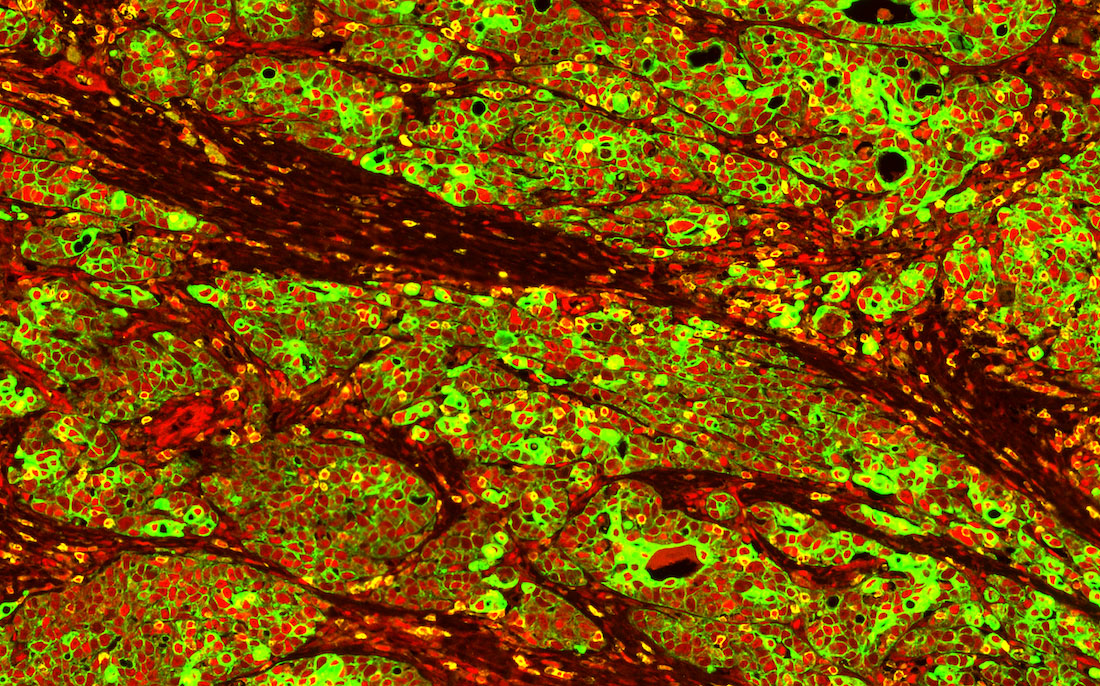
DALLAS – May 21, 2026 – When activated in ovarian cancer cells, the receptor for the body’s primary stress hormone alters the tumor environment in ways that blunt immune response, according to new research led by UT Southwestern Medical Center. The findings, published in Endocrinology, identify a previously unrecognized role for the glucocorticoid receptor (GR) in shaping the ovarian cancer tumor microenvironment.
“Understanding master regulators (like GR) of tumor cell evasion from the immune system could lead to more effective treatment of ovarian cancer – both in combination with chemotherapy and eventually with immunotherapy,” said corresponding author Suzanne Conzen, M.D., Professor of Internal Medicine, Chief of the Division of Hematology and Oncology, and a member of the Harold C. Simmons Comprehensive Cancer Center at UT Southwestern.
Most ovarian tumors exist in a so-called “cold” state, meaning they attract few immune cells needed to mount an effective attack, but what drives that state has been poorly defined. The Conzen Lab previously found that ovarian cancers with high GR expression are linked to shorter periods of progression-free survival among patients, suggesting the receptor plays an important role in how the disease progresses.
In the new study, the team examined ovarian cancer cells from humans and mice, mouse tumor models, and large databases of patient tumor data. They found that when GR was switched on inside cancer cells, the cells released a mix of chemical signals that summoned immune-suppressing cells into the tumor. Those recruited cells, which are more abundant in patients with worse outcomes, shut down the immune system’s ability to attack the cancer.
When the researchers blocked GR, either with a drug called relacorilant or by genetically removing the receptor from tumor cells, the suppressive signals dropped. Fewer immune-suppressing cells made their way into tumors, and more of the immune cells that fight cancer moved in.
The findings also align with clinical progress already underway. The Food and Drug Administration recently approved relacorilant combined with nab-paclitaxel for platinum-resistant ovarian, fallopian tube, or primary peritoneal cancer. The phase three trial supporting that approval was based on a series of earlier research from Dr. Conzen and her colleagues showing that GR activity helps ovarian cancer cells survive chemotherapy. The new UTSW findings suggest the drug may also reawaken antitumor immunity.
“Future clinical trials will likely examine whether GR modulation could assist with immunotherapy responses in ovarian cancer,” Dr. Conzen said.
Other UTSW researchers in the Division of Hematology and Oncology who contributed to this study are first author and postdoctoral researcher Manisha Taya, Ph.D.; Tryambak Srivastava, Ph.D., and Woei-Yaw Chee, Ph.D., postdoctoral researchers; Andrew W. DeVilbiss, Ph.D., Instructor; and Lynda Bennett, Ph.D., Assistant Professor.
Dr. Conzen holds the Andrea L. Simmons Distinguished Chair in Cancer Research and is a member of the Experimental Therapeutics Research Program at Simmons Cancer Center.
This study was funded by grants from the National Institutes of Health (CA223426), the Cancer Prevention and Research Institute of Texas (RR1900371), and the National Cancer Institute (NCI) Cancer Center Support Grant (P30CA142543).
Dr. Conzen holds patents through the University of Chicago on methods related to using GR expression in triple-negative breast and prostate cancer prognosis and treatment and has received honoraria from Corcept Therapeutics for advisory board service related to breast cancer. UT Southwestern has a patent application pending on GR transcriptional activity in ovarian cancer.
About UT Southwestern Medical Center
UT Southwestern, one of the nation’s premier academic medical centers, integrates pioneering biomedical research with exceptional clinical care and education. The institution’s faculty members have received six Nobel Prizes and include 27 members of the National Academy of Sciences, 25 members of the National Academy of Medicine, and 13 Howard Hughes Medical Institute Investigators. The full-time faculty of nearly 3,400 is responsible for groundbreaking medical advances and is committed to translating science-driven research quickly to new clinical treatments. UT Southwestern physicians in more than 80 specialties care for more than 143,000 hospitalized patients, attend to more than 470,000 emergency room cases, and oversee nearly 5.3 million outpatient visits a year.