
Human cells can exchange genomic DNA that alters cell behavior
Children’s Research Institute scientists discover that DNA transferred between cells can be inherited, remain biologically active
DALLAS – May 19, 2026 – Scientists at Children’s Medical Center Research Institute at UT Southwestern (CRI) have discovered that large pieces of DNA can transfer directly between human cells, and the DNA can persist and change how the recipient cell functions. The findings, published today in Cell, challenge a long-standing view that the genomes of individual human cells evolve independently from one another.
The study shows DNA damage and errors in cell division can cause pieces of genomic DNA to escape from the nucleus and move into nearby cells through nanotubes – thin, tubelike structures that briefly form when some cells come into contact.
Once inside a recipient cell, transferred DNA can enter the nucleus and become incorporated into the cell’s genome. Researchers found that transferred DNA persisted through multiple rounds of cell division, remained biologically active, and conferred new traits to recipient cells.
“This was a surprising discovery,” said study leader Peter Ly, Ph.D., Assistant Professor in CRI and of Cell Biology, Pediatrics, and in the Harold C. Simmons Comprehensive Cancer Center. “Our findings suggest neighboring cells may be able to directly reshape one another’s genomes in ways we did not anticipate.”
Study first author Elizabeth Maurais, Ph.D., a recent graduate of the Genetics, Development and Disease Program at UT Southwestern, and other Ly Lab researchers uncovered this process while studying how cells respond to genomic instability, including DNA damage caused by chemotherapy and radiation treatment.
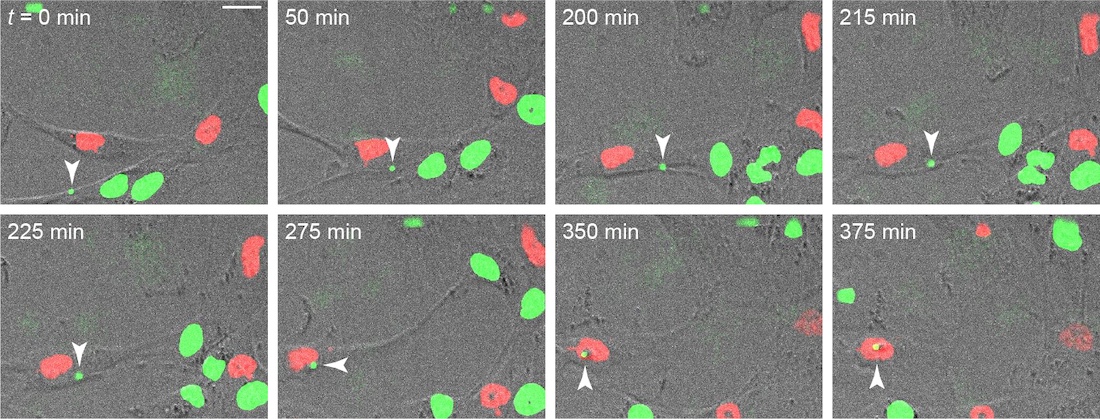
Using advanced live-cell microscopy, the team observed DNA moving from one cell to another. In one experiment, pieces of the Y chromosome transferred from male cells into female cells. The transferred DNA carried male-specific genes that became active in the female cells, indicating the transferred DNA remained functional after entering the recipient cell.
“There are many open questions. We now want to understand how widespread this process is, how it is regulated at the cellular and molecular levels, and what role it may play in human health and disease, including cancer,” Dr. Ly said. “These findings may have important implications for understanding how cancer genomes evolve and acquire large-scale chromosomal alterations.”
Researchers also observed DNA transfer between different types of human cells, which Dr. Ly said suggests the findings may be a general feature of human cell biology.
This research was funded by the National Institutes of Health (NIH), the Cancer Prevention and Research Institute of Texas (CPRIT), the U.S. Department of Defense, The Welch Foundation, a UT Southwestern Haberecht Wildhare-Idea Research Grant, a UT Southwestern Synergy Grant for Collaborative Research, and the Oklahoma Center for Adult Stem Cell Research.
Dr. Ly is a CPRIT Scholar in Cancer Research. Dr. Maurais received an NIH Ruth L. Kirschstein Predoctoral Fellowship from the National Cancer Institute.
About CRI
Children’s Medical Center Research Institute at UT Southwestern (CRI) is a joint venture of UT Southwestern Medical Center and Children’s Medical Center Dallas. CRI’s mission is to perform transformative biomedical research to better understand the biological basis of disease. Located in Dallas, Texas, CRI is home to interdisciplinary groups of scientists and physicians pursuing research at the interface of regenerative medicine, cancer biology, and metabolism – relentless discovery toward the treatments of tomorrow.
X/Twitter | LinkedIn | Instagram | YouTube | Facebook
About UT Southwestern Medical Center
UT Southwestern, one of the nation’s premier academic medical centers, integrates pioneering biomedical research with exceptional clinical care and education. The institution’s faculty members have received six Nobel Prizes and include 27 members of the National Academy of Sciences, 25 members of the National Academy of Medicine, and 13 Howard Hughes Medical Institute Investigators. The full-time faculty of nearly 3,400 is responsible for groundbreaking medical advances and is committed to translating science-driven research quickly to new clinical treatments. UT Southwestern physicians in more than 80 specialties care for more than 143,000 hospitalized patients, attend to more than 470,000 emergency room cases, and oversee nearly 5.3 million outpatient visits a year.