
Study explores why fasting can lead to a longer lifespan
How the body efficiently pivots metabolically after the fast is key to boosting health, UTSW-led research suggests
DALLAS – April 13, 2026 – Restricting calories has long been recognized as a powerful way to live longer, with periods of intermittent fasting proving more effective than a steady diet. However, the mechanism behind this phenomenon has been unclear.
Research led by UT Southwestern Medical Center scientists and published in Nature Communications suggests it’s not the fast itself that extends life, but how the body metabolically pivots during refeeding after fasting. Although the findings were made in Caenorhabditis elegans, a roundworm often used as a lab model, they could eventually lead to new ways to boost health in humans.
“Our discoveries shift the focus toward a neglected side of the metabolic coin – the refeeding phase. Our data suggest that the health-promoting effects of intermittent fasting are not merely a product of the fast itself, but are dependent on how the metabolic machinery recalibrates during the subsequent transition back to a fed state,” said study leader Peter Douglas, Ph.D., Associate Professor of Molecular Biology and a member of the Hamon Center for Regenerative Science and Medicine at UT Southwestern. Dr. Douglas co-led the study with Lexus Tatge, Ph.D., a former member of the Douglas Lab.
When organisms undergo fasting, their cells quickly burn through meager glucose reserves and shift to breaking down stored lipids, a potent source of energy. This process, called catabolism, is mediated by a protein known as NHR-49, which activates when glucose runs low and prompts cells to digest lipids. Refeeding causes NHR-49 to shut down, preventing cells from breaking down lipids and allowing them to rebuild their reserves. In 2022, Dr. Douglas and his colleagues published a study showing that NHR-49 also serves as a sensor for intracellular lipid stores, activating a mechanism that prevents cellular starvation when lipid supplies deplete.
Dr. Douglas and colleagues suspected that NHR-49’s activity could be key to fasting’s life-extending benefits. To test this idea, the team used genetic engineering to delete NHR-49 in C. elegans, then fasted the worms for 24 hours. Surprisingly, this did not diminish life extension. Fasting still boosted the altered worms’ average lifespan by about 41% and made older worms behave more youthfully, reflected in more movement, much like fasting did in C. elegans with intact NHR-49.
On a hunch, the researchers decided to examine the flip side of NHR-49 activation: What happened when the worms were refed after fasting and NHR-49 shut off?
To do this, they needed to better understand how NHR-49 naturally becomes inactivated. Experiments led by Vincent Tagliabracci, Ph.D., Associate Professor of Molecular Biology at UTSW and a Howard Hughes Medical Institute Investigator, and Victor Lopez, Ph.D., a postdoctoral researcher in the Tagliabracci Lab, revealed that this occurs when an enzyme known as protein kinase CK1 alpha 1 (KIN-19) chemically modifies NHR-49 through a process called phosphorylation. When Dr. Douglas and his colleagues tampered with this system to keep NHR-49 turned on – which maintained lipid breakdown even when C. elegans was refed – it eliminated any life extension from fasting.
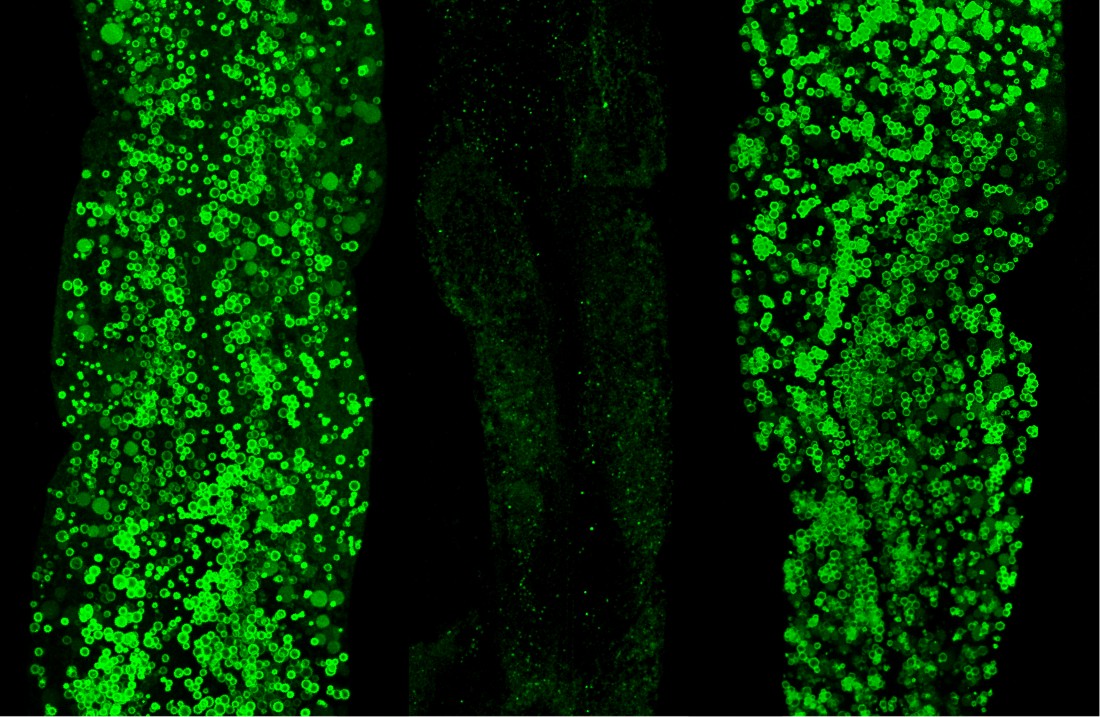
Together, Dr. Douglas said, these results suggest that being able to efficiently deactivate NHR-49 after fasting is a key factor in caloric restriction’s ability to lengthen lifespan. Finding ways to manipulate this system could eventually help people live longer without the need to fast.
“Our findings bridge a gap between lipid metabolism and aging research,” Dr. Douglas said. “By targeting aging, the single greatest risk factor for human disease, we move beyond treating isolated conditions toward a preventive model of medicine that enhances quality of life for all individuals.”
Dr. Douglas is a Southwestern Medical Foundation Scholar in Biomedical Research. Dr. Tagliabracci is a Michael L. Rosenberg Scholar in Medical Research.
A complete list of other UTSW authors who contributed to this research can be found in the study.
This study was funded by the Clayton Foundation for Research, The Welch Foundation (I-2061-20210327), the American Federation of Aging Research (AFAR 2023), and the National Institutes of Health (R01AG076529, R01GM15385).
About UT Southwestern Medical Center
UT Southwestern, one of the nation’s premier academic medical centers, integrates pioneering biomedical research with exceptional clinical care and education. The institution’s faculty members have received six Nobel Prizes and include 24 members of the National Academy of Sciences, 25 members of the National Academy of Medicine, and 13 Howard Hughes Medical Institute Investigators. The full-time faculty of nearly 3,400 is responsible for groundbreaking medical advances and is committed to translating science-driven research quickly to new clinical treatments. UT Southwestern physicians in more than 80 specialties care for more than 143,000 hospitalized patients, attend to more than 470,000 emergency room cases, and oversee nearly 5.3 million outpatient visits a year.