
Study finds new approach to lowering blood pressure
Combining team-based care, protocol-based treatment, and other interventions significantly reduced hypertension in low-income patients, UTSW researchers find

DALLAS – April 08, 2026 – A multifaceted, team-based care strategy significantly reduced blood pressure (BP) in low-income patients with uncontrolled hypertension, according to a study led by researchers at UT Southwestern Medical Center. Their findings, published in the New England Journal of Medicine, could eventually lead to the widespread use of this strategy at primary care clinics across the country.
“Poor hypertension control is a major clinical and public health challenge. This effective, sustainable, and scalable implementation strategy should be widely adopted in the U.S. to improve hypertension control,” said Jiang He, M.D., M.S., Ph.D., principal investigator and senior author of the study. Dr. He is Chair of Epidemiology in the Peter O’Donnell Jr. School of Public Health and Professor of Internal Medicine and Neurology at UT Southwestern.

Dr. He collaborated on the study with co-first author Jing Chen, M.D., M.Sc., Professor of Internal Medicine in the Division of Nephrology, the Charles and Jane Pak Center for Mineral Metabolism and Clinical Research, and of Epidemiology in the O’Donnell School of Public Health. Several of Dr. He’s former colleagues from Tulane University School of Medicine and Public Health also contributed to the research.
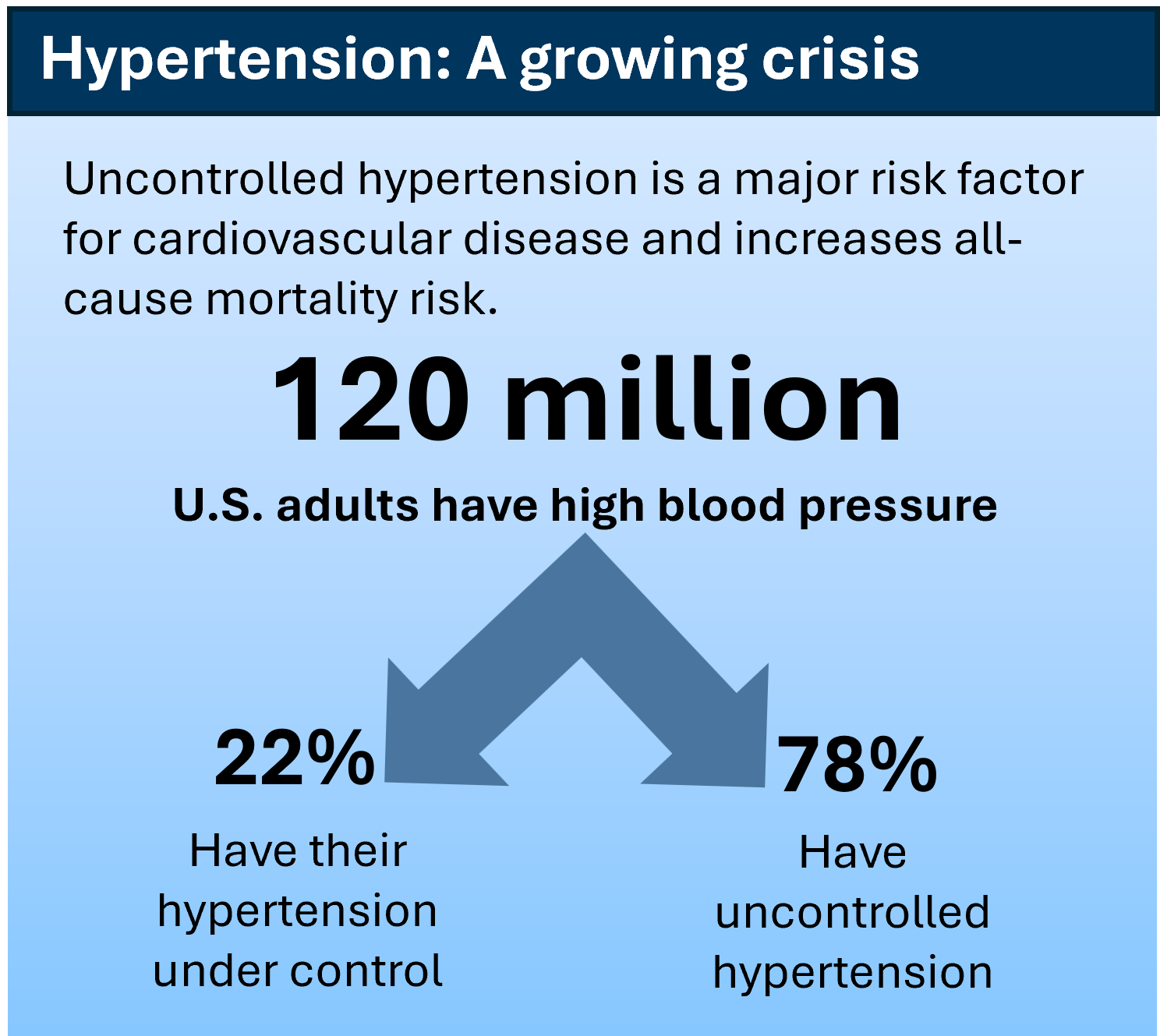
Nearly half of U.S. adults have high blood pressure, known clinically as hypertension, Dr. He explained. About 78% of them – approximately 93 million people – have uncontrolled hypertension, a major risk factor for cardiovascular disease, stroke, chronic kidney failure, dementia, and death from any cause. Despite the availability of effective antihypertensive medications and lifestyle interventions, uncontrolled hypertension is common, especially in low-income populations, Dr. He said.
Over the past several decades, clinical guidelines have recommended a systolic BP (the top number in a reading) of less than 140 mm Hg as the treatment goal to reduce the risk of cardiovascular disease and stroke among patients with hypertension. The Systolic Blood Pressure Intervention Trial (SPRINT) demonstrated that targeting a systolic BP of less than 120 mm Hg significantly reduced major cardiovascular events (including heart attack, heart failure, and stroke) and all-cause mortality compared with a target of less than 140 mm Hg. However, Dr. He said it has been unclear whether this BP treatment goal could be achieved in real-world primary care settings, such as clinics that serve low-income patients.

Dr. He and colleagues developed a novel, multifaceted implementation strategy to achieve better BP control. This multicomponent, multilevel intervention includes:
- Team-based care – Hypertension management is shared among primary care providers, nurses, and community health workers.
- Protocol-based treatment – Providers are trained to follow the SPRINT intensive BP management protocol.
- Home BP monitoring – Patients measure their blood pressure at home at least three times per week and share the readings with the care team.
- Health coaching – Community health workers support patients with medication adherence and lifestyle changes.
- BP auditing and feedback – BP data are reviewed, and the results are shared with clinicians to help improve hypertension control.
To test this strategy, Dr. He and colleagues partnered with 36 Federally Qualified Health Centers (FQHC) in Louisiana and Mississippi. These federally funded nonprofit clinics provide comprehensive primary care and preventive services to medically underserved populations, regardless of their ability to pay. The clinics were randomly assigned to multifaceted intervention and enhanced usual care groups. In the intervention clinics, the strategy was implemented, while in the usual care clinics, staff received training on current hypertension clinical guidelines and standard BP measurement.
A total of 1,272 patients with uncontrolled hypertension were included in this study. The study participants had an average age of about 59, nearly 57% were women, and about 63% were African American. Nearly 76% were unemployed, and about 73% had a family income of less than $25,000 per year.
Over 18 months, patients in the intervention clinics reduced their systolic BP by an average of 16 mm Hg, while the control group had a 9 mm Hg reduction. The intervention group also scored higher on a measure of how well patients and clinics adhered to the BP management strategy. The two groups reported similar levels of serious side effects.
Together, Dr. He said, these findings show that this innovative strategy is effective in lowering BP, even in resource-constrained populations. This reduction in BP has significant impacts on reducing cardiovascular disease, stroke, kidney failure, and dementia in populations with hypertension. Dr. He and his team hope to implement this novel strategy for patients in North Texas served by UT Southwestern and affiliated hospitals and clinics and beyond.
UTSW Biostatistical Consultant Siyi Geng, M.S., contributed to the study.
Dr. He holds the S. Roger and Carolyn P. Horchow Chair in Cardiac Research, in Honor of Jere H. Mitchell, M.D. Dr. Chen holds the Makoto Kuro-o Professorship in Bone and Kidney Research.
The study was funded by a research grant from the National Heart, Lung, and Blood Institute of the National Institutes of Health (R01HL133790).
About UT Southwestern Medical Center
UT Southwestern, one of the nation’s premier academic medical centers, integrates pioneering biomedical research with exceptional clinical care and education. The institution’s faculty members have received six Nobel Prizes and include 24 members of the National Academy of Sciences, 25 members of the National Academy of Medicine, and 13 Howard Hughes Medical Institute Investigators. The full-time faculty of nearly 3,400 is responsible for groundbreaking medical advances and is committed to translating science-driven research quickly to new clinical treatments. UT Southwestern physicians in more than 80 specialties care for more than 143,000 hospitalized patients, attend to more than 470,000 emergency room cases, and oversee nearly 5.3 million outpatient visits a year.