
Exercise keeps astronauts’ hearts strong enough for flight to Mars
Study co-led by UTSW suggests cardiac structure, function adequate for long-duration missions, Mars gravity
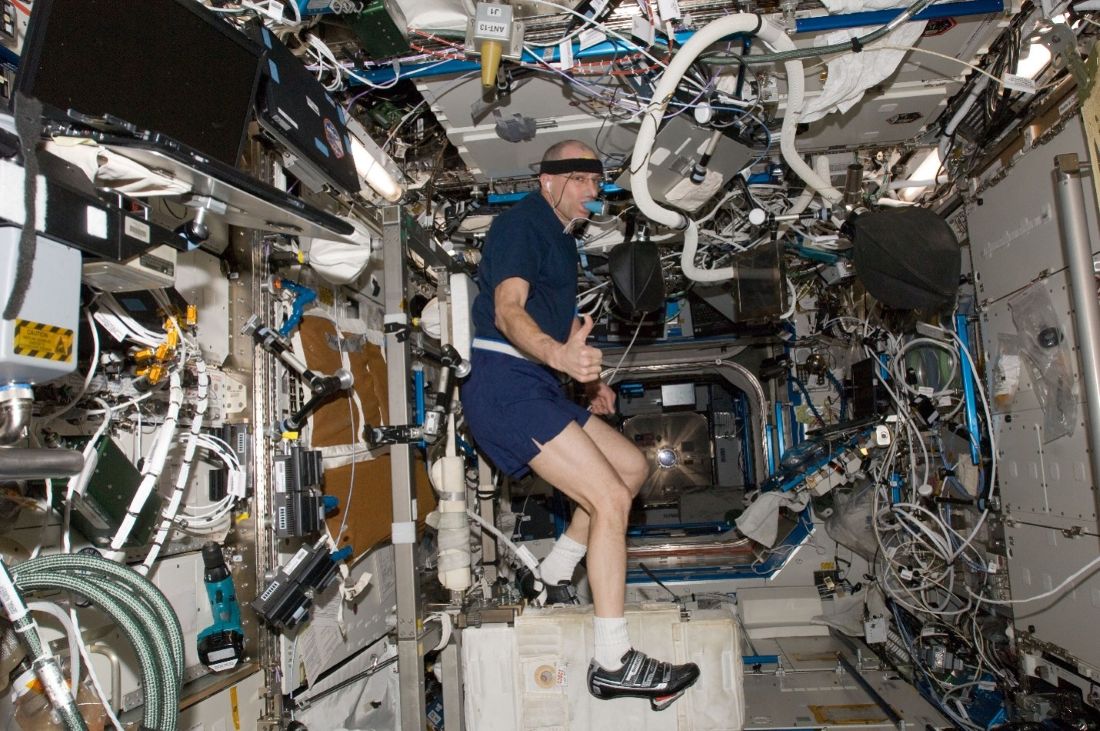
DALLAS – Sept. 23, 2026 – Intense exercise during long spaceflights helps to maintain heart structure and function within a range needed to tolerate the low-gravity environment of Mars, a study co-led by a UT Southwestern Medical Center researcher suggests. The findings, published in Circulation, not only address an issue critical to future space missions but could also lead to better interventions to improve heart health on Earth.

“Our previous studies had demonstrated that the heart atrophies in both bed rest and in space – it becomes smaller and stiffer – and we were concerned that could be a problem over long-duration spaceflight, especially for missions to Mars. Our findings suggest that the exercise countermeasures we already have in place are enough to keep the heart in good working order for Mars’ gravitational loads,” said Benjamin Levine, M.D., Professor of Internal Medicine in the Division of Cardiology at UT Southwestern who holds a Distinguished Professorship in Exercise Sciences. He is the founding Director of the Institute for Exercise and Environmental Medicine at Texas Health Presbyterian Hospital Dallas, where he holds the S. Finley Ewing Chair for Wellness and the Harry S. Moss Heart Chair for Cardiovascular Research.
Dr. Levine is a renowned sports cardiologist who treats athletes with cardiovascular problems from around the world and serves as a consultant to the NCAA, National Hockey League, National Football League, U.S. Olympic Committee, and USA Track and Field. He also has a unique background in space medicine, having served as a co-investigator on four Spacelab missions and the Russian Mir space station and as principal investigator on the International Space Station. His work with astronauts has translated to an area of clinical expertise, namely patients with “gravity diseases” such as syncope (fainting) and orthostatic intolerance (the inability to stand up and withstand the effects of gravity on Earth).
One of Dr. Levine’s recent efforts was co-leading NASA’s Integrated Cardiovascular Study (ICV), which investigated how long-duration spaceflight affects heart structure, function, and electrical activity, with the goal of defining risks and guiding countermeasures for future missions. In a recent phase of the ICV, he worked with collaborators including Michael Bungo, M.D., of the McGovern Medical School at UTHealth Houston, and James Thomas, M.D., of the Northwestern University Feinberg School of Medicine, to answer a critical question: How does the heart remodel itself over the course of a long spaceflight?
Although the ICV had previously evaluated the structure and function of astronauts’ hearts before and after their missions on the International Space Station, little was known about the time in between – particularly what might happen after landing on a planet like Mars with reduced gravity (Mars’ gravity is about 3/8 that of Earth’s).
Earlier studies on space-induced cardiac remodeling relied on cardiac MRI, a tool impossible to use during spaceflight. For the current research, the team turned to echocardiography with Doppler ultrasound, which allowed them to evaluate the heart’s anatomy and how efficiently it pumped blood.
The researchers worked with 14 astronauts, nine male and five female, each of whom orbited on the International Space Station for about six months – roughly the duration of a flight to Mars. Before they embarked on these missions, each astronaut underwent an echocardiogram with Doppler under varying simulated gravity conditions: lying flat (zero gravity), a 22% tilt (gravity similar to that of Mars), and sitting upright (Earth’s gravity). After they arrived on the space station, they received repeat measurements from other astronauts trained in echocardiography and Doppler at different points in their mission: about 14, 30, 75, and 135 days, then 15 days before landing.
As soon as they were able, the astronauts began exercise programs standard for those on the International Space Station. Lasting about 45 minutes to an hour each day, these routines incorporated both endurance- and strength-building.
Results showed that in the first two weeks of spaceflight, all the astronauts experienced some changes in their heart structure and function and their hearts shrank slightly – not surprising, Dr. Levine explained, since most astronauts experience some level of motion sickness when spaceflight begins and they are adjusting to mission duties, which limit their exercise. But as time progressed, these deficits gradually reversed, becoming closer to their pre-flight baselines.
Within a day after returning to Earth, each astronaut received a final echocardiogram with Doppler at simulated zero and Mars gravity conditions. Their cardiac structure and function, even after a half-year in space, suggested they’d perform well in conditions on Mars, Dr. Levine said – a finding he attributed to the exercise regimens each astronaut undertook.
He and his colleagues have already shown that similar exercise regimens incorporating endurance and strength can improve symptoms for people with postural orthostatic tachycardia syndrome (POTS) and other diseases that cause an intolerance to gravity on Earth. Findings from the ICV could lead to a better understanding of these conditions and novel ways to treat them, Dr. Levine said.
This research was funded by the National Space Biomedical Research Institute (NCC9-58), NASA (NNJ04HH01A), the Irene D. Pritzker Foundation, the Sandra Helton Foundation, and the National Heart Foundation of Australia.
About UT Southwestern Medical Center
UT Southwestern, one of the nation’s premier academic medical centers, integrates pioneering biomedical research with exceptional clinical care and education. The institution’s faculty members have received six Nobel Prizes and include 28 members of the National Academy of Sciences, 26 members of the National Academy of Medicine, and 14 Howard Hughes Medical Institute Investigators. The full-time faculty of nearly 3,400 is responsible for groundbreaking medical advances and is committed to translating science-driven research quickly to new clinical treatments. UT Southwestern physicians in more than 80 specialties care for more than 143,000 hospitalized patients, attend to more than 470,000 emergency room cases, and oversee nearly 5.3 million outpatient visits a year.