
Modified tau thwarts aggregation in neurodegenerative disease
UT Southwestern researchers develop designer protein that retains biological function, a finding that could lead to new treatments
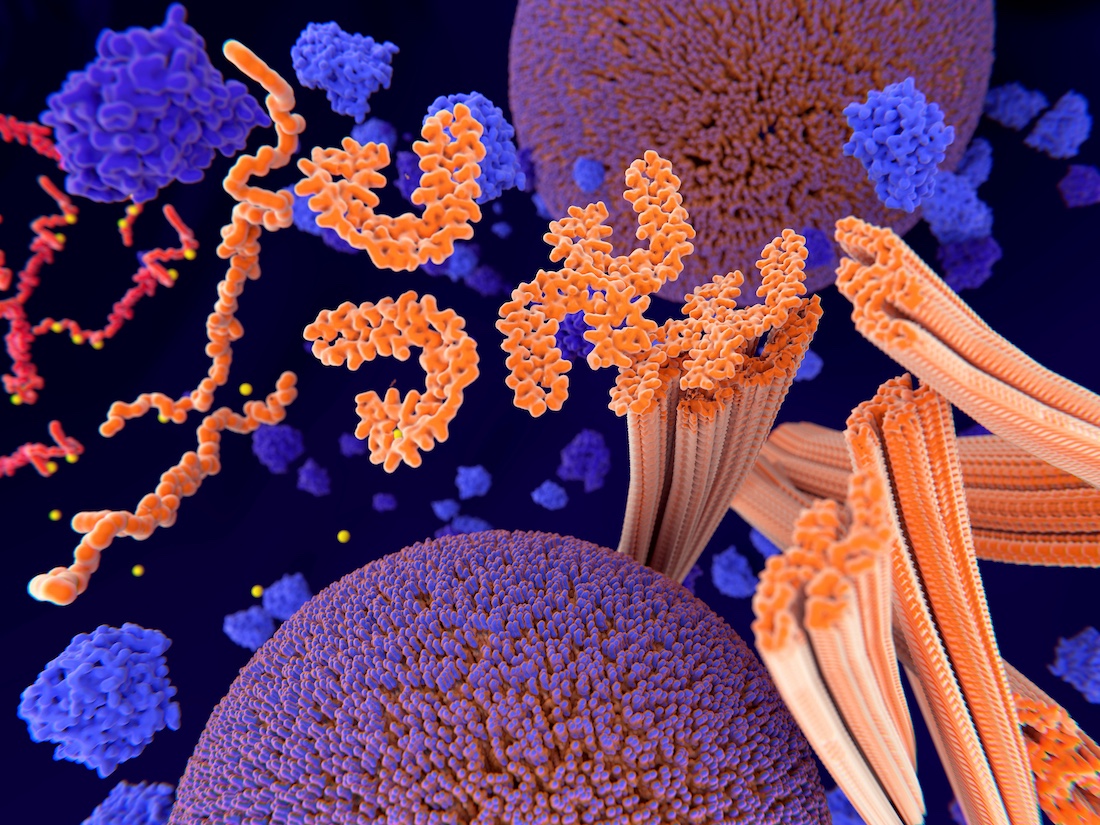
DALLAS – Dec. 22, 2025 – A designer version of the tau protein, developed by a team led by UT Southwestern Medical Center researchers, maintains its biological function while resisting aggregation, a pathological trait linked to neurodegenerative diseases called tauopathies. These findings, reported in Structure, could lead to new treatments for conditions including Alzheimer’s disease, frontotemporal dementia, chronic traumatic encephalopathy (CTE), and progressive supranuclear palsy.
“This is the first step toward creating a molecule that could, in principle, replace a protein that’s pathogenic (disease-causing) while still retaining its normal function,” said study leader Lukasz Joachimiak, Ph.D., Associate Professor in the Center for Alzheimer’s and Neurodegenerative Diseases and of Biochemistry and Biophysics at UT Southwestern.
Tau plays an essential role in cells, where it regulates assembly and stability of microtubules, protein assemblies that serve as highways to guide vesicles, organelles, and other components through cytoplasm. Tau binds to microtubules through a part of the tau protein in which a stretch of amino acids is repeated either three or four times. These versions of tau are known as 3R or 4R, respectively.
In tauopathies, tau proteins stick together, or aggregate, forming threadlike clumps that create deposits in the brain. Previous research has shown that the vast majority of tauopathies occur from aggregation of the 4R form of tau, Dr. Joachimiak explained. But why this happens – and whether it’s possible to modify tau to prevent aggregation without disrupting microtubule binding – has been unknown.
To answer these questions, researchers from the Joachimiak Lab and their colleagues constructed fragments of tau made of the 4R repeats and the so-called VQIVYK motif – the portion of the protein responsible for forming clumps – changing a few amino acids between these sections to mimic those found in 3R. Although fragments made without the amino acid substitutions readily aggregated in test tubes, the designed fragments did not.
A closer look revealed why: The section between the repeats and the VQIVYK motif in the designed fragments formed a rigid curve that gave them a hairpin shape, preventing them from contacting VQIVYK motifs on other fragments and forming clumps.
Further experiments confirmed that this design strategy also worked in larger pieces of tau and in cells, with the altered protein thwarting aggregation with natural 4R tau. Importantly, Dr. Joachimiak said, changing these amino acids didn’t affect tau’s ability to bind to microtubules, suggesting the altered protein can still perform its biological function.
“The fact that the engineered tau variants retained microtubule binding indicates it may be possible to preserve physiological function while reducing pathogenic aggregation,” he said.
Dr. Joachimiak added that his team’s future research will test whether replacing natural tau with this designer version can thwart tauopathies in animal models, a step toward crafting new treatments for neurodegenerative diseases.
“Many studies have examined tau isoforms, aggregation mechanisms, and mutations such as those associated with frontotemporal dementia,” he said. “But few, if any, have undertaken rational design of tau variants to reduce aggregation while retaining its function as we have with this research.”
Other UTSW researchers who contributed to this study are first author Sofia Bali, Ph.D., a former graduate student researcher in the Joachimiak Lab and now a postdoctoral researcher at the University of California, San Francisco; Josep Rizo, Ph.D., Professor of Biophysics, Biochemistry, and Pharmacology; Pawel M. Wydorski, Ph.D., postdoctoral researcher; Aleksandra Wosztyl, M.S., graduate student researcher; and Nabil Morgan, B.S., Research Assistant.
Dr. Joachimiak is an Effie Marie Cain Scholar in Medical Research. He and Dr. Rizo are Investigators in the Peter O’Donnell Jr. Brain Institute.
This study was funded by grants from the National Institutes of Health (F31NS12751301 and R01AG076459), an Effie Marie Cain Scholarship in Medical Research, a Chan Zuckerberg Initiative Collaborative Science Award (2018-191983), The Welch Foundation, and Target ALS.
About UT Southwestern Medical Center
UT Southwestern, one of the nation’s premier academic medical centers, integrates pioneering biomedical research with exceptional clinical care and education. The institution’s faculty members have received six Nobel Prizes and include 28 members of the National Academy of Sciences, 26 members of the National Academy of Medicine, and 14 Howard Hughes Medical Institute Investigators. The full-time faculty of nearly 3,400 is responsible for groundbreaking medical advances and is committed to translating science-driven research quickly to new clinical treatments. UT Southwestern physicians in more than 80 specialties care for more than 143,000 hospitalized patients, attend to more than 470,000 emergency room cases, and oversee nearly 5.3 million outpatient visits a year.