
UT Southwestern biochemist to receive O’Donnell Award from TAMEST
Yunsun Nam, Ph.D., honored by the Texas Academy of Medicine, Engineering, Science & Technology for her groundbreaking work on RNA-protein interactions
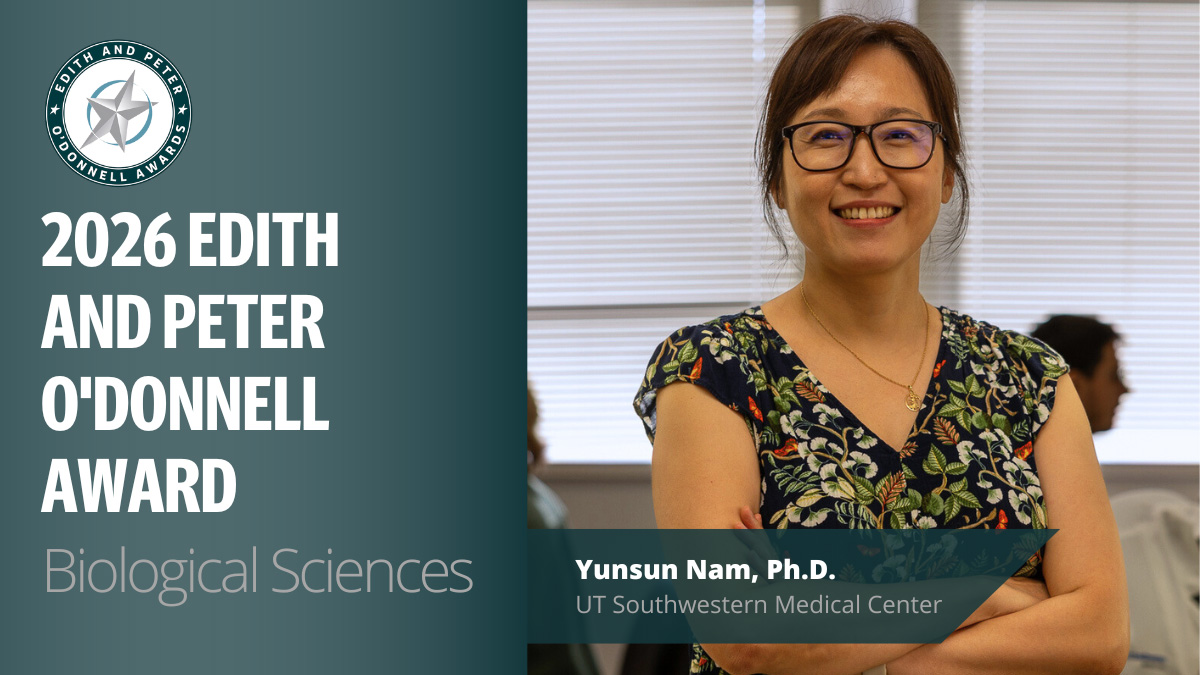
DALLAS – Dec. 11, 2025 – Yunsun Nam, Ph.D., Professor of Biochemistry and Biophysics at UT Southwestern Medical Center, will receive the 2026 Edith and Peter O’Donnell Award in Biological Sciences from the Texas Academy of Medicine, Engineering, Science & Technology (TAMEST) for her research into how RNAs and proteins interact at the molecular level. Her work has shed light on gene regulation, cancer biology, and RNA-based therapeutics.
TAMEST presents annual awards to recognize the achievements of early-career Texas investigators in the fields of science, medicine, engineering, and technological innovation. The O’Donnell Award comes with a $25,000 honorarium and an invitation to make a presentation before hundreds of TAMEST members. Dr. Nam is the 18th scientist at UT Southwestern to be honored with an O’Donnell Award since TAMEST launched the awards in 2006 and is one of five Texas-based researchers receiving the award this year.
“I am grateful for this award because recognition like this keeps encouraging us to aim high and keep challenging ourselves,” said Dr. Nam, who holds the Doris and Bryan Wildenthal Distinguished Chair in Medical Science. She is also a member of the Harold C. Simmons Comprehensive Cancer Center and an Investigator in the Peter O’Donnell Jr. Brain Institute.
Only an estimated 2% of the human genome codes for proteins. Most of the genome is still transcribed into RNAs, many of which function as noncoding RNAs that play crucial roles in gene regulation. The Nam Lab is particularly interested in a family of noncoding RNAs known as microRNAs that modulate messenger RNA (mRNA) translation and play key roles in diseases including cancer. Using cutting-edge biochemistry and structural biology methods, Dr. Nam and her colleagues have produced a wealth of insights into how microRNAs are processed in cells, modified with chemical groups, and remodeled by different proteins to exert their effects.
Using cryo-electron microscopy, which allows scientists to image molecules at atomic resolution, the team determined the core structure of the Microprocessor protein complex, the processing enzyme that produces microRNAs by cleaving longer RNA pieces. Their research showed that this complex recognizes where to cut RNA based on structural motifs found in the longer segments, rather than specific RNA sequences as some researchers had assumed.
Their research also extends to other classes of protein enzymes that act on RNAs, such as RNA modification enzymes. They found that structural motifs determine where the METTL1-WDR4 protein complex places chemical modifications to regulate the stability and function of transfer RNAs. In contrast, their work on the METTL3-METTL14 complex showed that some proteins determine where to chemically modify mRNAs through sequence recognition.
Chemical modification performed by both complexes has been found to go awry in various cancers, Dr. Nam explained, suggesting these complexes and their interactions with RNA could eventually serve as targets for novel cancer therapies.
“Yunsun is a rising star in the study of RNA-protein interactions,” said Yuh Min Chook, Ph.D., Professor of Pharmacology and Biophysics at UTSW and recipient of the 2015 O’Donnell Award in Biological Sciences, who nominated Dr. Nam for her O’Donnell Award. “Her work on how proteins modify RNAs is very much basic science, and yet when these modification processes go awry, they lead to diseases like cancer and developmental disorders. The work in the Nam Lab thus provides a unique foundation for development of therapeutics to target these diseases.”
Dr. Nam came to UTSW in 2013, supported by a recruitment grant from the Cancer Prevention and Research Institute of Texas. Born in Korea and raised in Indonesia, she was inspired to become a scientist at 8 years old after reading a biography of Marie Curie she had borrowed from the library. She followed her dream to Harvard University, where she earned an undergraduate degree in biochemical sciences and a doctoral degree in biological chemistry and molecular pharmacology, and continued on for postdoctoral fellowships. She became interested in noncoding RNAs while working on her last postdoctoral research project, where she studied RNA recognition by Lin28, a stem cell factor and an oncogene.
The Edith and Peter O’Donnell Awards recognize rising star Texas researchers who are addressing the essential role science and technology play in society and whose work meets the highest standards of exemplary professional performance, creativity, and resourcefulness. The Edith and Peter O’Donnell Awards are made possible by the O’Donnell Awards Endowment Fund, established in 2005 through the generous support of several individuals and organizations.
This year’s recipients will be honored at the 2026 Edith and Peter O’Donnell Awards Ceremony on Feb. 3 and will present their research at the TAMEST 2026 Annual Conference: Pioneering Climate Innovations at the Kimpton Santo Hotel in San Antonio.
“The Edith and Peter O’Donnell Awards have shone a spotlight on Texas’ brightest emerging researchers who are pushing the boundaries of science and technology for the past 20 years,” said Edith and Peter O’Donnell Awards Committee Chair Margaret A. Goodell, Ph.D., Chair and Professor of Molecular and Cellular Biology at Baylor College of Medicine and a member of the National Academy of Medicine. “Each year, these awards celebrate not only exceptional individual achievement but also the profound impact that innovative research has on communities, industries, and our future. It is inspiring to witness the next generation of trailblazers making Texas a global leader in transformative discovery.”
Dr. Nam is a Southwestern Medical Foundation Scholar in Biomedical Research and a UT Southwestern Presidential Scholar. Dr. Chook holds the Alfred and Mabel Gilman Chair in Molecular Pharmacology, is a Eugene McDermott Scholar in Biomedical Research, and is a member of Simmons Cancer Center.
About UT Southwestern Medical Center
UT Southwestern, one of the nation’s premier academic medical centers, integrates pioneering biomedical research with exceptional clinical care and education. The institution’s faculty members have received six Nobel Prizes and include 28 members of the National Academy of Sciences, 26 members of the National Academy of Medicine, and 14 Howard Hughes Medical Institute Investigators. The full-time faculty of nearly 3,400 is responsible for groundbreaking medical advances and is committed to translating science-driven research quickly to new clinical treatments. UT Southwestern physicians in more than 80 specialties care for more than 143,000 hospitalized patients, attend to more than 470,000 emergency room cases, and oversee nearly 5.3 million outpatient visits a year.