
UT Southwestern cell biologist to receive Maddox Award from TAMEST
Maralice Conacci-Sorrell, Ph.D., honored by Texas Academy of Medicine, Engineering, Science & Technology for cancer metabolism research
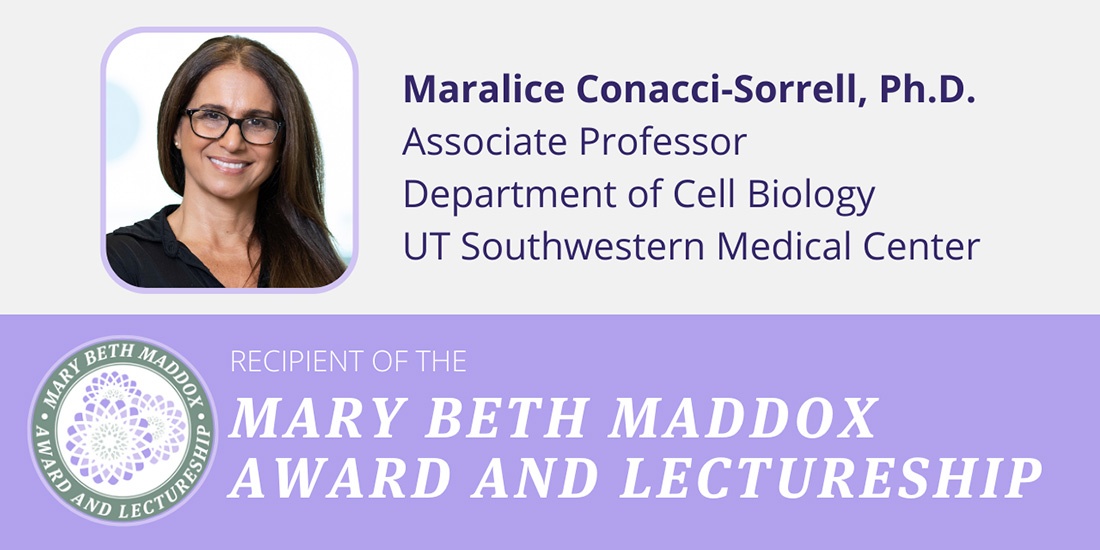
DALLAS – Dec. 18, 2025 – Maralice Conacci-Sorrell, Ph.D., Associate Professor of Cell Biology at UT Southwestern Medical Center, is the recipient of the 2026 Mary Beth Maddox Award and Lectureship from the Texas Academy of Medicine, Engineering, Science & Technology (TAMEST). Dr. Conacci-Sorrell is being honored for her pioneering research revealing how cancer cells harness nutrients to drive their growth and for creating targeted strategies to suppress untreatable cancers.
The Maddox Award, which recognizes women scientists in Texas who bring “new ideas and innovations to the fight against cancer,” was established in 2022 and named after former TAMEST Executive Director Mary Beth Maddox, who died from pancreatic cancer.
Since Dr. Conacci-Sorrell arrived at UT Southwestern in 2015, her research has uncovered how changes in cellular metabolism support uncontrolled growth in cancer and how these vulnerabilities can be targeted. Her work focuses on two fundamental processes: nutrient utilization and protein synthesis. By studying how cancer‑driving genes alter these pathways, she and her colleagues in the Sorrell Lab aim to identify strategies that disrupt tumor growth without harming normal tissues.
“Maralice has done highly innovative research in the cancer field and is an extraordinary educator and mentor,” said Steven Kliewer, Ph.D., Professor of Molecular Biology and Pharmacology at UTSW and a member of the National Academy of Sciences, who nominated Dr. Conacci-Sorrell for the award. “She is richly deserving of this honor.”
The Sorrell Lab discovered that certain cancers depend heavily on nutrients such as tryptophan to fuel their growth. In liver tumors, tryptophan can produce a metabolite that acts as a growth signal driving the cancer cells to multiply. Dr. Conacci-Sorrell and her colleagues showed in 2024 that removing this nutrient from the diet can halt tumor growth in mice, and adding the metabolite restored it – revealing a potential therapeutic target for liver cancer. In parallel, her studies on brain tumors revealed that blocking pyrimidine synthesis – the process cells use to make DNA and RNA building blocks – slows tumor growth even in drug-resistant forms of brain cancer.
“Dr. Conacci-Sorrell’s research has been pivotal in advancing our understanding of how cellular processes drive disease and uncovering strategies to address them,” said Helen Heslop, M.D., Mary Beth Maddox Award and Lectureship Committee Chair, Professor of Medicine and Pediatrics at Baylor College of Medicine, and member of the National Academy of Medicine. “Equally notable is her steadfast leadership and dedication to mentorship, cultivating pathways that open doors for the next generation of scientists.”
Dr. Conacci-Sorrell will be celebrated in February at the TAMEST 2026 Annual Conference: Pioneering Climate Innovations, where she will present her research and receive a $5,000 honorarium and award.
“I am honored to be recognized with women who are driving discovery in cancer biology and contributing to a stronger scientific community,” said Dr. Conacci-Sorrell, who has a secondary appointment in Children’s Medical Center Research Institute at UT Southwestern (CRI).
After the conference, Dr. Conacci-Sorrell will share her discoveries across the state during lectures at four TAMEST member institutions with National Cancer Institute-Designated Cancer Centers, including the Harold C. Simmons Comprehensive Cancer Center at UT Southwestern. Dr. Conacci-Sorrell is a member of the Simmons Cancer Center.
Dr. Conacci-Sorrell holds the John P. Perkins, Ph.D. Distinguished Professorship in Biomedical Science and is a Virginia Murchison Linthicum Scholar in Medical Research at UTSW. She won the Outstanding Educator Award for the Graduate School of Biomedical Sciences in 2023 and the Excellence in Postdoctoral Mentoring Award in 2024.
TAMEST, founded in 2004, comprises Texas-based members of the three National Academies (National Academy of Medicine, National Academy of Engineering, and National Academy of Sciences) and other honorific organizations. TAMEST includes more than 355 members, eight Nobel Laureates, and 23 member institutions.
Dr. Kliewer joined TAMEST in 2015. He holds the Diana K. and Richard C. Strauss Distinguished Chair in Developmental Biology at UTSW.
About UT Southwestern Medical Center
UT Southwestern, one of the nation’s premier academic medical centers, integrates pioneering biomedical research with exceptional clinical care and education. The institution’s faculty members have received six Nobel Prizes and include 28 members of the National Academy of Sciences, 26 members of the National Academy of Medicine, and 14 Howard Hughes Medical Institute Investigators. The full-time faculty of nearly 3,400 is responsible for groundbreaking medical advances and is committed to translating science-driven research quickly to new clinical treatments. UT Southwestern physicians in more than 80 specialties care for more than 143,000 hospitalized patients, attend to more than 470,000 emergency room cases, and oversee nearly 5.3 million outpatient visits a year.