
Middle ear fluid common in kids on ventilators, UTSW study finds
The research, which followed 94 babies and toddlers at Children’s Medical Center Dallas, could lead to interventions to prevent hearing and speech problems.
DALLAS – April 4, 2022 – Babies and toddlers who need a tracheostomy – a tube surgically inserted into their windpipe to help relieve breathing problems – are at a high risk of accumulating fluid behind their eardrum when on a ventilator. That’s the conclusion of a new study, published in the International Journal of Pediatric Otorhinolaryngology, by UT Southwestern head and neck surgeons. This buildup of fluid, called a middle ear effusion, can put them at risk for ear infections, hearing loss, and delays in speech and language development.
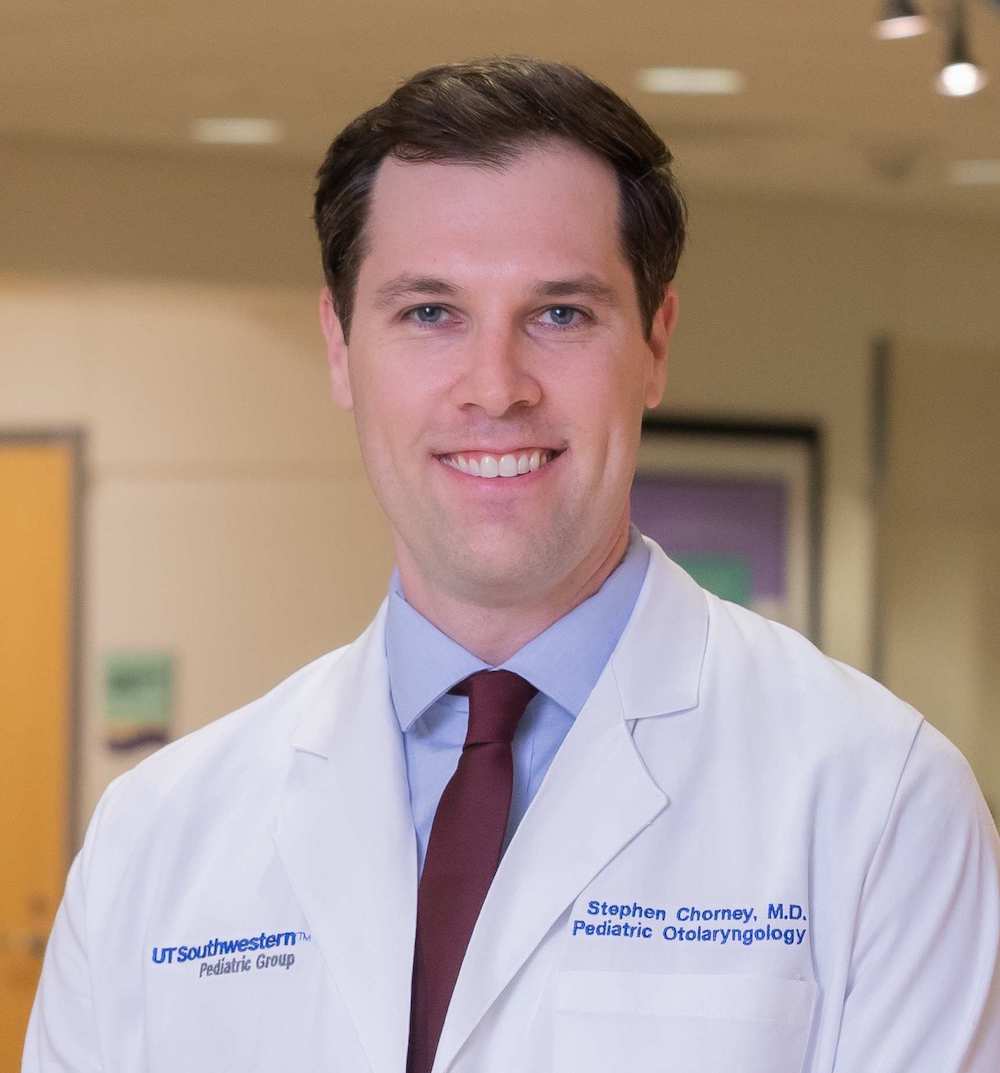
“The majority of the time that these children are being cared for, the focus is on more pressing lung and heart concerns,” said study leader Stephen R. Chorney, M.D., M.P.H., Assistant Professor of Otolaryngology – Head & Neck Surgery at UTSW and Pediatric Otolaryngologist at Children’s Health. “But our study suggests we should also be mindful of things that might appear more trivial, like ear effusions, because they can impact communication skills and developmental milestones in a vulnerable population of kids.”
Many young children who require a tracheostomy were born prematurely with underdeveloped lungs or narrow airways. In these cases, doctors may attach a mechanical ventilator – a form of life support to help a child breathe – to the tracheostomy tube.
Middle ear effusion (MEE) is a common problem for all young children. Nearly one in ten kids have ear tubes placed to help clear this fluid, treat infections, and reduce hearing loss. Dr. Chorney and his colleagues suspected, based on their own observations, that tracheostomy-dependent children on a ventilator might be at a higher risk of MEE.
The new study followed 94 children who received a tracheostomy before the age of two at Children’s Medical Center Dallas between 2015 and 2020. On average, the children underwent tracheostomy at 5 months old and would then periodically obtain hearing tests to determine the presence of MEE. In the two years following their tracheostomy, 74% of children requiring mechanical ventilation developed at least one MEE while only 31% of those not on the ventilator developed a MEE. When controlling for age, diagnosis of craniofacial syndrome, and result of newborn hearing test, mechanical ventilation predicted the presence of a MEE. Further, among all children with a tracheostomy, 80% of MEEs persisted for at least several months, between multiple hearing exams.
“This information allows us to have an objective reference point when communicating with parents,” said Dr. Chorney. “We know that this is a common phenomenon and we might consider ear tubes in some of these children.”
Since placing ear tubes requires general anesthesia, some children with a tracheostomy on ventilator support might not be good candidates for the procedure, and the new data helps clinicians weigh risks and benefits. In future studies, Dr. Chorney would like to explore the impact of MEEs on hearing and communication in this population.
“What we would hope is that if we’re more vigilant with screening for and addressing MEEs in these children, positive outcomes on speech and language development can be achieved,” he said. “But we need more data on that.”
Other UTSW researchers who contributed to this study included Erin M. Wynings, Hussein Jaffal, Rachel St. John, and Romaine F. Johnson.
About UT Southwestern Medical Center
UT Southwestern, one of the nation’s premier academic medical centers, integrates pioneering biomedical research with exceptional clinical care and education. The institution’s faculty members have received six Nobel Prizes and include 28 members of the National Academy of Sciences, 26 members of the National Academy of Medicine, and 14 Howard Hughes Medical Institute Investigators. The full-time faculty of nearly 3,400 is responsible for groundbreaking medical advances and is committed to translating science-driven research quickly to new clinical treatments. UT Southwestern physicians in more than 80 specialties care for more than 143,000 hospitalized patients, attend to more than 470,000 emergency room cases, and oversee nearly 5.3 million outpatient visits a year.
About Children’s Health
Children’s Health is the leading pediatric health care system in North Texas and has long been recognized as a leader in pediatric health. Its campuses include Children’s Medical Center Dallas, Children’s Medical Center Plano and multiple Children’s Health Specialty Centers, caring for 370,000 patients each year.
In partnership with UT Southwestern Medical Center, it is consistently recognized among the nation’s best pediatric hospitals by U.S. News & World Report. This commitment to excellence and outstanding care has resulted in recognition across all pediatric specialties for eight consecutive years, including Cancer, Cardiology & Heart Surgery, Behavioral Health, Diabetes & Endocrinology, Gastroenterology & GI Surgery, Neonatology, Nephrology, Neurology & Neurosurgery, Orthopedics, Pulmonology, and Urology.
Since 2009, Children’s Health has maintained Magnet® designation – the highest honor for nursing excellence – and continues to earn employer-of-choice recognition locally, nationally, and globally. These honors include the Great Place to Work® Certification™, the Gallup Exceptional Workplace Award and Top Workplaces recognition from USA TODAY and The Dallas Morning News. Children’s Health has also been named one of the 150 Best Places to Work in Healthcare by Becker’s Hospital Review for 14 consecutive years.