Advanced Heart Failure and Transplant Cardiology
One of the nation's highest-volume transplant and mechanical circulatory support programs, training fellows at the full spectrum of end-stage heart disease — from cardiogenic shock to durable LVAD to multi-organ transplantation.
Program Snapshot
- 1-year ACGME-accredited fellowship, 2 positions/year
- 5 individualized career tracks
- Faculty recognized nationally & internationally in their fields
- Transplant volume in the top quartile nationally
- ELSO Gold VA-ECMO Program
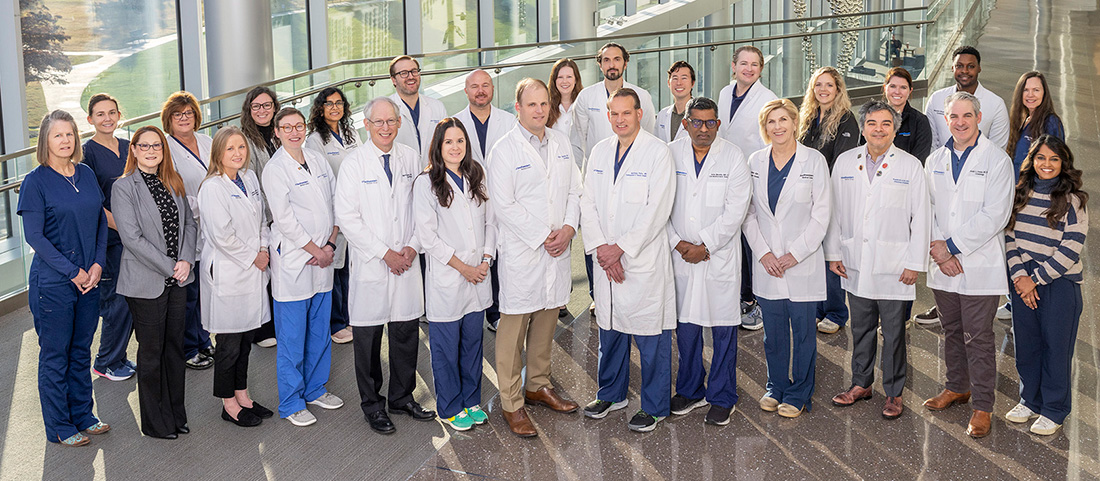
A program built on volume, breadth, and outcomes
For nearly 30 years, UT Southwestern's Advanced Heart Failure and Transplant Cardiology program has trained fellows in the care of complex cardiovascular disease across a broad range of specialty programs and advanced therapies.
Program highlights include:
- Training in cardiac sarcoidosis, amyloidosis, neuromuscular and hypertrophic cardiomyopathies, adult congenital heart disease, pulmonary hypertension, HFpEF, and cardio-oncology
- Dedicated advanced heart failure experience at Parkland Memorial Hospital, Dallas County's safety-net hospital
- Comprehensive exposure to mechanical circulatory support, including durable LVAD therapy and innovative sternal-sparing non-sternotomy LVAD implantation
- Advanced procedural training in invasive hemodynamics, LVAD RAMP studies, invasive cardiopulmonary exercise testing, and endomyocardial biopsy
- Rotations in a dedicated cardiac ICU and participation in an ELSO Gold-certified VA-ECMO program
- Experience at a large-volume pulmonary hypertension referral center and a high-volume structural heart program
- Exposure to complex transplant populations, including multi-organ transplant recipients and adults with congenital heart disease
Fellows train alongside nationally and internationally recognized faculty who lead clinical trials, develop practice guidelines, and advance standards of care in heart failure, transplantation, pulmonary hypertension, and mechanical circulatory support.
By the Numbers


112
Heart Transplants
Two Year Total for 2024 and 2025

58
Durable LVAD Implants
Two Year Total for 2024 and 2025

153
Temporary MCS/ECMO Runs
Two Year Total for 2024 and 2025
18
Multi-organ Transplants
Two Year Total for 2024 and 2025
7,500+
Advanced Heart Failure Clinic Visits
1,000+
Transplants since Program Inception in 1988
At a Glance
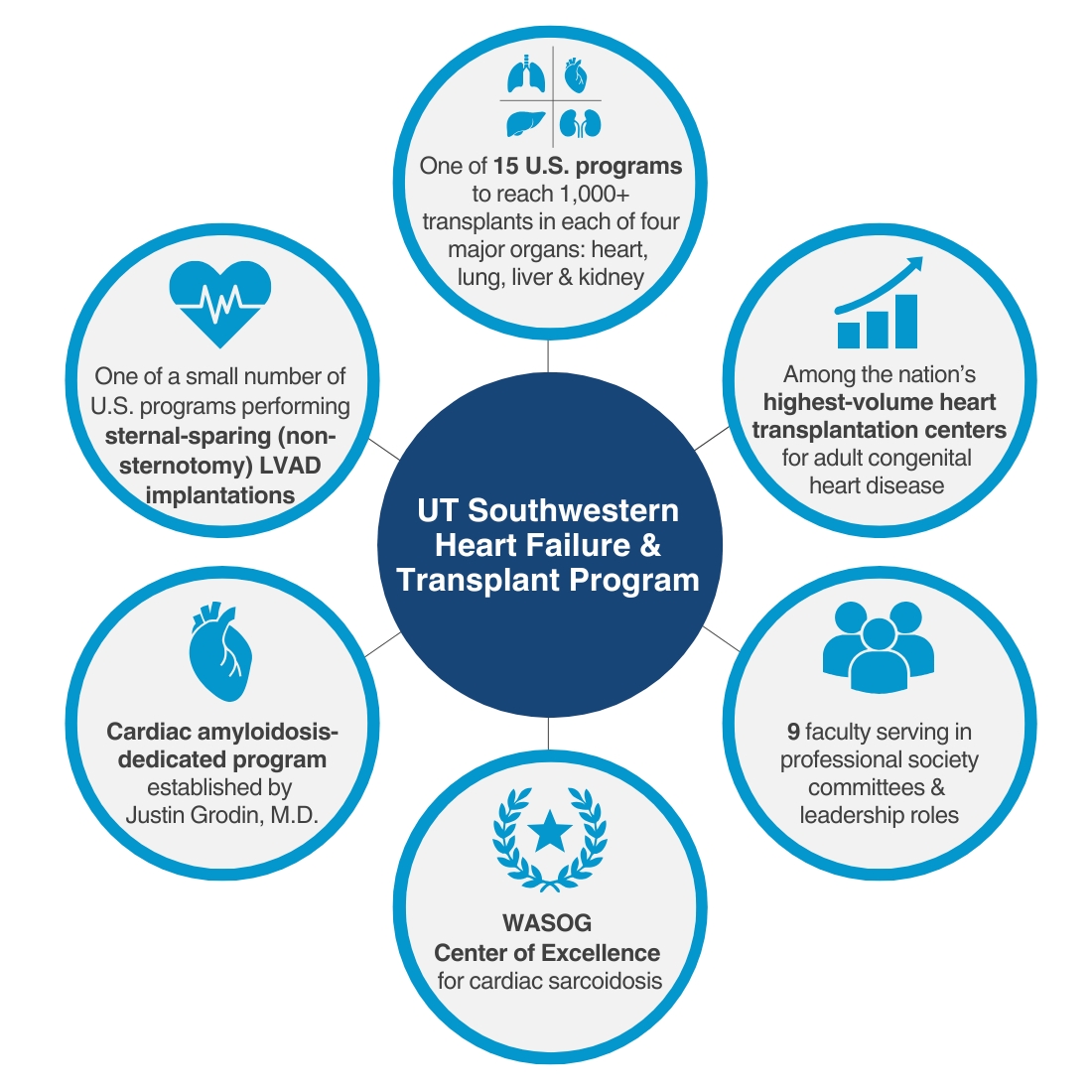
- UT Southwestern Heart Failure & Transplant Program Facts
- One of 15 U.S. programs to reach 1,000+ transplants in each of four major organs: heart, lung, liver & kidney
- Among the nation’s highest-volume heart transplantation centers for adult congenital heart disease
- 9 faculty serving in professional society committees & leadership roles
- World Association of Sarcoidosis and Other Granulomatous Disorders (WASOG) Center of Excellence for cardiac sarcoidosis
- Cardiac amyloidosis-dedicated program established by Justin Grodin, M.D.
- One of a small number of U.S. programs performing sternal-sparing (non-sternotomy) LVAD implantations
Five Career Tracks
Traditional
Balanced training across advanced HF, MCS, transplant, and critical care.
Outpatient
Durable LVAD and ambulatory transplant medicine with expanded outpatient HF focus.
Heart Failure
For careers focused on HF and cardiogenic shock outside transplant centers.
Critical Care
Deepened experience in the Cardiac ICU managing the most critically ill patients.
Elective
A personalized pathway approved by the Program Director.
Discover Our Experience
- Application Process
Incoming fellows are required to have successfully completed an ACGME-accredited Cardiovascular Disease fellowship prior to the start of their Advanced Heart Failure and Transplant Cardiology fellowship. In addition, incoming fellows must have a valid license or training permit from the Texas Medical Board, as well as current BLS and ACLS certifications.
Advanced Heart Failure and Transplant Cardiology fellowship programs across the country, including UT Southwestern Medical Center, are now utilizing the Electronic Residency Application Service (ERAS) to streamline the application process. In order to apply for a position, please submit a completed application through ERAS. Your application should include the following:
- An updated Curriculum Vitae (CV)
- A personal statement
- A USMLE score report including scores for Steps 1, 2CK, and 3
- At least three (3) – but no more than four (4) – letters of recommendation (LORs). LORs should be from faculty who can comment on your clinical, procedure, and interpersonal skills.
- We require that one of your LORs be from your Cardiovascular Diseases Fellowship Program Director.
We strongly encourage interested applicants to submit their applications as early as possible as we offer interviews on a rolling basis. We regret that we are unable to accept applications received outside of ERAS.
Per UT Southwestern policy, we are only able to accept incoming trainees who are United States citizens, permanent residents, or have J-1 ECFMG certified visas. We are unable to offer H1-B visas or any other type of visa.
Interviews
The Advanced Heart Failure and Transplant Cardiology fellowship conducts interviews in September.
- Curriculum & Conferences
Clinical Rotations
- Inpatient LVAD Service
- Inpatient Transplant Service
- Advanced HF, Transplant & VAD Consult Service
- Advanced HF Clinic at Parkland Memorial Hospital
- Transplant, LVAD & Advanced HF Outpatient Clinics
- Cardiac Catheterization Lab
Conferences
- ACHD Complex Patient Review
- Advanced Heart Failure, Transplant & MCS Didactic Conference
- Case Presentations
- Complex Immunology Conference Review
- Division Grand Rounds
- ECMO Data Review
- Journal Club
- LVAD Programmatic Discussion
- Morbidity & Mortality (M&M) Conference
- QAPI
- Transplant / LVAD Selection Committee
- Transplant Clinic Patient Review
- VA ECMO Meeting
Multidisciplinary Didactic Series
- Advanced Heart Failure
- Mechanical Circulatory Support, with hands-on device training
- Transplant Immunology
- Transplant Infectious Disease
- Transplant Psychiatry / Psychology
- LVAD Management & Complications
Procedural & Skills Training
- Invasive hemodynamics
- Invasive RAMP studies for LVAD optimization
- Level III CPET with direct Fick
- Endomyocardial biopsy
- Hands-on Impella, ECMO & LVAD training
- Clinical Trials & Investigator Involvement
Fellows train alongside faculty who are active in multicenter device and drug trials, national registries, and investigator-initiated research.
ACTIVE ENROLLING TRIALS
INNOVATE Trial — BrioVAD™ System
A prospective, randomized, multicenter trial evaluating the investigational BrioVAD left ventricular assist system against the HeartMate 3 for short- and long-term mechanical circulatory support in advanced, refractory heart failure. UT Southwestern is an enrolling site.
COMET-HF
A Multi-Center, Double-Blind, Randomized, Placebo-Controlled Trial to Assess Efficacy and Safety of Omecamtiv Mecarbil in Patients With Symptomatic Heart Failure With Severely Reduced Ejection Fraction
Active Research Across every Domain of Advanced Heart Failure
Domain Representative Study/Program Advanced HFrEF therapeutics COMET-HF / Omecamtiv Mecarbil Amyloidosis Identifying Subclinical Transthyretin Cardiac Amyloidosis in asymptomatic carriers of the V122I TTR Allele
UT Southwestern Cardiomyopathy BioBank
Determining the association of TTR stabilizing therapy with circulating TTR amyloid aggregates over time in patients with ATTR-CM; Longitudinal Biomarker Study
Iodine-124 Evuzamitide PET/CT Imaging in Carriers of TTR Mutations (EPIC-TTR)Durable mechanical circulatory support innovation BrioVAD / INNOVATE Trial Donor-heart preservation & expanded organ utilization XVIVO Heart Box / Normothermic Ischemia-Free Heart Preservation (NIHP) Heart Transplant Multiomic Profiling in Patients with Advanced Heart Failure: The UT Southwestern Advanced HeartFailure Biorepository
Cardiac Metabolic Profiling in Heart Transplant Recipients Using Hyperpolarized MRIPulmonary hypertension in advanced HF & transplant evaluation PH referral-center research, invasive hemodynamics, transplant risk stratification Specialized transplant populations HIV-positive donor heart transplantation Temporary MCS / ECMO quality & outcomes VA-ECMO Program, ELSO Platinum Certification Registries & Collaboratives
- Get With The Guidelines–Heart Failure (GWTG-HF) Registry
- AHA Cardiogenic Shock Registry
- Cardiogenic Shock Working Group
- Faculty Influence
Leadership Roles
- Faris Araj, M.D. – Multidisciplinary Heart Valve Team
- Mark Drazner, M.D. – Vice Chair, Clinical Affairs
- Justin Grodin, M.D., M.P.H. – Interim Section Head, Medical Director Cardiac Amyloidosis
- E. Ashley Hardin, M.D. – Program Director, AHFTC, Medical Director Cardiac Sarcoidosis Clinic, and Medical Director Inpatient APPs
- Anas Jawaid, M.D. – Medical Director of Heart Failure, Parkland Memorial Hospital
- Natalie Tapaskar, M.D. – Medical Director HCM
- Jennifer Thibodeau, M.D. – Medical Director HF/ECMO, Associate Director of Clinical Operations
- Lauren Truby, M.D. – Medical Director, Heart Transplant and LVAD
- Christopher Wrobel, M.D. – Associate Medical Director, Heart Transplant
Committees
- Heart Failure Society of America (HFSA),
- Mark Drazner, M.D., M.Sc. – Past president, board of directors
- E. Ashley Hardin, M.D. – incoming chair of the Women in HF Committee
- Jennifer Thibodeau, M.D., M.S.C.S. – Chair of the annual scientific meeting (ASM) committee
- International Society of Heart and Lung Transplant (ISHLT);
- Lauren Truby, M.D – Member of the PGD international consortium
- American Heart Association
- American College of Cardiology
- American Society of Transplantation
Guideline Writing Committees
- Mark Drazer, M.D., M.Sc.
- E. Ashley Hardin, M.D.
- Jennifer Thibodeau, M.D., M.S.C.S.
- Prominent Publications
Faris Araj, M.D.
- Patel PC, Reimold SC, Araj FG, Ayers CR, Kaiser PA, Peshock RM, Yancy CW, Ring WS, Gupta S, Mishkin JD, Mammen PP, Markham DW, Drazner MH. Concentric left ventricular hypertrophy as assessed by cardiac magnetic resonance imaging and risk of death in cardiac transplant recipients. J Heart Lung Transplant. 2010 Dec;29(12):1369-79. doi: 10.1016/j.healun.2010.05.008. PMID: 20599402.
- Amin AA, Araj FG, Ariyamuthu VK, Drazner MH, Ayvaci MUS, Mammen PPA, Mete M, Urey MA, Tanriover B. Impact of induction immunosuppression on patient survival in heart transplant recipients treated with tacrolimus and mycophenolic acid in the current allocation era. Clin Transplant. 2019 Aug;33(8):e13651. doi: 10.1111/ctr.13651. Epub 2019 Jul 19. PMID: 31230375.
Mark H. Drazner, M.D., M.Sc.
- Drazner MH, Rame JE, Stevenson LW, Dries DL. Prognostic importance of elevated jugular venous pressure and a third heart sound in patients with heart failure. N Engl J Med. 2001 Aug 23;345(8):574-81. doi: 10.1056/NEJMoa010641. PMID: 11529211.
- Drazner MH, Hellkamp AS, Leier CV, Shah MR, Miller LW, Russell SD, Young JB, Califf RM, Nohria A. Value of clinician assessment of hemodynamics in advanced heart failure: the ESCAPE trial. Circ Heart Fail. 2008 Sep;1(3):170-7. doi: 10.1161/CIRCHEARTFAILURE.108.769778. PMID: 19675681; PMCID: PMC2724723.
- Drazner MH, Velez-Martinez M, Ayers CR, Reimold SC, Thibodeau JT, Mishkin JD, Mammen PP, Markham DW, Patel CB. Relationship of right- to left-sided ventricular filling pressures in advanced heart failure: insights from the ESCAPE trial. Circ Heart Fail. 2013 Mar;6(2):264-70. doi: 10.1161/CIRCHEARTFAILURE.112.000204. Epub 2013 Feb 7. PMID: 23392790
Justin Grodin, M.D., M.P.H.
- Fontana M, Berk JL, Gillmore JD, Grodin JL, et al. Acoramidis in Transthyretin Amyloid Cardiomyopathy (ATTRibute-CM), NEJM 2024
- Grodin JL, Maurer MS. The Truth Is Unfolding About Transthyretin Cardiac Amyloidosis. Circulation. 2019 Jul 2;140(1):27-30. doi: 10.1161/CIRCULATIONAHA.119.041015. Epub 2019 Jul 1. PMID: 31549879; PMCID: PMC6761830.
Elizabeth Ashley Hardin, M.D.
- Hardin EA, Stoller D, Lawley J, Howden EJ, Hieda M, Pawelczyk J, Jarvis S, Prisk K, Sarma S, Levine BD. Noninvasive Assessment of Cardiac Output: Accuracy and Precision of the Closed-Circuit Acetylene Rebreathing Technique for Cardiac Output Measurement. J Am Heart Assoc. 2020 Sep;9(17):e015794. doi: 10.1161/JAHA.120.015794. Epub 2020 Aug 27. PMID: 32851906; PMCID: PMC7660774.
- Pham DD, Drazner MH, Ayers CR, Grodin JL, Hardin EA, Garg S, Mammen PPA, Amin A, Araj FG, Morlend RM, Thibodeau JT. Identifying Discordance of Right- and Left-Ventricular Filling Pressures in Patients With Heart Failure by the Clinical Examination. Circ Heart Fail. 2021 Nov;14(11):e008779. doi: 10.1161/CIRCHEARTFAILURE.121.008779. Epub 2021 Sep 10. PMID: 34503353; PMCID: PMC8595783.
Anas Jawaid, M.D.
- Beaini H, Jawaid A, Farr MA, Araj FG. Pulseless Paradoxus: Pulsus Paradoxus of the 21st Century. Circ Heart Fail. 2025 Apr;18(4):e012657. doi: 10.1161/CIRCHEARTFAILURE.124.012657. Epub 2025 Jan 20. PMID: 39831300.C
- Jawaid A, Wees I, Grodin JL. Disentangling Knots of Misfolded Proteins: Do We Really Know the Prognostic Implications of the Pathogenic V122I TTR Variant? Am J Cardiol. 2024 Jun 15;221:131-132. doi: 10.1016/j.amjcard.2024.04.028. Epub 2024 Apr 23. Erratum in: Am J Cardiol. 2024 Oct 1;228:88. doi: 10.1016/j.amjcard.2024.06.011. PMID: 38657853; PMCID: PMC11144071.
Nicholas Hendren, M.D.
- Hendren NS, Drazner MH, Bozkurt B, Cooper LT Jr. Description and Proposed Management of the Acute COVID-19 Cardiovascular Syndrome. Circulation. 2020 Jun 9;141(23):1903-1914. doi: 10.1161/CIRCULATIONAHA.120.047349. Epub 2020 Apr 16. PMID: 32297796; PMCID: PMC7314493.
- Hendren NS, de Lemos JA, Ayers C, Das SR, Rao A, Carter S, Rosenblatt A, Walchok J, Omar W, Khera R, Hegde AA, Drazner MH, Neeland IJ, Grodin JL. Association of Body Mass Index and Age With Morbidity and Mortality in Patients Hospitalized With COVID-19: Results From the American Heart Association COVID-19 Cardiovascular Disease Registry. Circulation. 2021 Jan 12;143(2):135-144. doi: 10.1161/CIRCULATIONAHA.120.051936. Epub 2020 Nov 17. PMID: 33200947.
Natalie Tapaskar, M.D.
- Tapaskar N, Wayda B, Malinoski D, Luikart H, Groat T, Nguyen J, Belcher J, Nieto J, Neidlinger N, Salehi A, Geraghty PJ, Nicely B, Jendrisak M, Pearson T, Wood RP, Zhang S, Weng Y, Zaroff J, Khush KK. Donor Electrocardiogram Associations With Cardiac Dysfunction, Heart Transplant Use, and Survival: The Donor Heart Study. JACC Heart Fail. 2024 Apr;12(4):722-736. doi: 10.1016/j.jchf.2023.12.007. Epub 2024 Jan 17. PMID: 38244008.
- Tapaskar N, Tremblay-Gravel M, Khush KK. Contemporary Management of Cardiogenic Shock During Pregnancy. J Card Fail. 2023 Feb;29(2):193-209. doi: 10.1016/j.cardfail.2022.09.014. Epub 2022 Oct 13. PMID: 36243342.
Jennifer Thibodeau, M.D., M.S.C.S.
- Thibodeau JT, Turer AT, Gualano SK, Ayers CR, Velez-Martinez M, Mishkin JD, Patel PC, Mammen PP, Markham DW, Levine BD, Drazner MH. Characterization of a novel symptom of advanced heart failure: bendopnea. JACC Heart Fail. 2014 Feb;2(1):24-31. doi: 10.1016/j.jchf.2013.07.009. Epub 2014 Jan 8. PMID: 24622115.
- Thibodeau JT, Drazner MH. The Role of the Clinical Examination in Patients With Heart Failure. JACC Heart Fail. 2018 Jul;6(7):543-551. doi: 10.1016/j.jchf.2018.04.005. Epub 2018 Jun 6. PMID: 29885957.
- Belkin MN, Fudim M, Baratto C, Grinstein J, Hollis I, Ijioma N, Kataria R, Lewis GD, Mak S, Tedford RJ, Thibodeau JT, Yaku H; American Heart Association Fellow-In-Training and Early Career Committee of the Council on Clinical Cardiology. Standardization of Baseline and Provocative Invasive Hemodynamic Protocols for the Evaluation of Heart Failure and Pulmonary Hypertension: A Scientific Statement From the American Heart Association. Circ Heart Fail. 2026 Feb;19(2):e000088. doi: 10.1161/HHF.0000000000000088. PMID: 41493051.
Lauren Truby, M.D.
- Truby LK, Kwee LC, Agarwal R, Grass E, DeVore AD, Patel CB, Chen D, Schroder JN, Bowles D, Milano CA, Shah SH, Holley CL. Proteomic profiling identifies CLEC4C expression as a novel biomarker of primary graft dysfunction after heart transplantation. J Heart Lung Transplant. 2021 Dec;40(12):1589-1598. doi: 10.1016/j.healun.2021.07.024. Epub 2021 Aug 11. PMID: 34511330; PMCID: PMC8670564.
- Truby LK, Klein L, Wilcox JE, Farr M. National Organ Procurement and Transplant Network Heart Allocation Policy: 6 Years Later. Circ Heart Fail. 2025 Jun;18(6):e011631. doi: 10.1161/CIRCHEARTFAILURE.124.011631. Epub 2025 Mar 21. PMID: 40115988; PMCID: PMC12173783.
Christopher Wrobel, M.D.
- Keshvani N, Subramanian V, Wrobel CA, Solomon N, Alhanti B, Greene SJ, DeVore AD, Yancy CW, Allen LA, Fonarow GC, Pandey A. Patterns of Referral and Postdischarge Utilization of Cardiac Rehabilitation Among Patients Hospitalized With Heart Failure: An Analysis From the GWTG-HF Registry. Circ Heart Fail. 2023 Aug;16(8):e010144. doi: 10.1161/CIRCHEARTFAILURE.122.010144. Epub 2023 Jul 11. PMID: 37431671; PMCID: PMC11092317.
- Wrobel CA, Drazner MH, Ayers CR, Pham DD, La Hoz RM, Grodin JL, Garg S, Mammen PPA, Morlend RM, Araj F, Amin AA, Cornwell WK 3rd, Thibodeau JT. Delayed febrile response with bloodstream infections in patients with continuous-flow left ventricular assist devices. J Investig Med. 2019 Mar;67(3):653-658. doi: 10.1136/jim-2018-000893. Epub 2019 Jan 29. PMID: 30696751; PMCID: PMC6391164.
Faculty Team
- Valve Team
- Left Ventricular Assist Devices (LVADs)
- Mechanical Circulatory Support (MCS)
- Invasive Hemodynamics
- Genetic Cardiomyopathy
- Amyloidosis
- Hypertophic Cardiomyopathy
- Cardiac Sarcoidosis
- Pulmonary Hypertension
- Hypertophic Cardiomyopathy
- Myocarditis
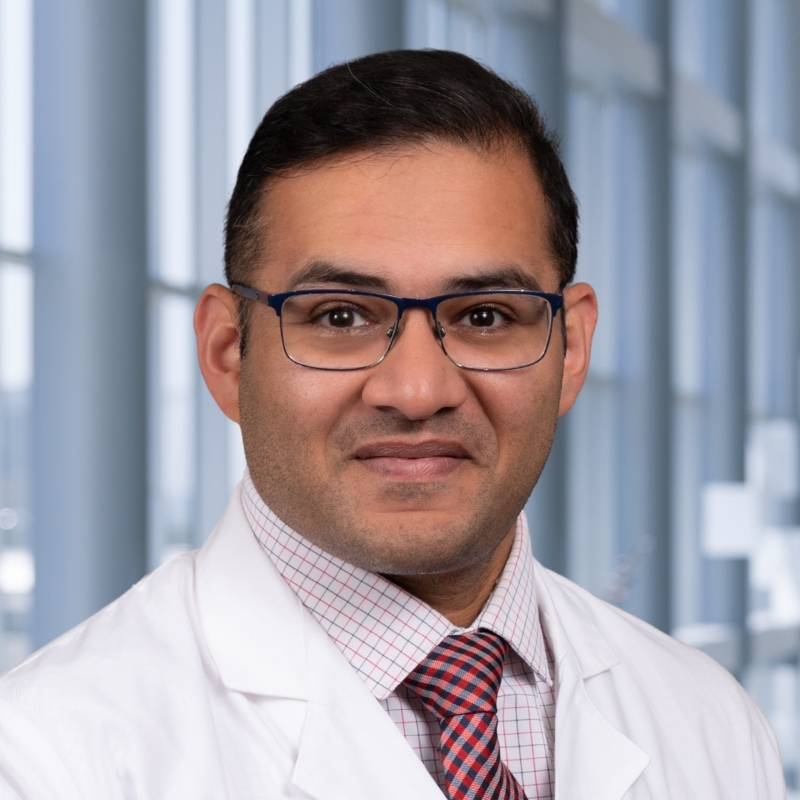
- Cardiac Sarcoidosis
- Left Ventricular Assist Devices (LVADs)
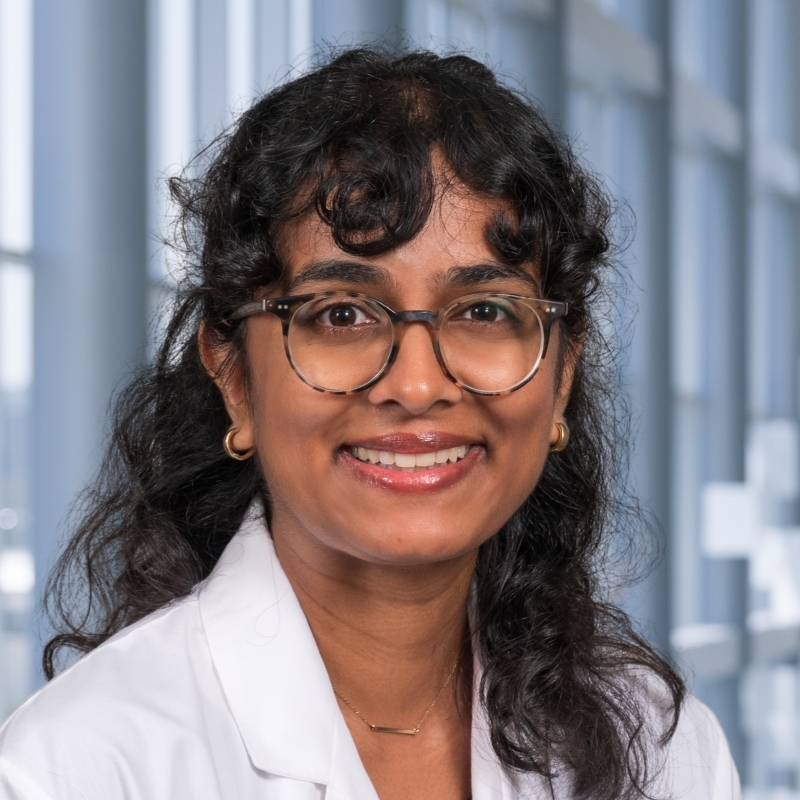
- Hypertrophic Cardiomyopathy
Jennifer Thibodeau, M.D., M.S.C.S.
- Extracorporeal Membrane Oxygenation (ECMO)
- Heart Transplant
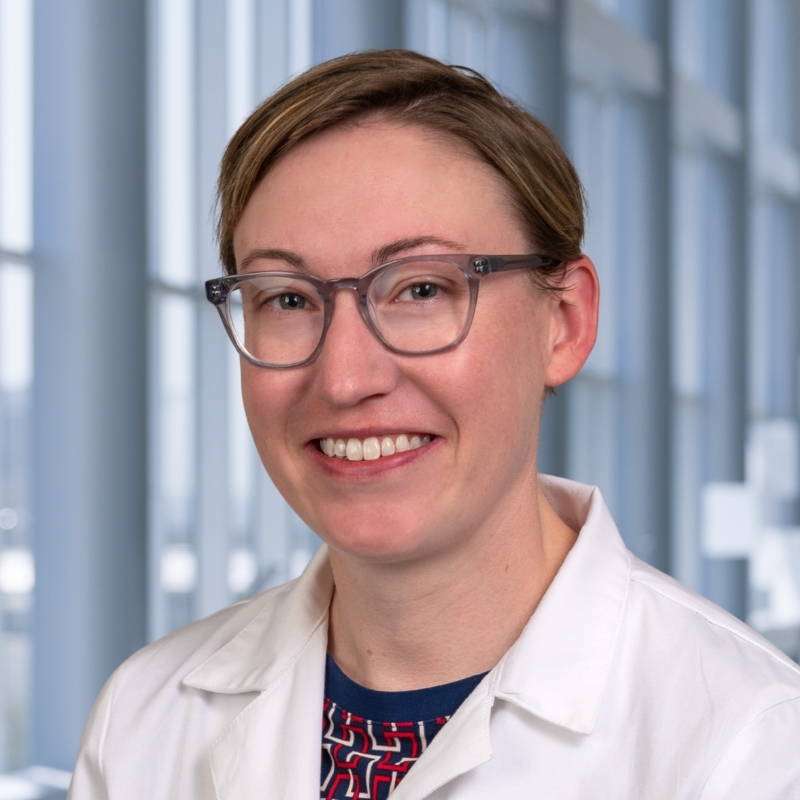
- Transplant Immunology
- General Cardiology
- Transplant Immunology
- Mechanical Circulatory Support
Contact Us
Division of Cardiology
UT Southwestern Medical Center
5323 Harry Hines Blvd.
Dallas, TX 75390-9047
Phone: 214-645-2062
Fax: 214-648-2480
william.brown@utsouthwestern.edu
Program Director
Associate Program Director