
New pediatric campus in Dallas reaches major construction milestone
UT Southwestern, Children’s Health celebrate placement of final beam atop 12-story structure that will become Moody Children’s Hospital

DALLAS – Sept. 29, 2026 – Watching the new pediatric campus created by Children’s Health℠ and UT Southwestern Medical Center rise in Dallas’ Southwestern Medical District holds special meaning for Cameron Strother.
Five years ago, his son, Finley, was born with a rare genetic disorder called branched-chain ketoaciduria, commonly known as maple syrup urine disease, which can cause life-threatening metabolic problems. When Finley was 16 months old, he underwent a liver transplant at Children’s Health.
The surgery was life-changing, both for Finley and his father.
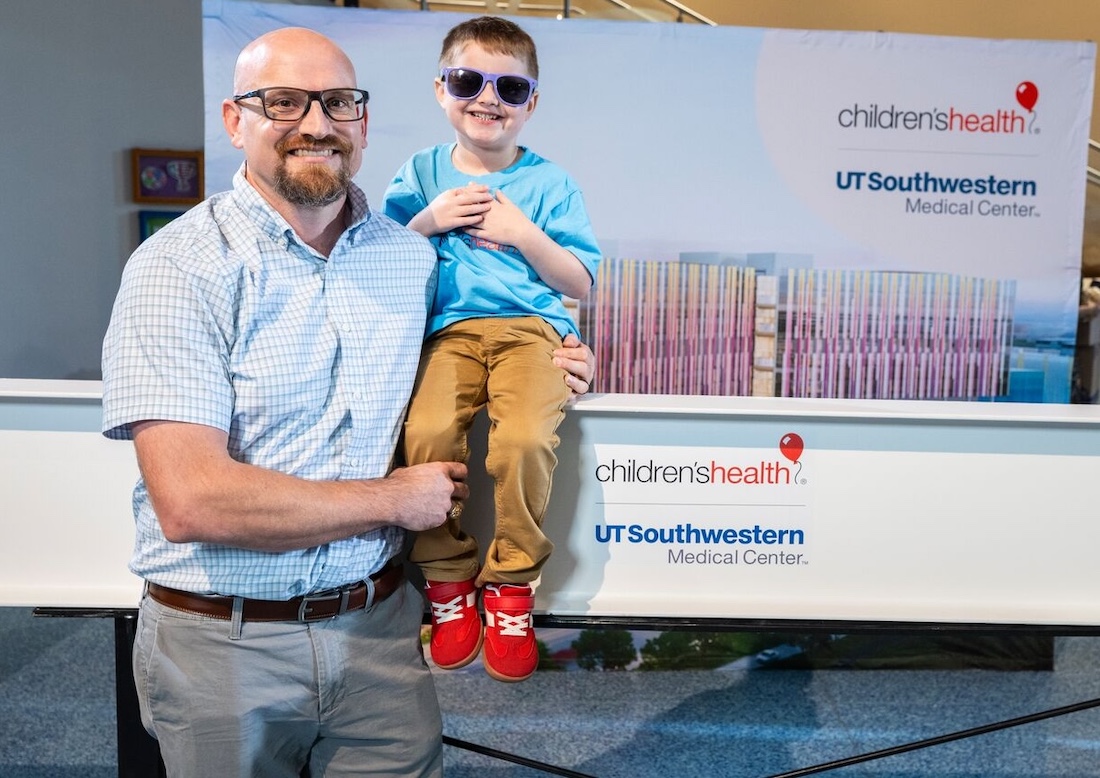
Today, Finley is a thriving little boy fascinated by bugs and his younger brother. And Strother spends his days helping build the same promise of care for future families. At Children’s Health, he oversees Risk and Environmental, Health and Safety on the new $5 billion campus construction project.
“This hospital is being built with thought and intention behind every detail,” Strother said. “From the technology we’re incorporating to the way the physical space is being designed for children and families, we are creating a state-of-the-art facility that will transform pediatric care for generations to come.”
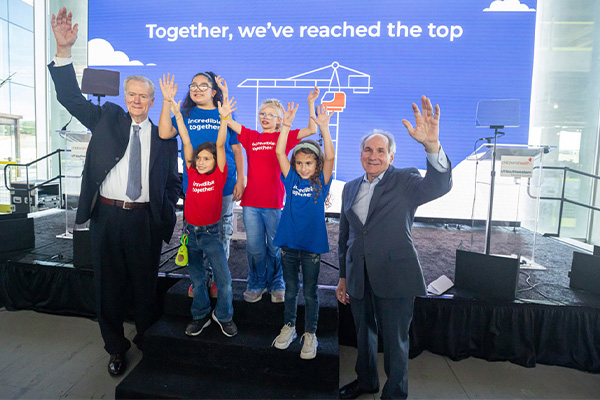
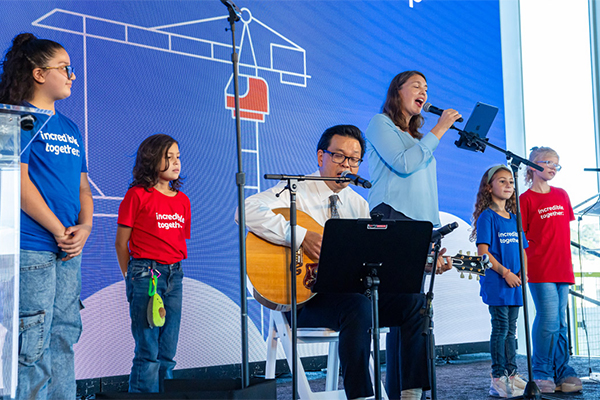
Today, leaders from UT Southwestern and Children’s Health marked a major milestone in the construction of the new Dallas pediatric campus with a “topping out” ceremony celebrating the placement of the final beam atop the hospital’s 12-story structural frame. The ceremony comes two years after work began on one of the largest healthcare construction projects in the country, recognizing patients, families, care teams, community supporters, and construction partners who have helped shape the future campus.
“We are now one milestone closer to achieving our goal of providing a transformative environment for children and their families, where we can set a new standard of excellence in pediatric healthcare, education, and research,” said Daniel K. Podolsky, M.D., President of UT Southwestern. “We want to thank our many community supporters and our campus community who contributed to the planning of the new campus, along with our construction and design partners, all of whom have been essential to reaching this important moment.”
The new campus, located directly across Harry Hines Boulevard from William P. Clements Jr. University Hospital, will span more than 5 million square feet and feature the 12-story Moody Children’s Hospital, with 552 beds across three towers. Projected to open in 2031, the campus will significantly expand inpatient, surgical, and ambulatory capacity to meet the needs of North Texas’ growing pediatric population.
“Today’s topping out is much more than a milestone in construction. It represents a promise that we are continuing to invest in the future, and in our children’s future, and to build something truly incredible for the families who we are privileged to care for today and for generations to come,” said Christopher J. Durovich, President and Chief Executive Officer of Children’s Health. “With every beam and with every floor, we move closer to opening a new campus for the world-class care that our teams provide every day. We are deeply grateful to our donors, our physicians, our team members, and our design and construction partners who are making our aspirations a reality.”
Designed around the needs of children and their families, the new Dallas pediatric campus will combine advanced technology and innovative care with thoughtful features that offer comfort and a sense of normalcy during challenging times. By bringing together the expertise of UT Southwestern and Children’s Health across every pediatric specialty, the campus will provide children with access to the full spectrum of care they need in one location.
Patient rooms will be spacious and family-centered, while green spaces will offer opportunities to connect with the outdoors. Services supporting children’s medical, emotional, educational, and social needs will help create an environment where children can continue to learn, play, and simply be kids throughout their time in the hospital.
- Patient rooms will be designed with flexibility in mind, comfortably accommodating two caregivers.
- Integrated technology will allow patients and families to personalize their environment and stay connected.
- Thoughtful design elements, including adaptable lighting, will help create a welcoming, healing environment for children and families.
- Amenities to support the overall well-being of patients and families including a multifaith chapel, playrooms and interactive features, a music therapy suite, a broadcast studio, and spaces for keeping up with their schoolwork.


“No family wants to be in the hospital, but we’re designing this one to feel as comfortable and welcoming as possible for children and their families,” Strother said. “As a parent, you’re facing one of the most difficult times in your life. Having a care team that communicates in a way you understand, partners with you, and supports you throughout that journey makes all the difference.”
In partnership with UT Southwestern Medical Center, Children’s Health Dallas is consistently recognized among the nation’s best pediatric hospitals by U.S. News & World Report. This year, Children’s Health Dallas was nationally ranked in all 11 pediatric specialties for the ninth consecutive year. UT Southwestern is the No. 1 adult hospital in Dallas-Fort Worth for the 10th consecutive year and nationally ranked in 11 specialties, the most of any hospital in Texas.
To learn more, visit childrens.com/watchusgrow, engage.utsouthwestern.edu/pediatriccampus, and give.childrens.com.
For assets and resources for this announcement, please use this downloadable media kit.
About UT Southwestern Medical Center
UT Southwestern, one of the nation’s premier academic medical centers, integrates pioneering biomedical research with exceptional clinical care and education. The institution’s faculty members have received six Nobel Prizes and include 28 members of the National Academy of Sciences, 26 members of the National Academy of Medicine, and 14 Howard Hughes Medical Institute Investigators. The full-time faculty of nearly 3,400 is responsible for groundbreaking medical advances and is committed to translating science-driven research quickly to new clinical treatments. UT Southwestern physicians in more than 80 specialties care for more than 143,000 hospitalized patients, attend to more than 470,000 emergency room cases, and oversee nearly 5.3 million outpatient visits a year.
About Children’s Health
Children’s Health is the leading pediatric health care system in North Texas and has long been recognized as a leader in pediatric health. Its campuses include Children’s Medical Center Dallas, Children’s Medical Center Plano and multiple Children’s Health Specialty Centers across the Dallas–Fort Worth metroplex, caring for more than 370,000 patients each year.
In partnership with UT Southwestern Medical Center, it is consistently recognized among the nation’s best pediatric hospitals by U.S. News & World Report. This commitment to excellence and outstanding care has resulted in recognition across all pediatric specialties for nine consecutive years, including Cancer, Cardiology & Heart Surgery, Behavioral Health, Diabetes & Endocrinology, Gastroenterology & GI Surgery, Neonatology, Nephrology, Neurology & Neurosurgery, Orthopedics, Pulmonology, and Urology.
Since 2009, Children’s Health has maintained Magnet® designation – the highest honor for nursing excellence – and continues to earn employer-of-choice recognition locally, nationally, and globally. These honors include the Great Place to Work® Certification™, the Gallup Exceptional Workplace Award and Top Workplaces recognition from USA TODAY and The Dallas Morning News. Children’s Health has also been named one of the 150 Best Places to Work in Healthcare by Becker’s Hospital Review for 14 consecutive years.
For more information and to support Children’s Health, visit childrens.com or like us on Facebook, follow Children’s Health on X, Instagram and LinkedIn, and subscribe to our YouTube channel.