
Grants
Grants provide the funding for our research. Many of our grants come from the National Institute of Health - some of the most difficult grants to be awarded.
Active
Why Do Some Women Keep Getting UTIs? The Bladder’s Ecosystem May Hold the Answer

Dr. Nicole DeNisco and Dr. Philippe Zimmern are in the final year of a prestigious five-year NIH study looking at how the bladder’s “ecosystem” of bacteria affects UTI vulnerability. Their fully enrolled clinical study is

tracking how the bladder’s bacteria changes over time, comparing the bladder’s ecosystem in women who have never experienced a UTI to those with an active UTI, examining how hormones may help to protect against infection.
1R01DK131267-01 | Nicole De Nisco, B.S., Ph.D. (PI) | 09/2021 - 04/2026
Bacteria Use Small, Sticky Fibers to Infect Our Cells?

That’s right. A two-year study with Dr. DeNisco, Dr. David Greenberg,and Dr. Zimmern is focused on how a newly discovered variant of Klebsiella, called K. quasi-pneumoniae, behaves in humans,particularly with regard to recurrent UTIs. They are also researching how these organisms control their small, hairlike attachment fibers to infect the bladder and cause disease.
R21 AI169323-01A1 | Nicole De Nisco, B.S., Ph.D. (PI) | 08/2023 - 7/2025
Comparing Treatment Strategies for Chronic Urinary Tract Infections

Dr. Zimmern is coordinating a multisite study to compare two treatments for women who repeatedly struggle with UTIs. Participants will be randomized into two groups. One group will receive an antibiotic, called nitrofurantoin; the other group will receive nitrofurantoin in addition to an outpatient procedure (fulguration) to eliminate sites of chronic infections.
1R01 DK140224-01A1 | Philippe E. Zimmern, M.D. | 09/2025 - 06/2030
Could a Supplement be the Answer to UTI Prevention?

Dr. Zimmern and his team are recruiting postmenopausal women with a documented history of recurrent UTIs for a randomized study to test whether taking a supplement called D-mannose for a year could aid in the prevention of chronic UTIs.
R21 AI169323-01A1 | Nicole De Nisco, B.S., Ph.D. (PI) | 08/2023 - 7/2025
Does Hormone Replacement Therapy Influence Bladder Bacteria?

Dr. DeNisco, Dr. Ann Lutich, and Dr. Zimmern want to learn how estrogen hormone replacement therapy — administered vaginally or throughout the body — changes the bacteria living in the vagina and possibly affecting the bladder to reduce the risk of UTIs. They are currently enrolling postmenopausal women who have not used estrogen therapy before and can be followed for a year.
1R21 AG086778-01A1 | Nicole De Nisco, Ph.D. (PI) | 03/2025 - 08/2027
Pelvic Organ Prolapse -- Keep it from POPing!
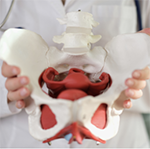
Quality of life can be significantly diminished among those with POP, which results from a bulge into the vagina that can be very uncomfortable. We have been exploring a new treatment that uses a special glue-like biological material to aid in holding vaginal tissues in place, preventing worsening of the bulge.
5RO1 HD097330-05 | Yi Hong, Ph.D. (PI) | 01/2019 - 01/2025 (NCE)
Novel Material to Correct Stress-Induced Urinary Leakage?
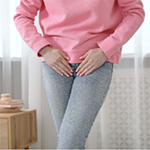
Just funded: a four-year study in which Dr. Zimmern will collaborate with Dr. Taylor Ware, from Texas A&M University, to examine the outcomes of a newly designed scaffold that supports the urethra to correct leakage. This innovative device is also capable of changing shape to allow for normal urination. The researchers will first validate the scaffold for its function in an animal model.
RO1 DK142071 | Taylor Ware, Ph.D. (PI) | 09/2025 - 09/2029
Illuminating a New Appraoch to Target UT-Causing Bacteria Bacteria Use Small, Sticky Fibers to Infect Our Cells?
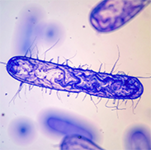
In collaboration with Dr. Jeremiah Gassensmith and Dr. DeNisco, Dr. Zimmern is studying a novel dye that can bind to bacteria. By illuminating bacteria in this manner, researchers could uncover and remove some harmful bacteria living within the bladder and causing chronic UTIs.
1R 21 DK40688-01 | Gassensmith, Ph.D. (PI) | 07/2024 - 06/2026
What's in the Pipeline?
Could Diabetes Alter the Urobiome? You Bet!

Many women with type 2 diabetes mellitus (T2DM) suffer from recurrent UTIs at a higher rate than counterparts without T2DM. Our preliminary results suggest that postmenopausal women with T2DM and with or without UTIs exhibit differences in the urinary bacteria associated with these infections. We plan to further evaluate clinical and bacterial changes over time in a large cohort of women with T2DM.
Stretchy Scaffold Implant Can Contract with the Bladder

Dr. Zhengwei Li and colleagues in collaboration with Dr. Zimmern designed a scaffold that can wrap around the bladder and stretch and contract with the bladder’s natural volume changes. This novel technology, using artificial intelligence, could be used to monitor bladder health or deliver targeted therapy to improve or restore bladder function over time.
A Home-Based Test Kit for UTIs?
Well, not just yet, but Dr. Shalini Prasad, Dr. DeNisco, and Dr. Zimmern are testing a new device that — in a matter of minutes — measures three unique markers to identify UTI and its risk of progression through machine learning. Further development of this device could not only offer fast answers from home but also enhance the use of more appropriately targeted antibiotic treatments.
Submitted
R21
Shalini Prasad, Ph.D. (PI) - UT Dallas
Title: "USENSE: an electrochemical biosensor for improved point-of-care urinary tract infection diagnosis."
Resubmitted October 2024
R 01
Larry Reitzer, Ph.D. - UT Dallas
Title: "Urovirulence of uropathogenic B2 strains."
Re-Submitted November 2024
In Preparation
R 21
Subash Sarguru, Ph.D. - Texas A&M University
Title: "Host-pathogen interaction in the porcine urinary tract."
To be submitted February 2025
R 21
Nicole De Nisco, B.S., Ph.D. - UT Dallas
Title: "Elimination of bladder bacterial reservoirs with intravesical VesiX CPC solution."
To be re-submitted March 2025
Randomized Controlled Trials and Prospective Studies at the Cain Bladder Center
RCT (October 2024)
Philippe Zimmern, M.D. (PI)
Title: "A multicenter randomized non-inferiority trial of empiric versus culture-based antibiotic therapy for UTIs in adult women with a history of recurrent UTIs."
RCT (February 2025)
Philippe Zimmern, M.D. (PI)
Title: "Randomized controlled trial of D-mannose for the prophylaxis of recurrent urinary tract infections in post-menopausal women."
RCT (April 2025)
Philippe Zimmern, M.D. (PI)
Title: "Randomized double blind clinical trial of methenamime hippurate versus nitrofurantoin for the prophylaxis of recurrent urinary tract infections in postmenopausal women."
Prospective study
Philippe E. Zimmern, M.D. and Nicole De Nisco, B.S., Ph.D. (PI) UT Dallas
Title: "The impact of estrogen hormone therapy modality on urobiome dynamics in postmenopausal women."
Completed
R21 EB028547-01
Taylor H. Ware, Ph.D. (PI)
08/01/2019 - 04/30/2022
Liquid Crystal Elastomer as a Dynamic Treatment of Incontinence
This grant received an extension until 2023. The data from this grant has been used to submit an R 01 grant in October 2024.
R01 DK120307-01
Mario Romero-Ortega, Ph.D. (PI)
07/06/2018 - 07/06/2023
Pelvic floor musculature in the aged and multiparous rabbit model as surrogate for the management of urinary incontinence and pelvic floor dysfunction in women.
This grant received an extension until 2024.
CTSA Pilot Award Grant at UT Southwestern 1UL1TR003163-01A1
Subash Sarguru, Ph.D. (Co-PI)
5/25/2022 - 05/24/2023
A miniature pigmodel of urinary tract infection
UT Dallas CoBRA Grant (No grant number)
Larry Reitzer, Ph.D. (PI)
07/01/2019 - 06/30/2021
Urinary tract infections and uropathogenic bacteria
2UG1HD054241-11
Ike Rahn, M.D. (PI)
07/01/2016 - 07/01/2021
To develop and implement pelvic floor related projects with the PFDN
5R01DK120307-04
Mario Romero-Ortega, Ph.D. (PI)
08/01/2021 - 07/31/2023
Neuromodulation of Individual Pelvic Floor Muscle Activity in Urinary Incontinence