
News Highlights - November 17, 2026
Kudos

Goss Receives Grant to Study Heart Health After Preterm Birth
Kara Goss, M.D., an Associate Professor in the Division of Pulmonary and Critical Care Medicine, has received a one-year, $75,000 grant from Children’s Health to investigate how extreme preterm birth may affect the coronary arteries and contribute to cardiovascular problems later in life.
The project, “Developmentally Arrested Coronary Vasculature after Extreme Preterm Birth,” is a first-of-its-kind study examining the structure and function of the coronary vasculature in people born extremely preterm and how those changes may affect exercise tolerance. People born extremely preterm face a 17-fold higher lifetime risk of heart failure, and Dr. Goss and her team are investigating whether impaired development of the coronary arteries may be one mechanism behind that increased risk.
The work extends the Goss Lab’s broader research into the lifelong cardiopulmonary effects of premature birth. The lab studies adolescents and adults born moderately to extremely preterm and has previously shown that the heart can remain smaller long after preterm birth. Its research also examines cardiac fibrosis, abnormal cardiac metabolism, and pulmonary vascular disease as potential contributors to later cardiovascular and pulmonary complications.
Dr. Goss joined the UT Southwestern faculty in 2020. ■
Research Report

Trial Finds Lower Inflammation Does Not Translate Into Lower Cardiovascular Risk
Ann Marie Navar, M.D., Ph.D., a Professor in the Division of Cardiology, co-authored an article in The New England Journal of Medicine reporting results from the ZEUS clinical trial, a large international study examining whether targeting inflammation could reduce cardiovascular events in high-risk patients.
The study focused on interleukin-6 (IL-6), a protein involved in the body’s inflammatory response. Previous research has linked elevated IL-6 and other markers of inflammation to increased cardiovascular risk, raising the possibility that blocking the pathway could help prevent heart attacks, strokes, and cardiovascular deaths.
In the ZEUS trial, investigators enrolled 6,376 adults with established atherosclerotic cardiovascular disease, chronic kidney disease, and persistent inflammation. Participants were randomly assigned to receive monthly injections of ziltivekimab, a monoclonal antibody that targets IL-6, or placebo. The primary outcome combined cardiovascular death, nonfatal heart attack, and nonfatal stroke.
Ziltivekimab produced substantial reductions in inflammation. After 24 months, IL-6 levels had fallen by 76 percentage points and high-sensitivity C-reactive protein by 64 percentage points relative to placebo. However, those biological changes did not translate into fewer cardiovascular events. During a median follow-up of 33 months, the primary outcome occurred in 17.6% of patients receiving ziltivekimab and 17.7% receiving placebo.
“We know inflammation plays an important role in cardiovascular disease, but these results show that lowering inflammation alone doesn’t necessarily translate into fewer cardiovascular events,” Dr. Navar said. “That an important finding because it could help us determine which inflammatory pathways are most important to target.” ■
Expanding Organ Supply Requires New Approach to Transplant Equity
Lisa VanWagner, M.D., M.Sc., an Associate Professor in the Division of Digestive and Liver Diseases and Director of Digestive and Liver Diseases Clinical Research, and colleagues argued in a Viewpoint article recently published in JAMA that advances expanding the supply of donor organs are changing one of the fundamental challenges in transplantation: ensuring equitable access may increasingly depend not on who receives a scarce organ, but on who reaches the transplant system in the first place.
For decades, transplant policies have been built around organ scarcity. But donation after circulatory death, machine perfusion technologies that can preserve and assess donor organs, and emerging approaches such as xenotransplantation and bioengineered grafts could substantially increase availability.
“Increasing the organ supply won‘t eliminate disparities on its own,” Dr. VanWagner said. “As more organs become available, the challenge may shift to whether patients have equal opportunities to be referred, evaluated, and listed for transplant.”
The authors called for equity to be measured across the entire transplant process, from referral and evaluation through transplantation and long-term outcomes. Among their proposed safeguards are standardized nonmedical listing criteria, greater reporting of barriers between referral and waitlisting, stronger regional referral and workforce networks, and assessment of whether new technologies reach underserved populations. They also highlighted particular risks for pediatric patients, who may not benefit equally as the donor pool expands and adult eligibility broadens.
“Scientific progress should translate into greater access to transplantation,” Dr. VanWagner said. “As the field advances, we need to look beyond the number of transplants performed and consider whether those advances are reaching the patients who could benefit from them.”
Dr. VanWagner serves as Director of the Clinical Scientist Training Program and Associate Program Director for Internal Medicine Resident Research. ■
Editorial Calls for Earlier Action to Prevent Atherosclerotic Cardiovascular Disease
Amit Khera, M.D., a Professor and Clinical Chief in the Division of Cardiology and Director of the Preventive Cardiology Program, and Wendy Post, M.D., of Johns Hopkins University, called for a shift toward preventing cardiovascular disease earlier in adulthood in an editorial published in The New England Journal of Medicine.
The editorial accompanied results from the REACT study, which used several imaging methods to look for atherosclerosis in adults ages 18 to 70 with no known clinical cardiovascular disease. Researchers found signs of the disease in 6.7% of women and 8.7% of men ages 18 to 29, rising to 21.3% and 34.6%, respectively, among those ages 30 to 39. By ages 60 to 70, more than 90% of participants had some degree of subclinical atherosclerosis.
“The findings add to growing evidence that atherosclerosis can begin decades before a heart attack or other cardiovascular event, underscoring why prevention needs to start earlier in life,” said Dr. Khera. “The burden of risk factors is already substantial in young adults, and atherosclerosis is nearly ubiquitous in older adults. It doesn’t have to be this way, but we must change course and take a longer-term view of heart disease prevention.”
The authors concluded that prevention should extend across the lifespan, with greater attention to healthy weight and diet, regular physical activity, smoking cessation, and earlier management of cardiovascular risk factors. The need is particularly pressing, they wrote, as obesity, diabetes, and cardiovascular-kidney-metabolic syndrome increasingly affect people at younger ages. ■
Dr. Khera holds the Dallas Heart Ball Chair in Hypertension and Heart Disease.
Education & Training
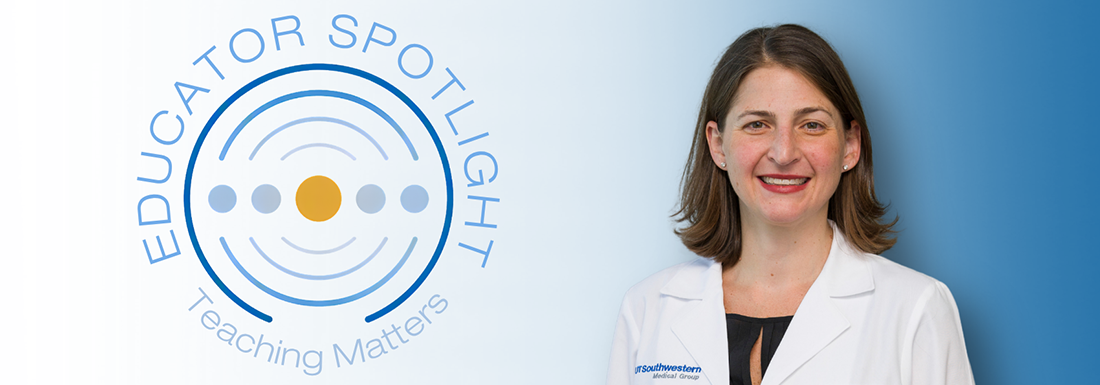
In the Spotlight: Rosechelle Ruggiero
Editor’s note: Rosechelle Ruggiero, M.D., M.S.C.S., is an Associate Professor in the Division of Pulmonary and Critical Care Medicine who joined the UT Southwestern faculty in 2011. She earned her medical degree from Georgetown University and completed residency training at UT Southwestern, where she also received fellowship training in pulmonary and critical care medicine and served as Chief Fellow. She serves as Associate Program Director in the Internal Medicine Residency, where she focuses on mentorship and resident recruitment.
What is your role at UTSW and within the residency program? What part of the resident experience do you help lead or support?
Clinically, I am one of the Pulmonary and Critical Care attendings, and I attend in the Parkland ICU and on the consult service. As an Associate Program Director, I spearhead residency recruitment with Dr. Maddie Kubiliun.
What are you always happy for a resident to reach out to you about?
I truly love all aspects of my interactions with the residents. I’ve always loved teaching at the bedside in the ICU, and, now as an APD, I have truly enjoyed getting to know my mentees on a more personal level. But I have to say I’m always happy when a resident comes to me with a goal and we can work toward that goal together, whether it’s trying to improve their ITE score, become a better critical care doctor, or seek career mentorship.
What is your favorite part of being an APD or working with our residents?
Definitely, working side by side with the residents in the ICU. I truly believe every single member of the team has something to contribute, and I am constantly humbled by how much I learn from our house staff every single day. Additionally, watching the residents grow throughout their first ICU rotation and then from year to year is something that I’ll never tire of experiencing. Teaching the next generation of doctors is the best part of my job, hands down, and keeps medicine fun!
What clinical, educational, or professional interests or projects are you especially excited about right now?
It’s interview season, so I’m excited to meet all the new applicants and to work alongside our leadership team to select a great new residency class! ■