
News Highlights - October 27, 2026
Kudos

Parkland Physician of the Year Awards
Three Department of Internal Medicine faculty members were recognized through Parkland Health’s Physician of the Year Awards program, which honors physicians for outstanding patient care, professionalism, and service to the health system. The awards are administered through Parkland’s Employed Physicians Committee and recognize clinicians who exemplify compassionate, patient-centered care.
Out of a field of 34 candidates, Anita Hegde, M.D., an Associate Professor in the Division of Hospital Medicine and Associate Chief Quality and Safety Officer for Parkland Health, was a runner-up for Parkland Health’s Physician of the Year Award for Inpatient and Specialty Services. Anusha Govind, M.D., an Assistant Professor in the Division of Infectious Diseases and Geographic Medicine, and Marlyn Mayo, M.D., a Professor in the Division of Digestive and Liver Diseases, received Honorable Mention.
The honors highlight the contributions of Department faculty who provide care across the Parkland system and reflect their commitment to clinical excellence, patient safety, and compassionate service. ■
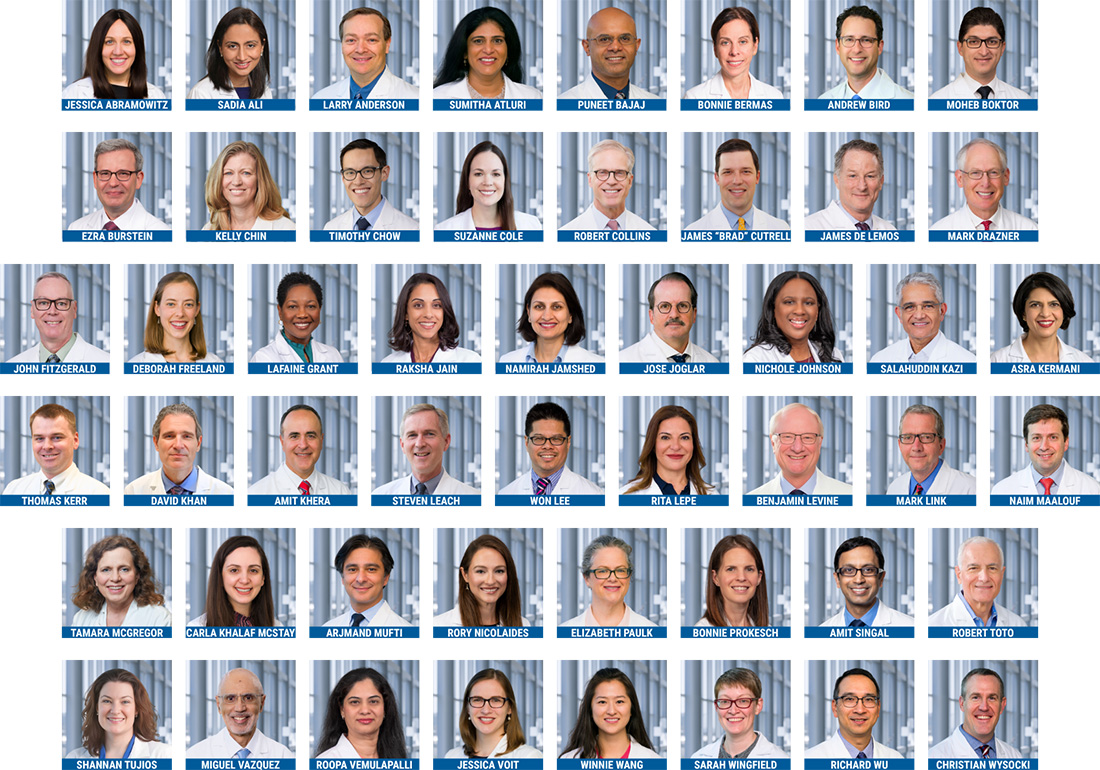
- D Magazine's 2026 Best Docs in Internal Medicine
Row 1: Jessica Abramowitz, Sadia Ali, Larry Anderson, Sumitha Atluri, Puneet Bajaj, Bonnie Bermas, Andrew Bird, Moheb Boktor
Row 2: Ezra Burstein, Kelly Chin, Timothy Chow, Suzanne Cole, Robert Collins, James “Brad” Cutrell, James de Lemos, Mark Drazner
Row 3: John Fitzgerald, Deborah Freeland, Lafaine Grant, Raksha Jain, Namirah Jamshed, Jose Joglar, Nichole Johnson, Salahuddin Kazi, Asra Kermani
Row 4: Thomas Kerr, David Khan, Amit Khera, Steven Leach, Won Lee, Rita Lepe, Benjamin Levine, Mark Link, Naim Maalouf
Row 5: Tamara McGregor, Carla Khalaf McStay, Arjmand Mufti, Rory Nicolaides, Elizabeth Paulk, Bonnie Prokesch, Amit Singal, Robert Toto
Row 6: Shannan Tujios, Miguel Vazquez, Roopa Vemulapalli, Jessica Voit, Winnie Wang, Sarah Wingfield, Richard Wu, Christian Wysocki
Annual List of Area’s Best Doctors Includes 50 Internal Medicine Faculty
Each year, D Magazine highlights the region’s best doctors as chosen by their peers. Votes are tallied and sorted by the magazine’s editorial staff, with the remaining votes vetted by an anonymous panel of doctors.
This year, 243 UT Southwestern physicians were included among the most recommended providers, including 50 faculty members with primary or secondary appointments in Internal Medicine.
Only licensed, board-certified physicians could vote in the process, according to D Magazine. For a vote to be counted, ballots had to include the voter’s Texas Medical License number. Each physician could nominate up to three doctors in each specialty. More than 6,000 clinicians submitted nominations, answering the question of whom they would want to take care of their loved ones who needed medical attention. ■
Research Report

Study Highlights Department-Wide Gains in Blood Pressure Measurement and Control
A Department-wide quality improvement initiative that engaged all 15 clinical divisions and 61 outpatient clinics significantly improved the rate of repeat blood pressure measurement for patients with elevated readings, according to a study published in The Joint Commission Journal on Quality and Patient Safety. The work highlights the impact of the Department’s Quality, Process Improvement and Outcomes Committee in advancing quality metrics and supporting systemwide improvements in patient care.
Co-led by Puneet Bajaj, M.D., M.P.H., an Associate Professor in the Division of Rheumatic Diseases, and Michael Bowen, M.D., M.P.H., M.S.C.S., an Associate Professor in the Division of General Internal Medicine, the study evaluated a Department-wide effort to increase repeat blood pressure checks when an initial reading was 140/90 mmHg or higher. Through a centralized quality infrastructure that included a data dashboard, regular performance feedback, staff education, and collaboration among quality representatives from every division, the Department increased repeat blood pressure measurement rates from 41% to 61% during the study period.
The initiative was associated with improvements in blood pressure control across the Department. Among more than 273,000 patient encounters, the percentage of visits ending with a controlled blood pressure reading rose from 74% to 78%. Nearly four in 10 patients with an initially elevated reading were reclassified as having controlled blood pressure after a repeat measurement, underscoring the importance of accurate assessment.
“The project’s success stemmed from a collaborative approach that combined Department-level coordination with local improvement efforts tailored to individual clinics,” Dr. Bajaj said. “The findings demonstrate how shared quality metrics, data transparency, and cross-divisional engagement can drive meaningful improvements in care delivery across a large and diverse clinical enterprise.”
Additional authors included Kayla Murphy, M.D., an Internal Medicine resident; Caleb Hood, M.D., Chief Cardiology Fellow; Karunakara Dirisala, M.S., Senior Quality Improvement Analyst; Jessica Voit, M.D., Assistant Professor in the Division of Geriatric Medicine; and Rebecca Vigen, M.D., M.S.C.S., M.P.A., Associate Professor in the Division of Cardiology. ■
Dr. Bowen is a Dedman Family Scholar in Clinical Care.
Study Provides Insight Into How Aficamten Improves Heart Function in Nonobstructive HCM
Sheila Hegde, M.D., M.P.H., an Associate Professor in the Division of Cardiology, led an international study published in Circulation that showed the investigational drug aficamten improved several measures of heart function in patients with symptomatic nonobstructive hypertrophic cardiomyopathy (HCM).
The study evaluated heart imaging data from 517 participants in the Phase 3 ACACIA-HCM clinical trial. Researchers observed that patients who received aficamten showed significant improvements in several measures of left ventricular diastolic function, which reflects how well the heart relaxes and fills with blood between beats.
“Hypertrophic cardiomyopathy causes the heart muscle to become abnormally thick, making it harder for the heart to relax and fill properly between beats,” Dr. Hegde said. “While earlier studies focused on aficamten’s effects in patients with obstructive HCM, this analysis also found improvements in measures of diastolic function in patients with nonobstructive HCM.”
Improvements were seen as early as two weeks after treatment began and continued throughout the study. Changes in selected measures of heart function were also associated with improvements in exercise capacity, lower levels of a heart failure biomarker, and higher patient-reported quality-of-life scores.
The findings provide new insight into the effects of aficamten in patients with nonobstructive HCM. ■
Education & Training
Research Training Program Supports Future Physician-Scientists
Residents interested in careers in cardiovascular, pulmonary, or hematology research are encouraged to apply for the UT-StARR program, a residency research program funded by the National Heart, Lung, and Blood Institute. Designed to help physician-scientists launch research careers during residency, the program provides protected research time, faculty mentorship, structured research training, and professional development support.
The program supports up to two Internal Medicine or Pediatrics residents annually and allows participants to dedicate one to two years to basic, translational, or clinical research focused on heart, lung, or blood disorders. Beginning July 1, 2027, selected residents will spend 80% of their time conducting research while maintaining limited clinical responsibilities or pursuing additional training opportunities.
UT-StARR provides salary and fringe support, research and training funds, travel funding, mentorship from a faculty-led committee, and opportunities to connect with investigators and research trainees across UT Southwestern.
Applicants must be residents in good standing and meet NIH training grant eligibility requirements. Applications are due Dec. 15, 2026, and selected residents will begin the program in July 2027. ■
In Case You Missed It

Cires-Drouet Discusses Blood Clots in MedBlog Post
When Jalen Hurts led the Philadelphia Eagles to a Super Bowl victory, fans focused on his performance on the field. But professional athletes also face health risks that are easy to overlook, including blood clots. In a recent MedBlog post, Rafael Cires-Drouet, M.D., an Associate Professor in the Division of Vascular Medicine, explained how repetitive overhead motions common in sports such as football, basketball, swimming, and baseball can increase the risk of developing deep vein thrombosis (DVT) in the shoulder and arm.
Using the recent diagnosis of San Antonio Spurs All-Star center Victor Wembanyama as an example, Dr. Cires-Drouet described how repetitive athletic activity can contribute to thoracic outlet syndrome, a condition that can compress blood vessels and increase the risk of clot formation. He outlined the warning signs of DVT, including swelling, pain, discoloration, heaviness, and numbness in an arm or leg, and emphasized the importance of seeking prompt medical attention.
“While upper extremity clots are uncommon, spotting the symptoms and getting medical care fast are critical,” he said. “Early diagnosis and treatment can help prevent serious complications, including pulmonary embolism, a potentially life-threatening condition in which a clot travels to the lungs.”
The article also explored risk factors, diagnostic testing, treatment options, and what athletes can expect during recovery. While a blood clot diagnosis can temporarily sideline even elite competitors, many athletes are able to return to their sport with appropriate treatment and follow-up care. ■