
News Highlights - July 28, 2026
Kudos

UT Southwestern Selected for National Sarcoidosis Clinical Data Registry
UT Southwestern Medical Center has been selected as one of 13 inaugural clinical centers to participate in the Foundation for Sarcoidosis Research (FSR) Clinical Data Registry, a new national initiative designed to advance understanding of sarcoidosis through standardized, long-term data collection across leading expert centers. Powered by the FSR Global Sarcoidosis Clinic Alliance, the registry aims to improve diagnosis and screening, identify biomarkers, assess treatment outcomes, and create new opportunities for research collaboration.
The participating sites were chosen through a competitive process based on multidisciplinary expertise, access to diverse patient populations, and institutional commitment to sarcoidosis research and care.
Connie C.W. Hsia, M.D., a Professor in the Division of Pulmonary and Critical Care Medicine, led UT Southwestern’s effort to join the registry.
“UT Southwestern is proud to be part of the FSR Clinical Data Registry that connects diverse institutions to advance sarcoidosis management and improve patient outcomes,” Dr. Hsia said. “By integrating our clinical data into this powerful registry, we can collaborate globally to deepen our understanding of this complex disease and deliver enhanced, personalized care to the community.”
Sarcoidosis is an inflammatory disease that can affect multiple organs, most commonly the lungs. FSR officials said the registry will help create the most comprehensive multidisciplinary sarcoidosis dataset assembled to date, supporting discoveries that could improve care and outcomes for patients nationwide.
The UTSW team includes faculty members from the divisions of Cardiology, Digestive and Liver Diseases, Endocrinology, Nephrology, Pulmonary and Critical Care Medicine, and Rheumatic Diseases, as well as from the departments of Dermatology, Neurology, Ophthalmology, and Radiology. ■

Hanker Receives Faculty Development Mentoring Award
Ariella Hanker, Ph.D., an Associate Professor in the Division of Hematology and Oncology, has received the Mentoring Award from UT Southwestern’s Office of Faculty Development as part of its inaugural Research Track Faculty Excellence Awards.
The award recognizes Dr. Hanker’s commitment to mentoring and supporting the professional growth of research faculty and trainees. Established earlier this year, the awards highlight the contributions of Research Track faculty to UT Southwestern’s research mission and honor excellence in mentoring, innovation, collaboration, and scholarship.
The Research Track Faculty Development Program, led by the Office of Faculty Development, provides professional development, leadership learning opportunities, and community-building activities designed to support faculty across the research track.
Dr. Hanker holds a bachelor’s degree in chemistry from the University of Virginia in Charlottesville and a doctorate in genetics and molecular biology from the University of North Carolina at Chapel Hill. She joined the UT Southwestern faculty in 2018.
Her research focuses on developing more effective targeted therapies for breast cancer and understanding why tumors become resistant to treatment. She studies breast cancer-associated genetic alterations and investigates mechanisms of resistance to therapies such as HER2 inhibitors, antiestrogens, PI3K/AKT inhibitors, and CDK4/6 inhibitors, with the goal of identifying new treatment strategies that improve patient outcomes. ■

Kuppalli Profiled in The Lancet Infectious Diseases 25th Anniversary Issue
Krutika Kuppalli, M.D., an Associate Professor in the Division of Infectious Diseases and Geographic Medicine, is featured in the 25th anniversary issue of The Lancet Infectious Diseases. The profile highlights her career in outbreak response, public health policy, and global health, tracing her work from the 2014 West African Ebola epidemic to leadership roles during the COVID-19 pandemic, mpox outbreaks, and ongoing international responses to emerging infectious diseases.
The article emphasizes Dr. Kuppalli's belief that effective outbreak response depends not only on scientific expertise but also on community trust, partnerships, and support for frontline healthcare workers. It describes her contributions to pandemic preparedness and response, including work with the World Health Organization, public health agencies, and international collaborators. The profile also highlights her current roles as Medical Director of the Travel Medicine Clinic at UT Southwestern and educator and researcher focused on emerging infectious diseases, outbreak preparedness, and the effects of misinformation on public health.
“Reflecting on my journey, from outbreak response and global health to academic infectious diseases, I’m reminded that none of it would have been possible without the extraordinary mentors, colleagues, collaborators, friends and family who have supported me along the way,” Dr. Kuppalli said. “I’m deeply grateful and excited to continue serving patients and advancing global health.” ■
Research Report
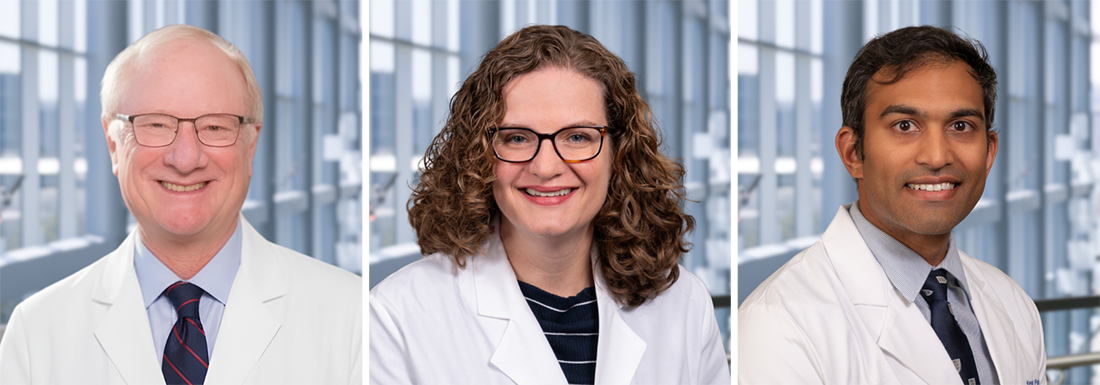
Cardiology Team Receives NASA-Backed Grant to Study Fontan Physiology and Spaceflight
Benjamin Levine, M.D., a Professor in the Division of Cardiology and Director of the Institute for Exercise and Environmental Medicine at Texas Health Presbyterian Hospital Dallas, Keri Shafer, M.D., an Associate Professor and Director of Adult Congenital Heart Disease, and Keval Patel, M.D., Ph.D., a fellow, all in the Division of Cardiology, have received a $150,000 catalyst grant from the Translational Research Institute for Space Health (TRISH) and NASA’s Human Research Program (HRP) to study patients who have undergone the Fontan operation as a model for long-duration spaceflight. For their project, “Fontan Circulation as a Terrestrial Model for Jugular Venous Flow Reversal,” they are joined by colleagues from the Canadian Space Agency, former postdoctoral fellow Eric Hedge, Ph.D., and Richard Hughson, Ph.D.
The Fontan operation is a lifesaving surgical procedure performed in children born with complex congenital heart defects and only one functioning pumping chamber. The procedure reroutes blood returning from the body directly to the lungs rather than through the heart, creating a unique circulation that operates without a dedicated pump to move blood through the lungs. This physiology leaves patients with chronically elevated venous flows to the upper body, one of the unique features of blood distribution during spaceflight that is very difficult to reproduce on Earth, especially for an extended period.
TRISH, a Baylor College of Medicine-led consortium that partners with the HRP, supports research aimed at advancing human health and performance during space exploration while accelerating discoveries that can benefit people on Earth. Researchers believe the physiology of patients who have undergone the Fontan procedure share important features with the cardiovascular changes that occur during prolonged exposure to microgravity.
“By studying this population, we hope to generate insights that could help protect astronaut health during extended space missions while also improving care for people living with Fontan circulation,” said Dr. Levine. ■
Dr. Levine holds the Distinguished Professorship in Exercise Medicine and the S. Finley Ewing Jr. Chair for Wellness and the Harry S. Moss Heart Chair for Cardiovascular Research at Presbyterian Hospital Dallas.
Study Examines Hospitals and Markets Selected for New Medicare Payment Model
A new study by researchers in the Division of General Internal Medicine found that the markets selected for Medicare’s Transforming Episode Accountability Model (TEAM), a mandatory bundled payment program for five common surgical procedures, closely resemble markets across the country. The researchers compared 186 TEAM markets and 727 participating hospitals with 618 nonparticipating markets and 2,155 hospitals.
The analysis, published in Population Health Management, showed that participating and nonparticipating markets were similar in many demographic, socioeconomic, and health care characteristics, including household income, educational attainment, Medicare Advantage enrollment, and prior experience with bundled payment programs. However, hospitals participating in TEAM were more likely to be teaching and safety-net institutions, have larger patient volumes and bed capacity, and operate with lower profit margins.
The findings suggest that TEAM may generate results that are broadly applicable across U.S. markets while expanding participation beyond hospitals that have traditionally taken part in voluntary bundled payment programs. ■