
News Highlights - June 2, 2026
Announcements

University of Cincinnati’s Stephanie Donnelly to Become Department Administrator
Stephanie Donnelly, M.B.A., has been named Department Administrator, bringing more than 20 years of healthcare administration experience spanning academic medicine, hospital operations, and physician practice management, effective July 13.
She will assume the role from Akela McDonald, M.H.A., who has served as interim Department Administrator since April 2025, providing steady leadership over the past 13 months. During that time, the Department’s classified staff grew 6.42%, from 685 to 729, and recruited 107 new faculty members.
Ms. Donnelly most recently served as Vice Chair for Operations and Finance and Executive Director of Business and Administration in the Department of Psychiatry and Behavioral Neuroscience at the University of Cincinnati College of Medicine. In this role, she led the department’s operational, financial, administrative, and strategic functions, overseeing a large, multidisciplinary enterprise of faculty and staff while managing a combined budget exceeding $54 million. Her work focused on advancing patient care, strengthening financial performance, and improving departmental productivity across clinical, research, and education missions.
Her earlier experience includes key leadership roles within the University of Cincinnati College of Medicine, where she served as a business administrator for divisions within Internal Medicine and led administrative and strategic initiatives supporting clinical service lines, fellowship programs, and research operations. She also held positions at Cincinnati Children’s Hospital Medical Center, where she managed clinical trials, grant funding, and financial operations, and developed expertise in regulatory compliance and global health programs.
Ms. Donnelly is recognized for her strength in financial and operational leadership, including budget development and oversight, revenue cycle management, strategic planning, and team development. Her experience leading complex, matrixed organizations and optimizing clinical and research operations positions her well to support the department’s mission and continued growth.
She holds a bachelor’s degree in business management from Franklin University in Columbus, Ohio, and a Master of Business Administration degree from Xavier University in Cincinnati. ■
Kudos

Wesson Appointed to State CKD Task Force
Texas Gov. Greg Abbott has appointed Donald Wesson, M.D., M.B.A., a Professor in the Division of Nephrology, to the state’s Chronic Kidney Disease (CKD) Task Force.
The Task Force was established to bring together nephrologists, nurses, dietitians, educators, and other experts from across Texas to assess how effectively CKD is being addressed across state agencies, health systems, and research efforts. The group advises state leaders on prevention, early screening, diagnosis, and management of kidney disease, while also supporting education for health care professionals on evidence-based clinical guidelines.
“Dr. Wesson’s appointment adds deep clinical and research expertise to the Task Force,” said Samir M. Parikh, M.D., Professor and Chief of the Division of Nephrology. “His work has advanced understanding of chronic kidney injury and informed strategies to slow disease progression, particularly through dietary and medical interventions. He also brings leadership experience in academic medicine and health care delivery, including efforts to improve kidney care at the population level.”
The Task Force’s work comes at a time when CKD remains a major and growing health challenge in Texas.
“More than 50,000 Texans receive dialysis, and thousands more are waiting for transplants, while many others are living with earlier-stage disease that often goes undiagnosed,” Dr. Wesson said. “The condition is frequently called a ‘silent disease’ because it can progress without symptoms until advanced stages.”
Recent findings from the Task Force’s 2025 biennial report highlighted the scale and urgency of this issue. Texas has one of the highest rates of end-stage renal disease (ESRD) in the country, with more than 80,000 affected patients and a growing burden over time. CKD is also closely linked to common conditions such as diabetes and hypertension, underscoring the need for earlier detection and better management of these risk factors.
The report emphasized several priorities, including expanding early screening programs, improving public awareness of kidney disease risk, and increasing access to care through telemedicine and community-based initiatives. It also called for strengthening partnerships with health systems and national organizations, supporting research and innovation, and encouraging organ donation to address transplant needs.
Another key recommendation focused on integrating new tools such as biomarker testing, artificial intelligence, and genetic screening into routine care to identify high-risk patients earlier and tailor interventions more effectively. ■
Dr. Parikh holds the Robert Tucker Hayes Distinguished Chair in Nephrology, in Honor of Dr. Floyd C. Rector, Jr., and the Ruth W. and Milton P. Levy, Sr. Chair in Molecular Nephrology.
Staff Members Take on New Roles
We congratulate the following staff members who recently took on new positions within the Department:
- Heather Burzlaff – Program Coordinator, Department Administration
- Iris De La Rosa – Clinical Research Assistant II, Pulmonary & Critical Care Medicine
- Cassandra Olvera – Sr. Administrative Associate, Department Administration
- Talitha Sackey – Accountant II, Department Administration
- Khyati Vadera – Population Science Project Coordinator III, Pulmonary & Critical Care Medicine
- Shangkui Xie – Temporary Staff Specialist, Pulmonary & Critical Care Medicine
- Yihun Zeleke – Temporary Staff Associate, Cardiology
Research Report
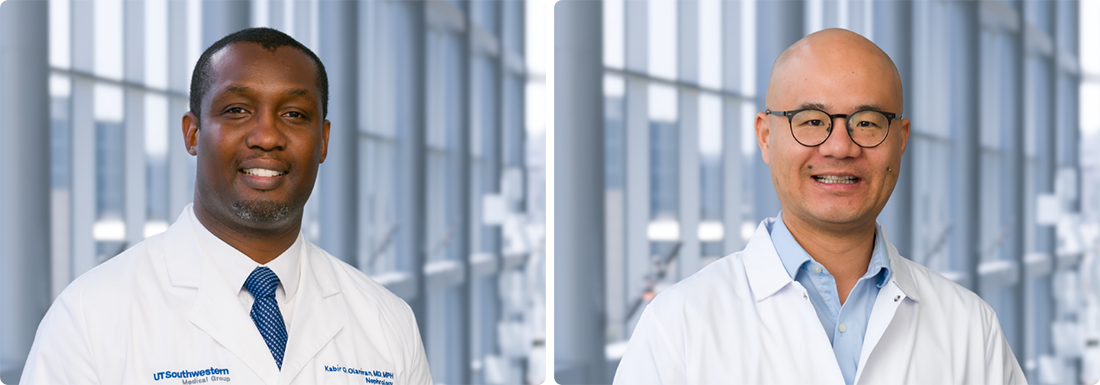
Olaniran, Ying Receive Early-Stage Research Grants
Two faculty members have received $50,000 Early-Stage Research Grants from The Cary Council to support new ideas aimed at improving care for people with chronic kidney disease and colorectal cancer.
Kabir Olaniran, M.D., M.P.H., an Assistant Professor in the Division of Nephrology, received funding for his project, “Novel Biomarkers for Early Detection and Prevention of Chronic Kidney Disease in People with Sickle Cell Disease.” His work focuses on finding early warning signs in the body, known as biomarkers, that could help doctors detect kidney disease sooner and prevent it from getting worse in people with sickle cell disease.
Dr. Olaniran earned his medical degree from the University of Lagos in Nigeria. He completed his internal medicine training at Lincoln Medical Center in the Bronx, where he also served as Chief Medical Resident. He then completed a nephrology fellowship at Harvard Medical School and earned a Master of Public Health degree in clinical effectiveness from the Harvard T.H. Chan School of Public Health. His clinical and research work focuses on kidney disease in people with sickle cell disease and sickle cell trait.
Binbin Ying, Ph.D., an Assistant Professor in the Division of Digestive and Liver Diseases and the Department of Biomedical Engineering, was awarded funding for his project, “An Electroadhesive Hydrogel Platform for Prolonging Local Treatment of Residual Colorectal Cancer after Radiation Therapy.” One of his research focuses is on developing soft, flexible biomaterials (hydrogels) that can gently stick to tissue. These materials could help deliver treatment directly to residual cancer cells that remain after radiation therapy, potentially improving results for patients. His goal is to make these materials stronger and more versatile, so they work better with the body and last longer.
Dr. Ying earned two bachelor’s degrees, one in mechanical engineering from Donghua University and another in international economics and trade from the Shanghai Institute of Foreign Trade. He received a master’s degree in biomedical engineering from Shanghai Jiao Tong University and a doctorate in mechanical engineering from McGill University. Before joining the UT Southwestern faculty, he was a Banting Postdoctoral Fellow in the laboratories of Giovanni Traverso, Ph.D., and Robert Langer, Sc.D., at the Massachusetts Institute of Technology and Brigham and Women’s Hospital. ■

Study Identifies How Bystander T Cells Enter the Brain and Drive Early Injury After Viral Infection
New research led by Jennifer Berger, Ph.D., an Instructor in the Division of Infectious Diseases and Geographic Medicine, shows how certain immune cells can quickly enter the brain after a viral infection and contribute to early damage.
Scientists have known that viral infections can cause inflammation in the brain and may be linked to problems like memory loss or cognitive decline. But it has not been clear how immune cells get into the brain so quickly or what role they play at the start of infection.
In the study, published in The Journal of Immunology, Dr. Berger and her colleagues found that T cells move into the brain within just a few days after infection. Many of these cells are not targeting the virus directly. Instead, they are “bystander” T cells. That means they are activated by general alarm signals from the immune system, not by recognizing the virus itself.
“These bystander T cells are drawn into the brain by signals released from immune cells that already live there or move in during infection,” Dr. Berger said. “These signals include IL-15 and interferons, which act like distress calls and pull more immune cells into the brain. Once there, the T cells become highly active and can damage nearby tissue.”
Dr. Berger, who led the study’s experiments and data analysis, showed that IL-15 plays a key role in this process. When IL-15 was removed in lab models, far fewer T cells entered the brain, and those that did were less active. When IL-15 was added on its own, it was enough to trigger T cells to move into the brain.
The researchers also found that these T cells can cause harm even when they are not helping control the virus. Reducing the number of these cells did not change how much virus was present early on, but it did reduce signs of damage in brain cells. This suggests that the body’s own immune response can contribute to injury.
Additional experiments showed that this process does not depend on T cells recognizing a specific virus. Even T cells trained to respond to a completely different virus were pulled into the brain and activated. This confirms that the response is driven by general immune signals rather than a targeted attack.
Together, the findings describe a new way the immune system interacts with the brain during infection. Signals such as interferons trigger the release of IL-15, which then draws in bystander T cells that can add to early inflammation and tissue damage.
The work highlights a possible new target for treatments aimed at reducing brain inflammation after viral infections.
Additional researchers from the Division of Infectious Diseases and Geographic Medicine who contributed to the study include Camille Merrick, a research associate, and J. David Beckham, M.D., Professor and Division Chief. ■
Dr. Beckham holds the Jay P. Sanford Professorship in Infectious Diseases.
Education & Training

Applications Open for Parkland Health Equity Fellowship
Applications are now being accepted for the Parkland Health Equity Fellowship, a two-year program designed to prepare physicians to lead efforts that improve care for underserved populations.
Offered through Parkland’s Center of Innovation and Value in partnership with the Division of General Internal Medicine, the fellowship provides immersive training at the intersection of clinical care, population health and health policy. The program is open to physicians who have completed residency training and are interested in advancing equity‑driven, value‑based care.
“The fellowship provides mentored training in health services research, population health and policy, along with opportunities to collaborate across disciplines and engage community partners,” said Arthur Hong, M.D., an Associate Professor in the Division of General Internal Medicine and Program Director. “Fellows also build skills in data analysis, communication and leadership while developing scholarly projects focused on measurable improvements in health outcomes.”
In addition to research and project work, fellows participate in structured didactics and seminars covering topics such as health policy, clinical innovation and healthcare financing. The curriculum is designed to help physicians understand and address the root causes of healthcare inequities while preparing them to drive system‑level change.
“The fellowship is a unique launchpad for future clinical leaders who are committed to improving care for the underserved,” Dr. Hong added. “We are looking for individuals who are brimming with ideas, and who are eager to use the best available evidence to identify and evaluate solutions for the systematic improvement of health and health care.”
Applicants interested in advancing their careers in equity‑focused, value‑based care are encouraged to explore the program and apply. ■