
News Highlights - May 26, 2026
Kudos
Four Faculty Selected as IDSA Fellows
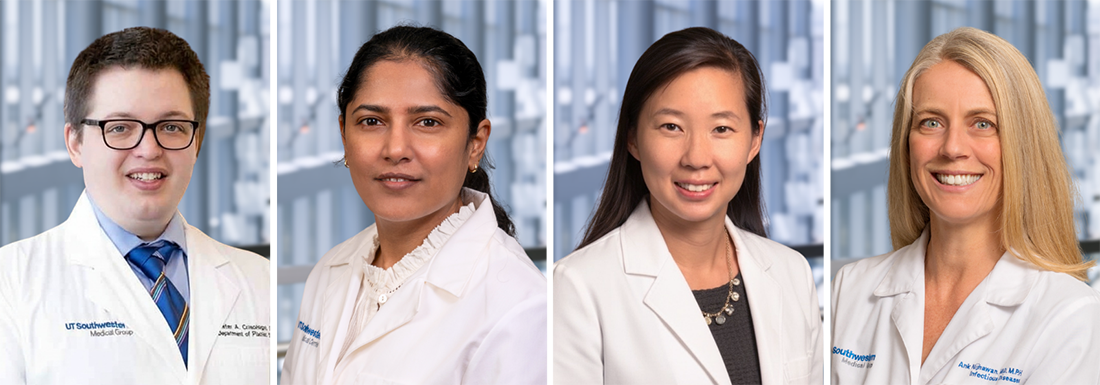
Peter "Andrew" Crisologo, D.P.M., Vidya Jagadeesan, M.D., M.B.B.S., Minji Kang, M.D., and Ank Nijhawan, M.D., M.P.H. (pictured, from left), have been selected as Fellows of the Infectious Diseases Society of America (IDSA). Candidates for fellowship must demonstrate significant service to the profession, and have local, regional, or national impact.
Dr. Crisologo earned his Doctor of Podiatric Medicine and Surgery at Des Moines University. He completed a residency in podiatric medicine and surgery with an added reconstructive rearfoot and ankle surgery credential at the Ohio State University Wexner Medical Center and later completed a fellowship in both diabetic limb salvage and research at UT Southwestern. He joined the faculty in 2022. His clinical and research interests focus on diabetic limb preservation, including medical and surgical treatment and management of lower extremity ulcerations and infections.
Dr. Jagadeesan earned her medical degree from the M.S. Ramaiah Medical College and Teaching Hospital in Bangalore, India. She completed internal medicine residency training at Greater Baltimore Medical Center in Baltimore, Maryland, where she also served as Chief Resident. She then obtained advanced training through fellowships in infectious diseases and in medical microbiology at the University of Utah in Salt Lake City, and in transplant infectious diseases at the University of Pittsburgh Medical Center.
Originally from Suwon, South Korea, Dr. Kang holds a bachelor’s degree in biological sciences from Cornell University in Ithaca, New York. She earned her medical degree at Sidney Kimmel Medical College in Philadelphia and completed internal medicine residency training at the University of Maryland Medical Center in Baltimore. She then obtained fellowship training in infectious diseases, infection prevention, and antimicrobial stewardship at the University of California San Diego. She joined the faculty in 2020 and currently serves as Associate Director of Infection Prevention at UT Southwestern.
Originally from The Netherlands, Dr. Nijhawan holds a bachelor’s degree in romance languages from Princeton University. She earned her medical degree at UT Southwestern, where she also completed internal medicine residency training. She received advanced training through a combined infectious diseases fellowship at Massachusetts General Hospital and Brigham and Women’s Hospital in Boston. She then pursued a clinical research fellowship at Brown University Miriam Hospital in Providence, Rhode Island. She also holds a master’s degree in public health from the Harvard School of Public Health. She joined the faculty in 2012. ■
Rajora Recognized by DaVita for Dialysis Care Leadership
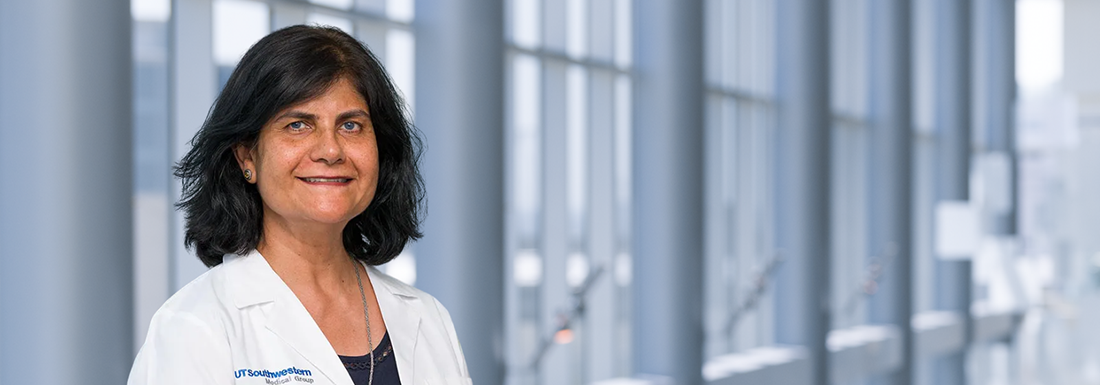
Nilum Rajora, M.D., a Professor in the Division of Nephrology, has been recognized by DaVita Kidney Care for outstanding clinical leadership at Dallas East Dialysis.
The recognition will be highlighted at DaVita’s upcoming Physician Leadership Meeting in Denver.
Dr. Rajora’s clinic earned distinction for its high performance in prescribing longer dialysis treatment times, specifically achieving strong adoption of four-hour hemodialysis sessions among patients. According to DaVita, this metric is a key indicator of quality and reflects both clinical leadership and patient-centered engagement.
In-center hemodialysis typically involves three treatments per week lasting about four hours each, a standard supported by clinical guidance and widely implemented across dialysis providers.
“Evidence shows that longer treatment times can have a meaningful impact on patient outcomes,” said Samir M. Parikh, M.D., Professor and Chief of the Division of Nephrology. “Research indicates that four-hour dialysis sessions improve toxin removal and allow for safer fluid management, reducing complications during treatment.”
Studies also associate longer dialysis durations with improved survival and lower hospitalization risk, underscoring the importance of adequate treatment time as a clinical priority.
“Despite these benefits, adoption can be challenging, as longer sessions require added time commitment for patients and sustained engagement from care teams,” Dr. Parikh added. “Nationally, shorter treatments remain common, even though evidence consistently links extended time on dialysis with better outcomes.”
DaVita leaders credited Dr. Rajora and the Dallas East Dialysis team with overcoming these barriers through physician leadership, patient education and team alignment. By increasing the number of patients receiving full-length treatments, the clinic has helped advance a care model that prioritizes both safety and long-term health outcomes. ■
Research Report

Link Co-Authors Study Advancing Risk Prediction in Hypertrophic Cardiomyopathy
Mark Link, M.D., a Professor in the Division of Cardiology, is a co-author on a large international study published in JAMAthat identifies new predictors of long-term outcomes in hypertrophic cardiomyopathy (HCM).
HCM is a common inherited heart condition and a leading cause of sudden cardiac death in younger people, but predicting which patients will develop life-threatening problems has been challenging. Current tools focus mainly on the risk of sudden cardiac death and do not always capture the full picture of disease progression.
In this study, researchers followed nearly 2,700 patients at 44 centers in North America and Europe for almost seven years. They combined several types of information, including medical history, heart imaging, and blood tests, to better understand what drives poor outcomes such as dangerous heart rhythms, heart failure, or the need for a transplant.
The study identified a few key factors that stood out. One of the strongest signals came from cardiac MRI scans, which can measure scar tissue in the heart. Patients with more scarring were more likely to have serious events. Researchers also found that higher levels of a blood marker called NT-proBNP, along with changes in heart size and function, were linked to greater risk.
“These findings matter for patient care because they point to a more complete way to evaluate risk,” Dr. Link said. “Instead of relying mostly on older scoring systems, clinicians can use imaging and lab tests to get a better sense of who may need closer monitoring or treatment.”
More accurate risk prediction could help doctors make better decisions about when to recommend interventions such as implantable defibrillators, which can prevent sudden death but are not necessary for every patient. It may also help identify patients who need more aggressive management of heart failure symptoms earlier in the course of disease. ■
Study Shows ‘Living’ Implant can Treat Joint Infection
Researchers at Harvard’s Wyss Institute have developed a new type of implant that can both detect and treat infection from inside the body, according to a study published in Science and co-authored by Alexander M. Tatara, M.D., Ph.D., an Assistant Professor in the Division of Infectious Diseases and Geographic Medicine at UT Southwestern.
The team designed an implantable “living material” that contains genetically engineered bacteria enclosed within a durable hydrogel scaffold. The material safely keeps the bacteria contained while allowing them to sense infection and release treatment when needed.
Unlike traditional drug delivery systems, which release medication on a fixed schedule, this system responds in real time. The engineered bacteria are programmed to detect signals from harmful microbes and then produce antimicrobial proteins on demand.
The researchers showed that the material could keep the bacteria safely confined for months while maintaining their function. In laboratory testing, the implant prevented bacterial escape even under mechanical stress and supported long-term viability of the engineered cells.
To test its effectiveness, the team used a mouse model of periprosthetic joint infection, a serious complication that can occur after joint replacement surgery. The implants detected the presence of Pseudomonas aeruginosa, a difficult-to-treat pathogen, and released therapeutic proteins that reduced bacterial burden at the infection site.
“This makes the implant both a biosensor and a treatment system in one,” said Dr. Tatara. “We developed a ‘living’ biomaterial where engineered bacteria can sense infectious organisms and then produce antimicrobial compounds. The surrounding material keeps the bacteria safely contained, so they can do their job without spreading. Using bacteria to fight bacteria is pretty neat.”
The authors say the platform could offer a new approach for treating infections associated with medical devices, where early detection and targeted therapy are critical. Because the system can be programmed with different genetic circuits, it may also be adapted for other diseases that require localized, responsive treatment. ■