
News Highlights - May 5, 2026
Announcements

UT Southwestern Establishes Will and Liza Lee Center for Liver Disease and Transplant Research
UT Southwestern has established the Will and Liza Lee Center for Liver Disease and Transplant Research, honoring the enduring contributions of William M. Lee, M.D., Professor Emeritus of Internal Medicine, and his wife, Elizabeth “Liza” Lee, M.A., a longtime leader in Dallas education. Made possible through the generosity of community friends, the Center launches at a pivotal moment, as chronic liver disease has become the second-leading cause of digestive disease-related death in the United States and continues to impose disproportionate burdens on patients across Texas.
The Center will advance research, accelerate therapeutic development, and expand care delivery for patients with hepatitis C, fatty liver disease, alcohol-related liver disease, and hepatocellular carcinoma. It bears the name of Dr. Lee, whose nearly four decades at UT Southwestern helped build one of the nation’s leading hepatology programs through landmark work in acute liver failure, viral hepatitis, and drug-induced liver injury, supported by continuous National Institutes of Health funding. His contributions have shaped clinical practice nationwide and were most recently recognized with the American Gastroenterological Association’s 2026 Distinguished Clinician Award in Academic Practice. The Center also honors Mrs. Lee’s influence as longtime Headmistress of The Hockaday School, reflecting the couple’s shared commitment to education, mentorship, and service.
Amit Singal, M.D., M.S., a Professor and Interim Chief of the Division of Digestive and Liver Diseases, Chief of Hepatology, and Medical Director of the Liver Tumor Program, has been named the Center’s inaugural Director. A nationally recognized leader in liver cancer and metabolic liver disease, Dr. Singal was mentored by Dr. Lee, underscoring the continuity of leadership and excellence the Center is designed to sustain and extend. ■
Dr. Singal is a Dedman Family Scholar in Clinical Care and holder of the Willis C. Maddrey, M.D. Distinguished Chair in Liver Diseases.

Elmquist Elected to National Academy of Sciences
Joel Elmquist, D.V.M., Ph.D., Professor and Vice Chair of Research, has been elected to the National Academy of Sciences (NAS), one of the highest honors for American scientists. Dr. Elmquist was elected by his peers in recognition of his distinguished and continuing achievements in original research.
Dr. Elmquist is recognized for transformative insights into how the brain regulates energy balance, glucose metabolism, and body weight. Using advanced genetic and neurobiological tools, his research has identified key neural circuits and hormones, including leptin and melanocortin pathways, that link the central nervous system to obesity, diabetes, and metabolic disease. This work has helped establish the brain as a critical driver of whole-body metabolic health and a potential target for new therapies.
“Election to the National Academy of Sciences is among the highest honors a scientist can receive, and it reflects the extraordinary impact Joel’s work has had on our understanding of metabolism and disease,” said Ezra Burstein, M.D., Ph.D., Professor and Interim Chair. “His discoveries have reshaped how the field thinks about the brain’s role in whole-body health.”
Dr. Elmquist’s election strengthens the NAS’s ability to carry out its mission, established more than 150 years ago by President Abraham Lincoln, to provide independent, science-based advice to the nation on critical issues. Membership in the Academy is reserved for researchers whose work has had a lasting impact on their fields and on the advancement of science in service to the public good.
Dr. Elmquist was among 120 U.S. and 25 international members announced on April 28.
Other members of the NAS with primary or secondary appointments in Internal Medicine, and the years they were elected, are: Michael Brown, M.D., and Joseph Goldstein, M.D., both in 1980; Helen Hobbs, M.D., 2007; Bruce Beutler, M.D., 2008; Donald Hilgemann, Ph.D., 2021; and Jonathan Cohen, Ph.D., 2022.
“It is especially meaningful to join so many UT Southwestern scientists whose work I have long admired,” Dr. Elmquist said. “I am grateful for the opportunity to contribute to science that ultimately aims to improve human health.” ■
Dr. Elmquist holds the Carl H. Westcott Distinguished Chair in Medical Research and the Maclin Family Distinguished Professorship in Medical Science, in Honor of Dr. Roy A. Brinkley.
Dr. Burstein holds the Berta M. and Cecil O. Patterson Chair in Gastroenterology.

Frye Becomes Director of Interventional Pulmonology
Laura Frye, M.D., an Associate Professor in the Division of Pulmonary and Critical Care Medicine, has been appointed Director of Interventional Pulmonology, succeeding Kim Styrvoki, M.D., who stepped down in February 2025.
Dr. Frye holds a bachelor’s degree from New York University. She earned her medical degree at the University of Kansas School of Medicine and completed internal medicine residency training at the University of Kansas Medical Center. She then received advanced training through fellowships in pulmonary and critical care medicine and advanced lung disease, both at the Hospital of the University of Pennsylvania in Philadelphia. In addition, she obtained fellowship training in interventional pulmonary at the Cleveland Clinic.
Prior to joining the UT Southwestern faculty in 2026, Dr. Frye served on the faculty at the University of Utah, where she was involved in both the thoracic oncology and transplant programs.
Dr. Frye’s clinical interests include complex airway disease, transplant pulmonology, and minimally invasive diagnostic and therapeutic pulmonary procedures. She specializes in advanced diagnostic and therapeutic bronchoscopy to diagnose and treat diseases of the airways, lungs, and pleura, as well as lung cancer screening and the management of pulmonary complications of cancer and cancer treatment. ■
Kudos

Dike-Noble Named A 2026 Patient Safety Star
Ogechi Dike-Noble, M.D., a Clinical Associate Professor in the Division of Hospital Medicine, was recognized by the UT Southwestern Health System as a Patient Safety Star during its Celebration of Excellence on Friday, May 1. The Patient Safety Star award recognizes individuals who advance safe, high-quality care through a commitment to learning from mistakes, teamwork, and creating a safe environment for patients, visitors, and staff. Awardees are honored across inpatient and outpatient settings in clinical staff, non-clinical staff, and provider categories.
Dr. Dike-Noble was recognized for her exceptional contributions to patient safety investigations and quality improvement. Her nominator cited her timely, thorough, and insightful reviews, noting her ability to synthesize complex clinical events, identify root causes, and deliver practical recommendations that prevent recurrence and strengthen systemwide safety processes. Her work has led to improved workflows, enhanced interdisciplinary communication, and stronger patient safeguards.
Colleagues also praised Dr. Dike-Noble’s collaborative leadership style and solutions-focused approach. Widely respected for her professionalism, integrity, and positivity, she exemplifies patient-centered care, accountability, and continuous improvement. Her impact continues to elevate investigative excellence and patient safety outcomes across the organization.
Originally from Newark, New Jersey, Dr. Dike-Noble holds a bachelor’s degree in biological sciences from Rutgers University. She earned her medical degree at the University of Medicine and Dentistry of New Jersey’s Wood Johnson Medical School in Piscataway, New Jersey. She then completed internal medicine residency training at Beth Israel Deaconess Medical Center in Boston.
Dr. Dike-Noble joined the UT Southwestern faculty in 2015. ■
Physician Advisor Group Wins Poster Contest
The UT Southwestern Physician Advisor Group was also recognized at the Celebration of Excellence Awards, winning in the Financial Performance category for its poster, “Optimizing P2P Denial Reviews: Implementing Batch Processing to Improve Efficiency and Overturn Rates.”
“This effort not only highlights how physician advisors continue to strive for the financial health of the health system, but it also shows innovation and reduced administrative burden on other faculty,” said Shweta Chowdhury, M.D., who established the Physician Advisor program, which has grown from one to 14 physicians in four years.
Additional poster contributors included Meron Kiros Weldeab, M.D., an Assistant Professor in the Division of Hospital Medicine and Physician Advisor Denials Lead; Cheryl Adams, M.B.A., Physician Advisor Program Manager; Stephanie Huckaby, D.N.P., RN-BC, NEA-BC, Decision Support, Utilization Management Manager. ■

Abraham Receives AAIM Educational Program Development Award
Reeni Abraham, M.D., a Professor in the Division of General Internal Medicine and Associate Vice Chair for Undergraduate Medical Education, received the Louis N. Pangaro, MD, Educational Program Development Award from the Alliance for Academic Internal Medicine during Academic Internal Medicine Week earlier this month.
This national honor recognizes Dr. Abraham’s innovative contributions to curriculum design, program development, and her leadership in advancing undergraduate and graduate medical education. Her work in advising students for residency has also been widely regarded at the national level, helping shape best practices that support medical students in their transition to residency. ■
Dr. Abraham holds the Nadine and Tom Craddick Professorship in Medical Education.
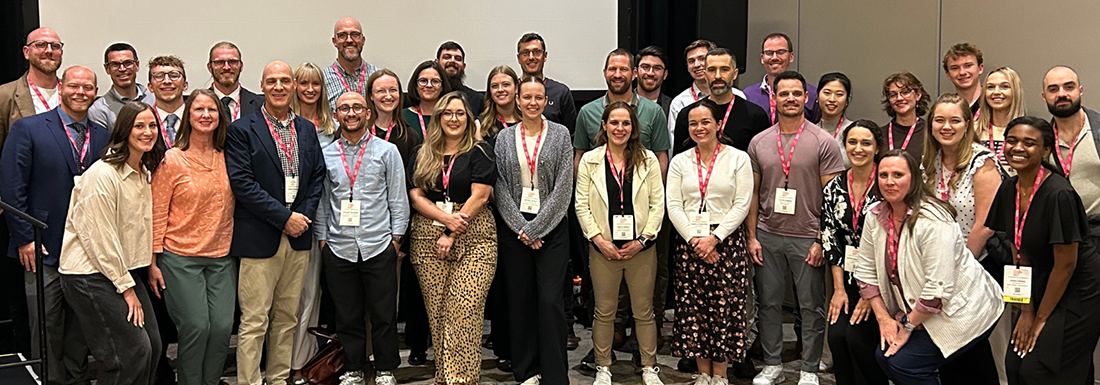
Crandall Receives Honor Award
Craig Crandall, Ph.D., a Professor in the Division of Cardiology and Director of the Thermal and Vascular Physiology Laboratory at the Institute for Exercise and Environmental Medicine at Texas Health Presbyterian Hospital Dallas, formally received the 2026 Honor Award from the Environmental and Exercise Physiology (EEP) section of the American Physiological Society (APS). The award recognizes his sustained contributions to environmental and thermal physiology, along with longstanding leadership and mentorship in the field.
Dr. Crandall, (front row, third from left) is pictured with members of his “scientific family tree” at the APS summit where he received the award. The group includes eight of the 29 UT Southwestern postdoctoral fellows he has served as primary mentor to, along with students mentored by those fellows and several third‑generation trainees. The photo reflects the breadth of Dr. Crandall’s mentorship and the lasting impact of his training legacy across multiple generations of scientists. ■
Staff Members Take on New Roles
We congratulate the following staff members who recently took on new positions within the Department:
- Brian Adamson – Lead Technical Support Specialist, Department Administration
- Whitney Abindu – Clinical Research Assistant II, Pulmonary & Critical Care Medicine
- Saurav Bhattacharya – Research Scientist, Digestive & Liver Diseases
- Sauche Eiland – Program Coordinator, Endocrinology
- Uma Gude – Lead Clinical Research Assistant, Pulmonary & Critical Care Medicine
- Daria Hoyer – Sr. Administrative Assistant II, Endocrinology
- Angad Kumar – Research Scientist, Digestive & Liver Diseases
- Elaine Konda – Sr. Research Dietitian, Endocrinology
- Jacy Mann – Manager of Education Programs, Instruction Administration
- Laonica Moore Jenkins – Administrative Associate, Hematology & Oncology
- Egzona Tan – Sr. Research Nurse, Cardiology
- Jay Carlo Vallente – Sr. Administrative Assistant II, Digestive & Liver Diseases
- Yu Wang – Lead Clinical Research Coordinator, Pulmonary & Critical Care Medicine
- Kira Weller – Research Technician II, Hypothalamic Research
Research Report

Merola, Weber and Colleagues Examine GLP‑1 Drugs in Psoriasis Care
A new review in JAMA Dermatology takes a close look at the growing interest in GLP‑1–based medications for people with psoriasis, a chronic inflammatory disease closely tied to cardiometabolic risk. Co-authored by Joseph Merola, M.D., M.M.Sc., Professor and Chair of Dermatology and a faculty member in the Division of Rheumatic Diseases, and Brittany Weber, M.D., Ph.D., an Assistant Professor in the Division of Cardiology and Director of the Cardio‑Rheumatology and Cardio‑Dermatology Program, the review was developed by the National Psoriasis Foundation Medical Board.
The authors explain that psoriasis is more than a skin condition. It is associated with higher rates of cardiovascular disease, obesity, type 2 diabetes, liver disease, and other systemic conditions. GLP‑1 receptor agonists, originally developed for diabetes and weight management, are now approved for several cardiometabolic indications that are common in patients with psoriasis. Emerging evidence suggests these medications may also improve psoriasis severity and quality of life, particularly in patients with obesity or diabetes, while lowering systemic inflammation.
The review summarizes small clinical trials and cohort studies showing improvements in skin disease activity alongside weight loss, better metabolic control, and reductions in inflammatory markers. While the findings are promising, the authors stress that most studies to date are limited by small sample sizes and short follow-up. Larger randomized trials are ongoing to better define when and how GLP‑1–based therapies should be used in psoriatic disease.
“For internists, the takeaways are practical.” Dr. Weber said. “Psoriasis should be recognized as a marker of elevated cardiometabolic risk, even when patients present primarily with skin symptoms.”
GLP‑1 therapies prescribed for diabetes or obesity may offer added benefits for psoriasis and systemic inflammation, but they are not yet approved specifically for skin disease.
“Coordination among primary care, dermatology, cardiology, and rheumatology is key, particularly when managing cardiovascular risk, medication selection, and monitoring for adverse effects,” Dr. Merola added. ■
Medicare Advantage Expands At-Home Benefits, But Gaps Remain
A new study published in the Journal of General Internal Medicine finds that Medicare Advantage plans are slowly expanding benefits that help older adults live safely at home, but access remains limited and uneven. A research group led by Jessica Billig, M.D., an Assistant Professor in the Division of General Internal Medicine, reviewed plan data from 2020 to 2025 and found that the share of Medicare Advantage plans offering at least one support for aging at home, such as caregiver support, home safety modifications, or in-home services, grew from about 15 percent to 31 percent over that period. Enrollment in those plans also increased, reaching about 14.7 million people in 2025.
Despite that growth, the study found major gaps. No plans offered a full set of aging-in-place benefits during the six-year study period, and fewer than 1 percent offered four or more of these services in any given year. Even when benefits were available, they were often not offered consistently from year to year, and many plans required cost-sharing that could make services hard to afford. “Older adults in Medicare Advantage may still struggle to access reliable, affordable support to remain independent at home,” Dr. Billig said. “We need stronger policies to encourage broader and more consistent coverage of these benefits.”
Other General Internal Medicine researchers who contributed to this study are Shining Yang, M.S., biostatistician; Jennifer Cardin, M.Sc., clinical research assistant; Joseph Joo, M.D., M.S., Assistant Professor; and Joshua Liao, M.D., M.Sc., Professor. ■