
News Highlights - April 14, 2026
Kudos
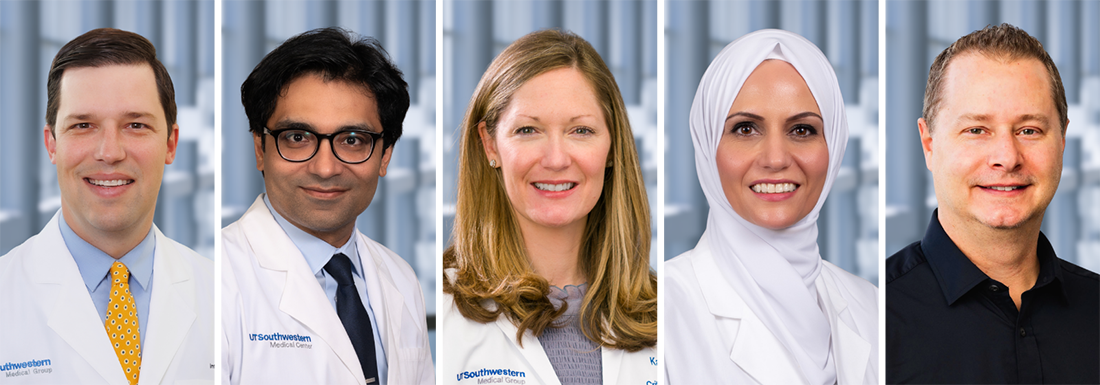
Faculty Assembly Appointments Include Five from Internal Medicine
Thirty-five faculty members from the Medical School, the Graduate School, the School of Health Professions and the Peter O’Donnell Jr. School of Public Health have been appointed to UT Southwestern’s newly established Faculty Assembly, including five members from Internal Medicine.
The Faculty Assembly will serve as an advisory body to institutional leadership and is designed to ensure faculty engagement in accordance with Regents’ Rules and Texas Senate Bill 37. Members were selected following an open self-nomination process available to full-time faculty in good standing across all tracks and ranks. Department chairs reviewed nominations and forwarded them to the Provost Leadership Team, which made recommendations to the UTSW president for final selection.
Internal Medicine appointees include, from left, James “Brad” Cutrell, M.D., a Professor in the Division of Infectious Diseases and Geographic Medicine, who will serve as co-chair of the Faculty Assembly. Other members are Salman Allana, M.D., an Assistant Professor in the Division of Cardiology; Kara Goss, M.D., an Associate Professor in the Division of Pulmonary and Critical Care Medicine; Sawsan Rashdan, M.D., an Associate Professor in the Division of Hematology and Oncology; and Jim Stimpson, Ph.D., who holds a secondary appointment as a Professor in the Division of General Internal Medicine. ■
Dr. Cutrell is a Distinguished Teaching Professor.

Kera Plays Key Role in AHA’s Updated Dietary Guidance
Amit Khera, M.D., a Professor in the Division of Cardiology, Clinical Chief of Cardiology and Director of Preventive Cardiology, served as vice chair of the dietary guidance writing committee for the American Heart Association’s updated scientific statement on heart healthy eating, released last month.
The 2026 statement, published in the journal Circulation, updates the Association’s 2021 dietary guidance and outlines nine core features of a heart healthy dietary pattern shown to reduce cardiovascular disease risk across the life span. As vice chair, Khera helped guide the review and synthesis of the latest nutrition science, emphasizing overall dietary patterns rather than single foods or nutrients and reinforcing the importance of sustainable, culturally adaptable eating habits beginning early in life.
The guidance highlights diets that are rich in fruits, vegetables and whole grains; prioritizes plant-based protein sources and unsaturated fats; and recommends limiting ultra-processed foods, added sugars and sodium. It also reiterates that people who do not drink alcohol should not start, and those who do should limit intake. The statement reflects growing evidence that lifelong dietary habits play a role in preventing heart disease, which affects nearly half of U.S. adults, according to the American Heart Association. ■
Dr. Khera holds the Dallas Heart Ball Chair in Hypertension and Heart Disease.
Research Report
Wakeham Receives NIH Pathway to Independence Award

Denis J. Wakeham, Ph.D., a postdoctoral researcher in the Division of Vascular Medicine and the Institute for Exercise and Environmental Medicine (IEEM), has received a Pathway to Independence (K99/R00) award from the National Heart Lung Blood Institute at the NIH. The five-year grant will support his assessment of the adverse hemodynamic and end-organ consequences of descending thoracic aortic aneurysms and their repair.
Dr. Wakeham’s mentors for the project are Benjamin Levine, M.D., Professor in the Division of Cardiology and Founding Director of the IEEM at Texas Health Presbyterian Hospital Dallas, Satyam (Tom) Sarma, M.D., an Associate Professor in the Division of Cardiology and Co-Director of the Cardiovascular Physiology Autonomic Function Laboratory at the IEEM, Michael D. Nelson, Ph.D., a Professor in the Department of Kinesiology at The University of Texas at Arlington and affiliate faculty within the Division of Cardiology, and Joshua Beckman, M.D., Professor and Division Chief of Vascular Medicine and Executive Clinical Director of Cardiovascular Services at UT Southwestern.
Dr. Wakeham holds a bachelor’s degree in sport and exercise science from the University of South Wales in Pontypridd, Wales, and a master’s degree in cardiovascular science and genetics from University College London, in England. He received his doctoral degree in cardiovascular physiology from Cardiff Metropolitan University in Cardiff, Wales, before joining UT Southwestern in 2021. ■
Dr. Beckman holds the Gayle and Paul Stoffel Distinguished Chair in Cardiology. Dr. Levine holds the Distinguished Professorship in Exercise Sciences and the S. Finley Ewing Chair for Wellness and the Harry S. Moss Heart Chair for Cardiovascular Research at Texas Health Presbyterian Dallas.

Kong Receives $3.5M NIH Grant to Investigate Celiac Disease
Xiao-Fei Kong, M.D., Ph.D., an Assistant Professor in the Division of Digestive and Liver Disease, has been awarded two NIH grants to support his research on characterizing the genetic risks of celiac disease. The first is a five-year R01 grant to study a new genetic disorder that predisposes individuals to heightened gastrointestinal inflammatory responses, with the aim of better characterizing the immunological impact of this genetic illness and advancing precision treatment. The second is a two-year R03 grant to develop novel approaches that use population and familial genetic data to facilitate risk stratification for celiac disease screening and management.
“These projects involve multiple co-investigators, collaborators, and advisors from across UTSW, reflecting the breadth of expertise available on campus to address this disease,” Dr. Kong said. “Dr. Shang Ma from the Children’s Research Institute collaborates on mouse model studies, Drs. Michelle Alkalay from Children’s Health and David Fudman from the Division of Digestive and Liver Diseases contribute to clinical enrollment, Drs. Zhikai Chi and Mingyi Chen from Pathology provide expertise in pathological interpretation, and Drs. Ezra Burstein and Helen Hobbs serve in advisory roles to help advance these projects.”
Celiac disease is a common gastrointestinal problem affecting about 1% of the population. The chance of developing celiac disease was 10 times higher in family members if one of the first-degree relatives was diagnosed, causing an enormous health and economic burden.
In his research lab, Dr. Kong explores celiac disease, inflammatory bowel disease, inborn errors of immunity, and rare liver diseases. His previous work led to the discovery of several new genetic diseases, including human SPPL2A deficiency, inherited STAT1 disorders and interferonopathy in Down Syndrome. ■
Dr. Burstein holds the Berta M. and Dr. Cecil O. Patterson Chair in Gastroenterology. Dr. Hobbs holds the Dallas Heart Ball Chair in Cardiology Research.

Automated Insulin Technology Shows Promise for People with Type 2 Diabetes
A new study by Marconi Abreu, M.D., an Associate Professor in the Division of Endocrinology and Medical Director of the Parkland General Endocrinology Clinic, and colleagues suggests that automated insulin delivery systems can significantly improve blood sugar control for people with Type 2 diabetes who require insulin.
The study, published in Diabetes Care, analyzed data from nine clinical studies involving more than 1,500 adults with Type 2 diabetes and found that automated insulin systems increased the amount of time patients spent with blood glucose levels in a healthy range by about 16 percentage points. On average, that translated to nearly four additional hours per day with blood sugar levels between 70 and 180 milligrams per deciliter.
The researchers also found that participants experienced an average reduction in hemoglobin A1c of 1.27 percentage points, a clinically meaningful improvement associated with lower risk of diabetes-related complications. Mean blood glucose levels dropped by about 21 milligrams per deciliter. These gains occurred without increases in severe low blood sugar episodes, body weight or daily insulin dose.
“These results show that automated insulin delivery can lead to substantial improvements in glucose control for people with Type 2 diabetes while minimizing some of the barriers that come with traditional insulin therapy,” Dr. Abreu said.
AIDs have long been considered standard care for people with Type 1 diabetes, but their use in Type 2 diabetes has been more limited. The new analysis suggests these technologies can benefit a broader population, particularly people who need insulin but face challenges such as frequent injections, fluctuating glucose levels or fear of hypoglycemia. ■
Addison and Colleagues Address Heart with Novel T-Cell Immunotherapies
Daniel Addison, M.D., an Associate Professor and Director of Translational Research in the Division of Cardiology, co-authored a new article in Nature Reviews Cardiology highlighting emerging concerns about the heart-related side effects of T cell–based cancer immunotherapies, treatments that have transformed care for patients with various blood cancers and solid tumors.
The article examines how therapies designed to activate the immune system against cancer can simultaneously stress the cardiovascular system. While T-cell immunotherapies, including chimeric antigen receptor T-cell therapy (CAR-T) and bispecific antibody therapy (BsAb), have achieved remarkable success in treating difficult to treat cancers, their powerful immune activation can trigger inflammation that affects the heart.
“One of the most significant drivers of heart complications is cytokine release syndrome, an intense inflammatory reaction that can occur after T cell therapies,” Dr. Addison said. “In severe cases, this response has been linked to abnormal heart rhythms, heart failure, and reduced heart function.”
While not all patients experience these events, the authors note that cardiovascular complications are more common in patients who develop severe inflammatory reactions early after treatment.
“Careful monitoring and early recognition of heart-related symptoms are essential as the use of T cell immunotherapies continues to expand,” Dr. Addison said.
The researchers emphasize that most patients do not have traditional contraindications to receiving these treatments. But these patients benefit from proactive and individualized cardiovascular assessment before, during, and after these cancer treatments Improved collaboration between oncologists and cardiologists, an approach central to the field of cardio-oncology, is key to reducing risk and improving outcomes.
The review also outlines current strategies to manage and prevent cardiotoxicity, including the use of anti-inflammatory therapies and targeted medications when severe immune reactions develop. The authors point to a growing need for more research and practical clinical guidelines addressing this toxicity, as T-cell therapies move into broader use and are tested in earlier stages of cancer. ■
Dr. Addison holds the Audre and Bernard Rapoport Chair in Cardiovascular Research.
Kuppalli Joins World Experts to Co-Author Review on Mpox
Krutika Kuppalli, M.D., an Associate Professor in the Division of Infectious Diseases and Geographic Medicine, co-authored a review article that highlights the global impact of mpox. The article, published in Nature Reviews Microbiology, presents a comprehensive review of mpox, examining its historical emergence, global spread, and the factors driving its transition from a neglected tropical disease to a recognized global health threat.
The review traces mpox from its early history as a neglected tropical disease to its spread as a global public health emergency. Dr. Kuppalli and her colleagues, many of whom are recognized as the world’s leading experts in mpox, summarize what is known about the monkeypox virus, including how it replicates and how different strains, known as Clades I and II, have spread over time. The authors focus on the 2022 global outbreak and the 2023–2024 Clade Ib outbreak in Eastern Africa. The article also outlines symptoms, testing, clinical management, and available tools such as vaccines and treatments
“This article describes the challenges facing global response efforts, such as limited vaccine access in resource-limited settings, gaps in diagnostics, and the need to integrate mpox prevention into existing HIV and sexually transmitted infection programs,” Dr. Kuppalli said. “Sustained surveillance, equitable access to countermeasures, and Africa-led research are essential to preventing mpox from becoming a permanently entrenched global disease.”
Dr. Kuppalli’s co-authors included lead author Dimie Ogoina, M.B.B.S., Nigeria’s leading authority on mpox and a globally recognized infectious diseases expert, who was named to Time’s 100 in Health in 2023; Placide Mbala, M.D., M.Sc., a Congolese virologist, epidemiologist, and physician-scientist, recognized on Nature’s 10 list of people who shaped science in 2024 and Time‘s 100 in Health in 2025; Inger Damon, M.D., Ph.D., one of the world’s foremost experts on orthopoxviruses and former Director of the Division of High-Consequence Pathogens at the CDC; and Jake Dunning, M.B.B.S, Ph.D., Director of the NHS England High-Consequence Infectious Disease Network and a physician‑scientist known for bridging front-line clinical care with outbreak research and response. ■
Education & Training

Abraham to Present Plenary on Residency Application Process
Reeni Abraham, M.D., a Professor in the Division of General Internal Medicine and Associate Vice Chair for Undergraduate Medical Education, will deliver a plenary address next week at the Alliance of Academic Internal Medicine annual meeting in Seattle. Drawing on her national leadership in medical education and advising, Dr. Abraham will present “Transparency in the Application Process: What Does Holistic Review Mean for Your Learners,” a session that underscores her long-standing work at the intersection of learner development, program mission, and workforce preparation.
During her discussion, Dr. Abraham will examine how educators can promote a shared understanding of the intersection of mission, resource stewardship, and readiness as it applies to the residency application process. The talk will also highlight best practices to help applicants identify and articulate their values and career goals so they can more intentionally target residency programs aligned with those priorities. Additionally, the session will provide updates on the AAIM Residency Application Process Taskforce and its working groups, reflecting Dr. Abraham’s ongoing role in shaping transparent, data-informed approaches to holistic review that resonate with both UME and GME stakeholders. ■
Dr. Abraham holds the Nadine and Tom Craddick Professorship in Medical Education.