
News Highlights - March 24, 2026
Kudos

UT Southwestern Achieves Heart Transplant Milestone
UT Southwestern’s heart transplant program has achieved a landmark moment, completing its 1,000th transplant last week. The patient, recipient No. 1,000, is recovering well and has been discharged home.
The milestone reflects nearly four decades of collaboration among transplant coordinators, nurses, perfusionists, cardiac surgeons, cardiologists, and many others whose expertise and dedication have shaped the program’s success since the first heart transplant at UTSW took place in 1988.
“We are grateful to the 1,000 donors and their families whose generosity made these lifesaving procedures possible,” said Matthias Peltz, M.D., a Professor of Cardiovascular and Thoracic Surgery and Surgical Director of Cardiac Transplant.
“Each transplant represents a life renewed and a family restored,” said Nicholas Hendren, M.D., an Assistant Professor in the Division of Cardiology and Interim Section Chief of Heart Failure, Left Ventricular Assist Device, and Heart Transplantation Programs. “This achievement highlights the team’s sustained commitment to exceptional patient care and to advancing possibilities in cardiac transplantation.” ■
Education & Training

Department to Welcome New Residents in July
The results of the National Resident Matching Program (NRMP) Match were revealed on Friday, March 20. Of the more than 779 applicants interviewed by Internal Medicine, those who matched were from 41 different medical schools (including three international institutions).
Prior to the creation of the NRMP Match in 1952, residency recruitment was often chaotic, with hospitals competing for medical students and making offers earlier and earlier in training. Students frequently felt pressured to accept quickly, sometimes within hours, without the chance to explore their options. The introduction of the Match brought needed structure by allowing applicants and programs to rank one another, creating a fairer and more deliberate process. The system has continued to evolve as applications have increased, including the addition of preference signaling to help identify genuine interest.
Beginning in July, the Department will welcome new residents who matched in the following programs:
- 47 Categorical
- 15 Community & Population Health Track
- Seven Preliminary
- One Internal Medicine-Geriatrics
- 15 Physician-Scientists
- Four Internal Medicine-Pediatrics
- Two Internal Medicine-Psychiatry
“This year’s Match reflects the excellence of our programs and the dedication of our recruiting team,” said Salahuddin “Dino” Kazi, M.D., a Professor in the Division of Rheumatic Diseases, Vice Chair of Education, and Director of Residency Training. “The incoming class brings curiosity, drive, and a deep commitment to service. We’re excited to guide their growth and watch them shape the future of medicine.”
Dr. Kazi also noted that this year’s recruitment cycle was among the strongest the program has recorded.
“To fill 47 categorical positions, we matched applicants drawn from only the top third of our rank order list," he said. “This is a level of competitiveness that reflects the program’s continued national appeal.”
Regarding UTSW’s medical students, it was another excellent year with all IM applicants, both categorical and preliminary, finding positions in the Match.
“We are incredibly proud of the UT Southwestern graduating class of 2026! We had 62 students match into highly competitive internal medicine residency programs across the country. We are especially thrilled to have 22 of our best and brightest students staying on here to train at UT Southwestern, with an additional five UTSW students staying on as preliminary IM interns,” said Reeni Abraham, M.D., a Professor in the Division of General Internal Medicine, Head of Fashena College, and Associate Vice Chair for Undergraduate Medical Education. “None of this would be possible without supportive departmental leadership, dedicated IM course directors and the talented faculty and housestaff who have inspired these future physicians on their IM rotations. We are also extremely lucky to have an experienced IM Residency Advising Committee. Through active involvement in national residency application innovations, including program signaling, collaborating with the AAMC, and departmental structured evaluation letter initiatives, this team ensures our students receive the most current guidance and are exceptionally well positioned for success.” ■
Global Health Pathway Debuts with Trainees Gaining Hands-On Experience in Zambia
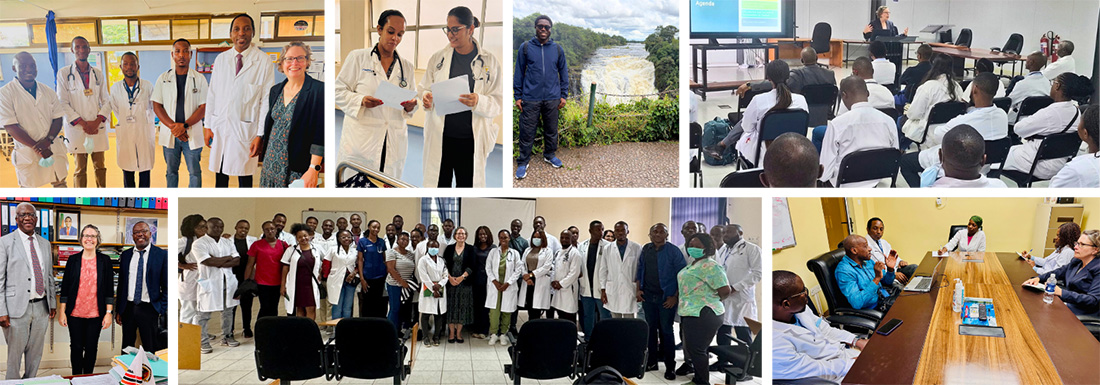
A new Global Health Pathway in the Internal Medicine Residency Program is already reshaping how trainees view patient care. Its first residents recently returned from a rotation in Lusaka, Zambia, where days spent in busy wards and clinics offered a direct view of medicine delivered with limited resources and unwavering resilience.
An academic agreement with the University of Zambia (UNZA) in Lusaka, facilitated by Fiona Strasserking, M.D., an Assistant Professor in the Division of Cardiology, and Roger Bedimo, M.D., a Professor in the Division of Infectious Diseases and Geographic Medicine, enabled third-year residents Yadonay Engeda, M.D., and Justin Lagbo, M.D., to complete a clinical rotation at University Teaching Hospital (UTH).
Both residents described the month as highly formative, offering exposure to resource-constrained care and conditions rarely encountered in North Texas.
Calling the rotation “a transformative experience,” Dr. Lagbo said he witnessed firsthand the resilience of communities and the impact of healthcare deliveries in resource-limited settings. “It deepened my understanding of health disparities and ignited my passion for working towards equitable solutions for all.”
Dr. Engeda noted that the rotation broadened her clinical approach. “It expanded my clinical perspective and deepened my appreciation for cost- and resource-conscious care,” she said. “Working in both inpatient and outpatient settings allowed me to participate directly in patient care while also gaining insight into system-wide efforts to improve access, coordination, and outcomes in the community.”
Christiana Renner, M.D., M.S., an Associate Professor in the Division of Hospital Medicine and Associate Program Director for the residency, spent one week in Lusaka meeting with faculty and leadership at UNZA and UTH, including Evans Mpabalwani, M.B.Ch.B., M.Med., M.Sc., Dean of the University of Zambia School of Medicine. She rounded with the renal transplant, cardiology, and infectious disease teams, seeing patients with conditions ranging from postoperative renal transplant complications to multidrug-resistant tuberculosis and cerebral malaria. She also attended the hepatitis B clinic and delivered two lectures on clinical reasoning to faculty and registrars.
Dr. Renner expressed gratitude for the hospitality of UNZA and UTH partners, including hepatologist and Internal Medicine Department Head Edford Sinkala, M.B.Ch.B., M.Med; infectious disease physician Sombo Fwoloshi, M.B.Ch.B., M.Med. M.Sc.; and immunologist Patrick Lungo, M.B.Ch.B., M.Med., Ph.D.; and for the candid conversations with trainees about challenges faced during medical training.
UNZA and UTH leaders are exploring further collaboration with UT Southwestern in medical education, quality improvement, and patient safety. ■
Research Report

Vongpatanasin Co-Authors Study that Assessed the Role of Heart-Healthy Strategies on Cognition in Older Adults
A new clinical trial published in JAMA Neurology co-authored by Wanpen Vongpatanasin, M.D., a Professor in the Division of Cardiology and Director of its Hypertension Section, provides important insights for clinicians treating older adults at elevated risk for dementia. The study, published in JAMA Neurology and led by Rong Zhang, Ph.D., a Professor in the Department of Neurology and the Institute for Exercise and Environmental Medicine at Texas Health Presbyterian Hospital Dallas, randomized 513 adults ages 60 to 85 who had a family history of dementia, subjective concerns about their memory, or hypertension, factors that collectively signal higher long‑term cognitive vulnerability. Participants were randomized to aerobic exercise training, intensive vascular risk reduction (via intensive blood pressure lowering and high-intensity statin treatment), a combination of the two, or usual care, and were observed over a 24‑month period.
The researchers found that while participants across all groups showed small improvements in cognitive test scores over time, neither exercise alone, intensive vascular risk reduction alone, nor the combination of the two produced better cognitive outcomes than usual care. The findings suggest that although these interventions are proven to benefit cardiovascular health, they did not translate into measurable cognitive improvements over the 24‑month period studied.
“The cardiovascular response to both interventions was exactly what we hoped to see,” Dr. Vongpatanasin said. “But short‑term cognitive change is harder to influence, and this trial shows that even well‑structured programs may not produce detectable gains over two years. Nevertheless, the use of high-intensity statin therapy in older adults without history of cardiovascular disease in our study did not result in worsening of cognitive function or cognitive disturbances, as suggested by case reports and some observational studies that had resulted in an FDA warning in 2012.”
The findings reinforce the importance of setting appropriate expectations when prescribing exercise or aggressive risk‑factor management for patients concerned about cognition. While these strategies remain foundational for cardiovascular health, their cognitive benefits may require longer treatment windows, younger intervention ages, or a multidomain approach that includes diet, cognitive training, and vascular management.
“As cardiologists, we routinely prescribe blood pressure and lipid control to protect the heart,” Dr. Vongpatanasin said. “This study reminds us that the brain may need even longer exposure, or additional strategies, before we see a measurable cognitive impact.” ■
Dr. Vongpatanasin holds the Fredric L. Coe Professorship in Nephrolithiasis Research in Mineral Metabolism; Norman and Audrey Kaplan Chair in Hypertension.
La Hoz Receives Funding to Study HHV-8 Infection in Organ Donation
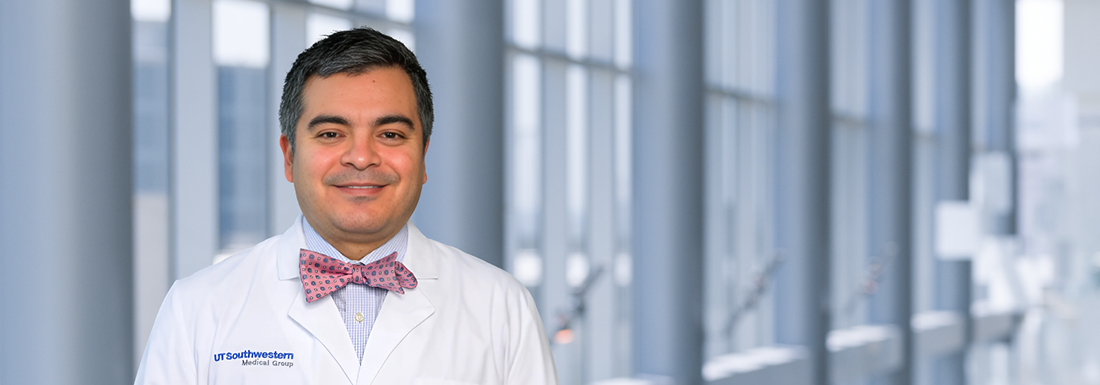
La Hoz Receives Funding to Study HHV-8 Infection in Organ Donation Ricardo La Hoz, M.D., an Associate Professor in the Division of Infectious Diseases and Geographic Medicine and Director of the Transplant Infectious Diseases Program, has received funding from the Mendez National Institute of Transplantation Foundation to support a multicenter study titled, “Defining the Burden of HHV-8 in Organ Donation: Prevalence and Risk Factors.” “Human herpesvirus-8 (HHV-8), the etiologic agent of Kaposi sarcoma, is an important but poorly characterized pathogen in solid organ transplantation,” said Dr. La Hoz. “Although donor-derived HHV-8 transmission has been reported and can result in severe complications in transplant recipients, the prevalence of HHV-8 infection among deceased organ donors in the U.S., and the associated donor risk factors, remains largely unknown.” This study will collaborate with multiple organ procurement organizations (OPOs) to systematically evaluate the prevalence of HHV-8 infection among deceased donors and identify demographic and clinical factors associated with infection. The findings will provide important data to better define the epidemiology of HHV-8 in the donor population and will help inform future strategies for donor screening, risk stratification, and prevention of donor-derived HHV-8 transmission in transplantation. ■
Need to Know
GIM Research Staff Launches Statistical Support
The Division of General Internal Medicine has launched Internal Medicine Program for Analytic Consultation and Translation (IMPACT), an initiative to accelerate research projects across the Department by providing analytic support to investigators, particularly during the early stages of research development.
Led by Arthur Hong, M.D., an Associate Professor in the Division of General Internal Medicine, IMPACT offers expert guidance on study design, including sample sizing, protocol development, and dataset selection. It also assists investigators in crafting Statistical Analysis Plans to support high-quality data analysis. Additionally, IMPACT’s analytic staff will help draft and review the Methods and Results sections for peer-reviewed manuscripts, and preliminary analyses for grant applications.
IMPACT will prioritize requests intended for peer-reviewed or grant-related deliverables and cannot provide staffing for long-term or already-funded projects. IMPACT is also not designed to support data cleaning, regulatory management, or qualitative research. ■
Personnel Updates
Davis, Edwards Named Classified Affairs Coordinators
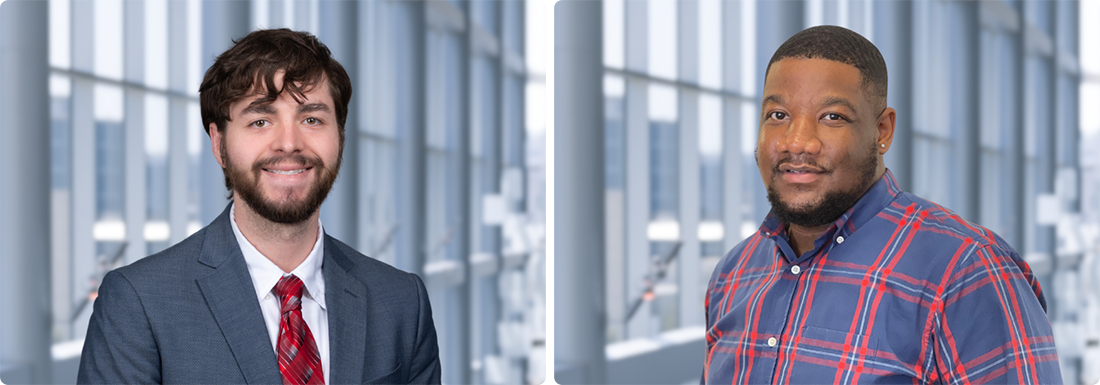
Joshua Davis, M.B.A., and Michael Edwards have joined the Administration Office as Classified Staff Coordinators, with responsibility for HR-related requests and position management.
Mr. Davis, left, holds a bachelor’s degree in marketing from Southeastern Louisiana University and a Master of Business Administration degree with a specialization in finance from Louisiana State University Shreveport. He brings experience in financial analysis, budget preparation, workflow optimization, and organizational planning, along with a background in human resources from his role as an HR Representative for Tangipahoa Parish Government. In that capacity, he managed hiring and onboarding, led managerial training sessions, developed salary plans and occupation studies, handled employee relations and policy development, and oversaw employment activities for approximately 500 employees, all of which position him well to support classification, position management, and HR‑related inquiries.
Mr. Edwards has a background in administrative operations, program coordination, and process improvement, with experience supporting multiple functional areas at UT Southwestern. In his previous role with the Education Administration team, he coordinated educational programs, managed budgets, maintained detailed records, oversaw onboarding processes, and supported scheduling, logistics, and operational workflows. His experience with PeopleSoft HCM and Financials, MedHub, QGenda, and other enterprise systems, paired with his work evaluating program operations, managing records, and coordinating employment‑related activities, equips him to assist in HR processes, documentation, and position management. ■