
In Memoriam: Albert Roberts
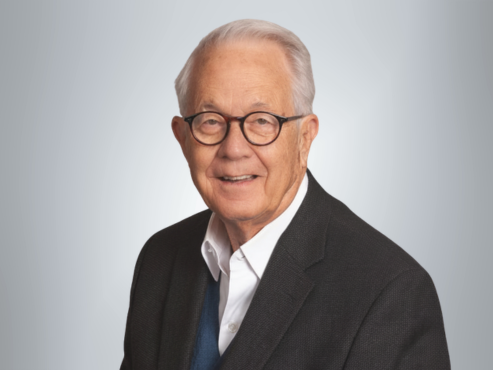
Albert Roberts, M.D., a Professor Emeritus in the Division of Nephrology and a pioneer in dialysis treatment for people with kidney disease, died on Friday, May 22. He was 96.
Dr. Roberts, who trained at UT Southwestern and served in multiple faculty positions dating back to the late 1950s, was also a renowned researcher, an Army doctor, a respected teacher, and a TV personality who helped translate complex medical topics for a public audience.
“Dr. Roberts was a physician’s physician who exemplified how the art of practice must go hand in hand with the science of medicine,” said Daniel Podolsky, M.D., President of UT Southwestern. “He formed lasting relationships with his patients, serving not only as their doctor, but as a counselor, adviser, and friend.”
In 1959, Dr. Roberts initiated the hemodialysis service at Parkland Memorial Hospital and conducted laboratory research in nephrology under the supervision of UT Southwestern’s Donald Seldin, M.D., and Floyd C. Rector, M.D. The following year, he entered private practice in Dallas, establishing the hemodialysis service at Baylor University Medical Center, where he also taught the nephrology course for Internal Medicine residents. His work helped shape the early clinical infrastructure for dialysis services in North Texas and influenced a generation of trainees.
“Across decades of service as a physician, educator, and leader, Dr. Roberts helped advance nephrology, strengthen graduate medical education, and extend the reach of academic medicine into public life,” said Ezra Burstein, M.D., Ph.D., Professor and Interim Chair of Internal Medicine. “He will be remembered for his clarity of purpose, steady leadership, and enduring commitment to patients, learners, and colleagues.”
From 1978 to 1981, Dr. Roberts appeared in more than 50 episodes of Here’s to Your Health, a PBS program that was broadcast nationally and reflected his commitment to education beyond the clinic and classroom.
Dr. Roberts was a member of the original medical staff of what is now Texas Health Presbyterian Hospital Dallas, playing a central role in developing the first Internal Medicine residency curriculum. In 1975, he was appointed Associate Dean for Postgraduate Education at UT Southwestern, extending his influence on medical training and academic leadership. In 1983, he returned to private practice while continuing to serve UTSW as Associate Dean and Professor of Internal Medicine. In 1987, he resumed full-time private practice and maintained his role as a Clinical Professor.
Dr. Roberts was deeply engaged with the American College of Physicians (ACP). From 1976 to 1987, he served as a Governor, Regent, and Vice-Chair of the Board of Regents, contributing to national physician leadership and policy development. During this period, he also participated in the creation of the Healthscope television series. In recognition of his enduring contributions, he was elected a Master of the ACP in 1990 and received the Laureate Award from the Texas Chapter in 1995.
In 1991, Dr. Roberts returned to UT Southwestern full time as Professor of Internal Medicine and Associate Dean for Practice Development. From 1994 until 2004, he held the Tim and Toni Hartman Professorship in Medicine, a role that reflected both distinction and trust in his leadership.
In 2004, a gift from Jean and Tom Walter established the Walter Family Distinguished Chair in Internal Medicine, in Honor of Albert D. Roberts, M.D.
Dr. Roberts earned his bachelor’s degree at Southern Methodist University and received his medical degree from UT Southwestern, where he also completed internal medicine residency training and served as Chief Resident, followed by fellowship training in nephrology. His medical training was paused for two years of military service at Fort Dix, New Jersey, an experience that reflected his early commitment to service.
Albert Dee Roberts Jr. was born on March 7, 1930, in Fort Worth to Albert Dee Roberts Sr., a surgeon, and Irene Burnett Lewis, a homemaker. He had three younger brothers, all of whom preceded him in death. He was married for 73 years to Diane Truett, who survives him. Together, they raised three children, Truett (Caroll), Hillary Roberts Marx (Robert), and Brenda (d. 2009).
---
Dr. Burstein holds the Berta M. and Cecil O. Patterson Chair in Gastroenterology.
Dr. Podolsky holds the Philip O’Bryan Montgomery, Jr., M.D. Distinguished Presidential Chair in Academic Administration and the Charles Cameron Sprague Distinguished Chair in Biomedical Science.