
Search
Drive-up site provides safe, efficient testing for hundreds of patients - CT Plus - UT Southwestern
https://www.utsouthwestern.edu/ctplus/stories/2020/covid-drive-through.html
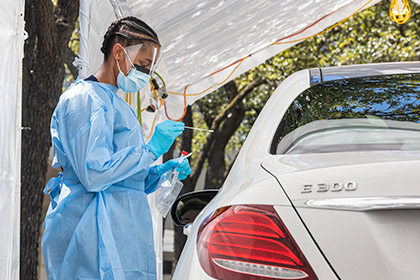
Each day, vehicles pull up to white tents erected outside the Bass Administrative and Clinical Center as patients arrive for COVID-19 testing. When the windows roll down, UT Southwestern nurses and staff do all they can to communicate empathy and quiet confidence through shielded eyes to ease the apprehension they can often see and feel.
Q&A with Dr. Elan D. Louis, Chair of Neurology and Neurotherapeutics - CT Plus - UT Southwestern
https://www.utsouthwestern.edu/ctplus/stories/2020/neurology-chair.html
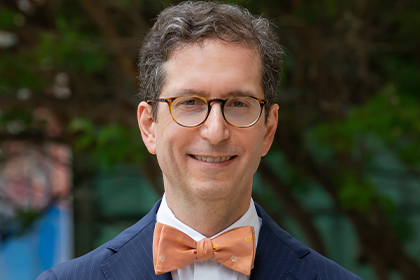
Dr. Elan D. Louis joined UT Southwestern as Chair of Neurology and Neurotherapeutics. Considered by many to be the world’s leading scholar on tremor disorders.
Online patient scheduling now available 24/7 - CT Plus - UT Southwestern
https://www.utsouthwestern.edu/ctplus/stories/2020/online-scheduling.html
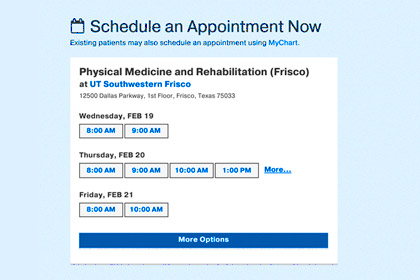
Last November, UT Southwestern began to phase in online scheduling with a first round of about 100 physicians. During its initial three months, more than 800 patients did just that, and 25 percent of them used the service after 5 p.m. or on the weekend.
UTSW expands virtual care during pandemic - CT Plus - UT Southwestern
https://www.utsouthwestern.edu/ctplus/stories/2020/covid-telehealth.html
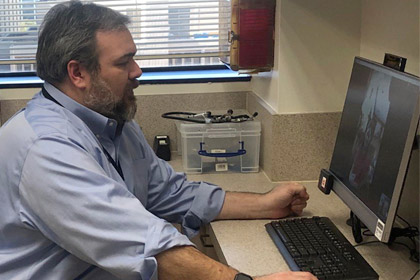
A physician huddled close to his desktop monitor, waiting for the next patient to appear on the computer screen. As with any new technology, there is a learning curve for both patient and provider that may include a spotty virtual connection or fine-tuning speaker volume or camera settings.
'This is My Why': UT Southwestern nurses share what motivates them - CT Plus - UT Southwestern
https://www.utsouthwestern.edu/ctplus/stories/2020/nurses-week.html
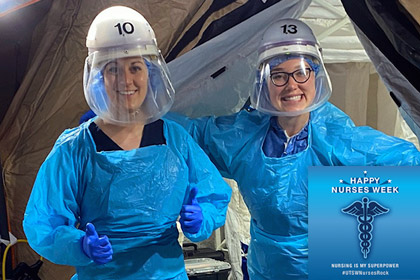
For every path we choose, there is a “why” we set out on it – a person who inspired us, a moment that defined our choices, a consideration that set us in the direction we chose to walk. In celebration of Nurses Week, May 6-12, we reached out to a cross-section of UT Southwestern nurses who work every day to embody the institution’s values of excellence, innovation, teamwork, and compassion as they care for UTSW patients and contribute to important research. We asked each to share their personal “why” with us. They filmed and penned the following responses to inspire our community.
In Memoriam: Green Center for Reproductive Biology Sciences - UT Southwestern, Dallas, Texas
https://www.utsouthwestern.edu/departments/green-center/who-we-are/in-memoriam/mendelson.html
Remembering Carole Mendelson, Ph.D., Professor of Biochemistry and Obstetrics and Gynecology, and a member of the Cecil H. and Ida Green Center for Reproductive Biology Sciences at the University of Texas Southwestern Medical Center.
UTSW chaplains provide comfort and hope to families of COVID-19 patients - CT Plus - UT Southwestern
https://www.utsouthwestern.edu/ctplus/stories/2020/chaplains-covid.html

For UTSW’s hospital chaplains, the COVID-19 pandemic is changing daily routines as well.
Research: Oral and Maxillofacial Surgery - UT Southwestern, Dallas, Texas
https://www.utsouthwestern.edu/departments/surgery/divisions-sections/oral-maxillofacial-surgery/research.html
Research opportunities exist both within and outside the Division of Oral and Maxillofacial Surgery, clinical scientists, and career scientists.
Bringing ‘black box’ technology to the operating room - CT Plus - UT Southwestern
https://www.utsouthwestern.edu/ctplus/stories/2020/or-black-box.html
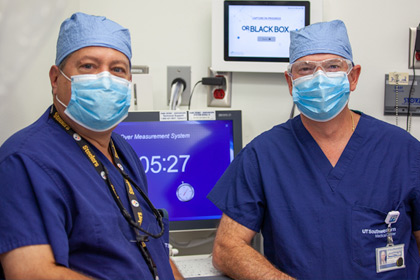
In August, UT Southwestern became the second hospital in the United States to begin using the OR Black Box system in its operating rooms. Developed by Surgical Safety Technologies Inc. (SST) in Toronto, the OR Black Box is installed in five operating rooms at William P. Clements Jr. University Hospital, where cameras, microphones, and links to patient monitors have been installed.
Meet the Chief: Division of Bariatric and Foregut Surgery - UT Southwestern, Dallas, Texas
https://www.utsouthwestern.edu/departments/surgery/divisions-sections/bariatric-foregut/chief.html
Meet the division chief of the Division of Bariatric and Foregut Surgery at UT Southwestern Medical Center in Dallas.