
Orphan Drug Boosts Radiation Therapy
UT Southwestern ❘ Discovery@UTSW 2026 ❘ P12–13 Orphan Drug
Researchers find that an orphan drug holds promise in boosting efficacy of radiation in non-small cell lung cancer.
For decades, lung cancer has been one of medicine’s toughest opponents. Radiation therapy can slow the disease, but delivering curative doses without harming nearby organs, such as the heart and esophagus has remained out of reach. But as lung cancer cells fight back, they rewire their metabolism to repair DNA damage from radiation and survive.
Blocking an Escape Route
That metabolic adaptation sparked an idea for Yuanyuan Zhang, M.D., Ph.D. Several years ago, when she was a resident doing research in the laboratory of Ralph DeBerardinis, M.D., Ph.D., who was at the time Professor in Children’s Medical Center Research Institute at UT Southwestern (CRI), she decided to screen for metabolic pathways that help cells resist radiation therapy.
Using CRISPR gene editing, Dr. Zhang started by switching off thousands of metabolism-related genes in non-small cell lung cancer (NSCLC) cells, one gene in each cell, and exposing them to radiation. One pathway stood out: lipoylation, a key molecular modification critical to metabolism.
As Dr. Zhang transitioned to the role of Assistant Professor of Radiation Oncology, she and her mentor asked a bold question: Could blocking this metabolic escape route make radiation more effective in killing lung cancer cells?
A Key Discovery
In research with their colleagues, the pair showed that a lipoylation inhibitor compound, designated by the Food and Drug Administration (FDA) as an orphan drug, boosted the effects of radiation in NSCLC cells. Their findings, published in Science Advances, suggest a new way to halt DNA repair in NSCLC, the most common form of lung cancer and one of the most difficult to treat.
“This study was motivated by the challenges faced by millions of lung cancer patients undergoing radiation therapy, where treatment-related toxicities limit both curative potential and the patient’s quality of life,” says Dr. Zhang, a radiation oncologist who specializes in lung cancer treatments.
Dr. DeBerardinis, a Howard Hughes Medical Institute Investigator since 2018 and now Director of the Eugene McDermott Center for Human Growth and Development, is a pioneer in cancer metabolism research. Studies from his lab have identified many metabolic processes that allow lung cancer cells to survive, grow, and spread. In this study, blocking lipoylation led to widespread metabolic changes in cancer cells, but a key discovery was that one altered metabolite, L-2-hydroxyglutarate (2-HG), impaired DNA repair and made tumor cells more sensitive to radiation.
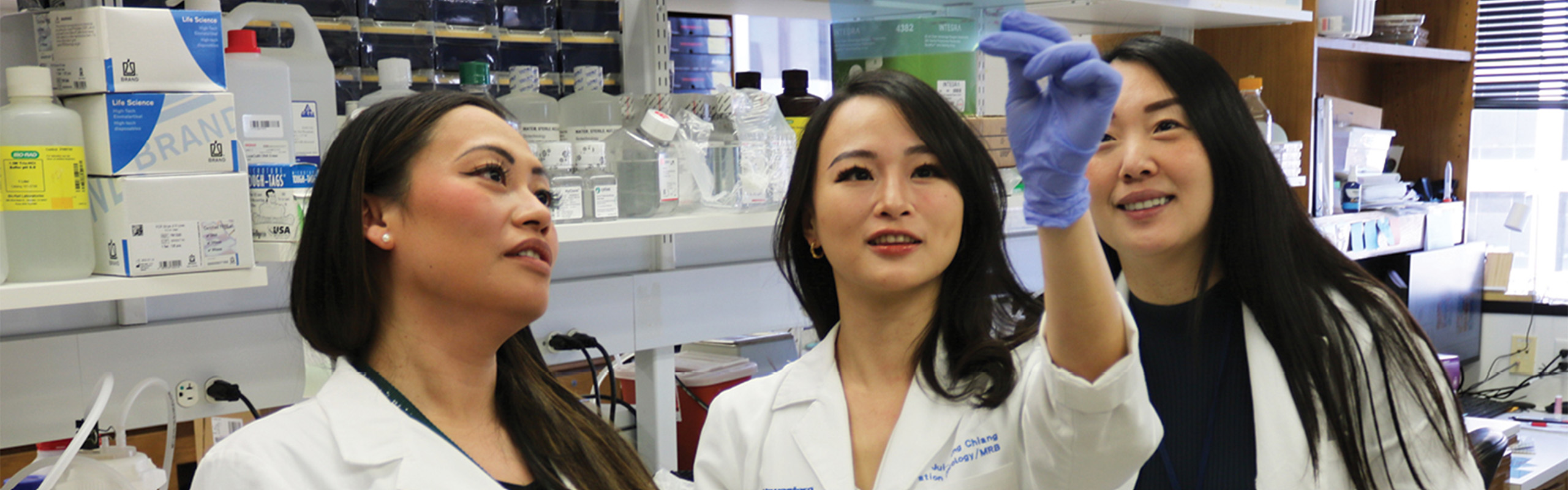
Jui-Chung Chiang, Ph.D., a postdoctoral fellow in Dr. Zhang’s Lab and the study’s first author, made significant contributions to help uncover how 2-HG affects homologous recombination, a process that cells use to fix damaged DNA, in cancer models of lipoylation deficiency.
Deploying an Orphan Drug
Enter CPI-613 (Devimistat), an investigational anticancer drug that inhibits lipoylation. The FDA issued orphan drug status for CPI-613 several years ago. Orphan drugs are used to treat rare conditions and come with certain incentives to encourage their development given their small patient population. On its own, CPI-613 has shown little success. Ongoing studies elsewhere suggest it may boost the sensitivity of cancer cells when combined with various chemotherapy medications.
For Drs. Zhang and DeBerardinis, the question was obvious. What if the drug were paired with radiation treatments? The team put the theory to the test in cancer cell lines and mouse models. As expected, CPI-613 alone didn’t slow tumor growth. But when combined with radiation, the results were striking. Tumors shrank faster and cancer cells lost their ability to recover.
“This study demonstrates for the first time that inhibiting lipoylation enhances lung cancer cells’ response to radiotherapy, offering a clinically translatable strategy using a clinically tested drug,” Dr. Zhang says. “Metabolic disturbances and genome instability are both key hallmarks of cancer, yet the connection between the two is still not fully understood. Our study, along with ongoing follow-up work, suggests that the mitochondrial lipoylation pathway can directly shape genome stability, which has important implications for cancer development and treatment.”
CPI-613 has already proved to be well tolerated in clinical trials, with few severe side effects for patients. Dr. Zhang is planning further studies to evaluate its efficacy and toxicity.
Further Implications
And the implications go beyond lung cancer. The team believes this approach is worth testing in other tumor types, paving the way for therapies tailored to a cancer’s unique metabolic fingerprint.
“Dr. Zhang’s work demonstrates the value of studying different kinds of metabolic disease together,” says Dr. DeBerardinis, who is also co-leader of the Cellular Networks in Cancer Research Program in the Harold C. Simmons Comprehensive Cancer Center and Director of the Genetic and Metabolic Disease Program at CRI. “Our experience with genetic defects in the lipoylation pathway in children helped us recognize the effects of lipoylation blockade in cancer cells and how these might relate to radiation therapy.”
For Drs. Zhang and DeBerardinis, this breakthrough reflects more than scientific ingenuity. It underscores UT Southwestern’s culture of collaboration.
“We bring together clinicians and basic scientists to work side by side, exploring open-ended cancer questions,” says Carlos L. Arteaga, M.D., Director of Simmons Cancer Center. “This research is turning molecular insights into patient-focused solutions.”