
Glow Getters
UT Southwestern ❘ Discovery@UTSW 2026 ❘ P6–9 Bench to OR Feature
Working together, a bioengineer and a surgeon at UTSW are lighting the way to a new era in cancer treatments with fluorescent nanotechnology and breathtaking clinical trial results.
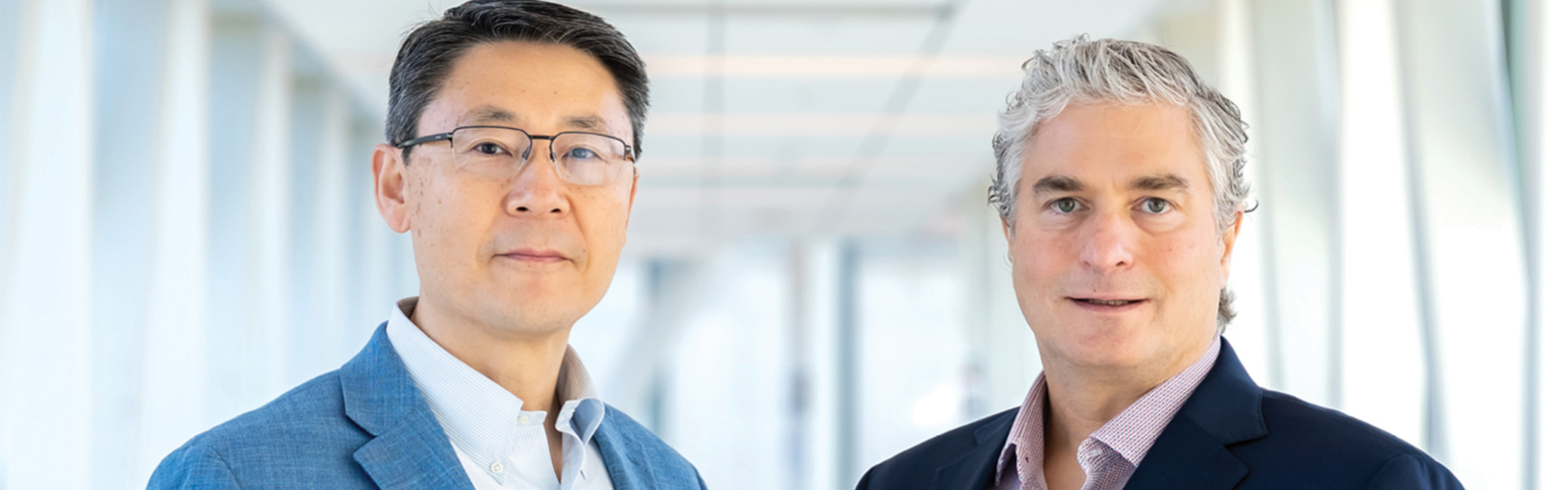
A partnership between Professors Jinming Gao, Ph.D., a chemist and biomedical engineer, and Baran Sumer, M.D., a head and neck cancer surgeon, combines nanotechnology and surgery to identify and remove cancer with extreme, unprecedented precision.
Their cross-disciplinary collaboration began nearly 20 years ago with a probing question: What if we could make cancer cells “light up” or “glow” so we could see exactly where the tumors are and more completely remove them? The answer to that came first in Dr. Gao’s lab with the discovery of what they now call the “fluorescent nanoprobe” and then in the operating room, where Dr. Sumer deployed the discovery, first in animal models and later in human patients. The results were eye-opening.
A Fast-Tracked Discovery
Delivered to patients via an IV prior to surgery, the nanoprobe – a pH-sensitive imaging agent called pegsitacianine – circulates through the body and “digitizes” acidic signals from cancer cells, making them glow under near-infrared light. Although human eyes can’t see that glow, surgical cameras or goggles developed at UT Southwestern can, and Dr. Sumer is currently testing different versions of those for effectiveness.
So promising were early results that the U.S. Food and Drug Administration (FDA) fast-tracked the fluorescent nanoprobe as an adjunct for visualization of metastases in the peritoneal cavity (space in the abdomen that contains the stomach, liver, and intestines). In 2023, the FDA awarded Drs. Gao and Sumer’s work its Breakthrough Therapy designation. In addition, the real-time imaging agent has been licensed by OncoNano Medicine, Inc., which Drs. Gao and Sumer co-founded.
Clinical trials showed the enhanced visibility provided by the fluorescent nanoprobe enabled surgeons to remove cancer cells throughout the abdomen at 50% to 60% higher rates than standard cancer imaging technology. Importantly, the nanoprobe was also able to detect cancer not visible on either CT or PET scans. Equally and perhaps even more importantly, Drs. Gao and Sumer designed their nanoprobe to be “tumor agnostic,” meaning it’s capable of seeking out and fluorescing cancer cells anywhere in the body.
Seeking a Partnership
The scientific partnership between Drs. Gao and Sumer began 18 years ago, when Dr. Sumer, after completing a fellowship in head and neck oncologic surgery at Washington University in St. Louis, was looking for his first job. He sought out UT Southwestern and Dr. Gao in particular.
“I wanted to work with someone who was an expert in nanotechnology, and Dr. Gao was known for it,” Dr. Sumer says. “We started working together immediately when I joined.”
And they haven’t looked back since.
“Our collaboration has endured over time,” Dr. Gao says. “It exemplifies the lasting value of sustained partnership and its importance in innovation across disciplines. Having Dr. Sumer’s clinical guidance was critical.”
Extraordinary Results
Given the early success of the fluorescent nanoprobe, Drs. Gao and Sumer received approval for and launched the ILLUMINATE Study in March 2024, a clinical trial designed specifically to gauge pegsitacianine’s efficacy for head and neck cancer. The phase two trial is scheduled to continue through 2027.
The study has two main goals: to assess how well the nanoprobe performs in finding cancer in areas such as the throat, salivary glands, and sinuses and, crucially, to ascertain how well it can find otherwise undetectable primary cancers where the disease first began. So far, with 60 patients participating and the hope of doubling that number by study’s end, the trial has yielded extraordinary results, finding 15 of 16 unknown primary cancers.
“The success rate is very gratifying because it means those patients may not need radiation,” Dr. Sumer says. “Or, if they do, it’s going to be very targeted because now we know where this cancer originated.”
Building on ‘Bench to Bedside’
The ILLUMINATE Study is a prime example of collaborative science and medicine at UT Southwestern. In fact, it builds on the phrase “bench to bedside,” taking discoveries from the lab, translating them to clinical applications for patients, and returning to the lab, where it is now yielding even more vital research for the future of the fluorescent nanoprobe, according to Dr. Gao.
“We’ve collected over 1 million cells for analysis from our patient samples, and now we have a much deeper understanding of how the nanoprobe is fluorescing in the tumor environment,” he says. “Our work is leading to discoveries in head and neck cancer and also basic science.”
Fundamental studies of tumor metabolism and vasculature cues for nanoparticle activation are helping researchers in the Gao and Sumer Lab to expand their discoveries. “We’re now developing newer nanoparticles to even more specifically and efficiently light up the tumors,” Dr. Gao says.
A Wow Factor
Even as their ILLUMINATE Study is at its halfway point, Drs. Gao and Sumer are involved in future plans that could and should further their fluorescent nanoprobe’s benefit to health care. One potential path is using the fluorescent images and videos they’ve gathered to train an artificial intelligence-based algorithm to both assist in surgical excision and help train novice surgeons in fluorescence-guided surgery. Another path is to adapt the technology to produce a nanovaccine that initiates an immune response against non-resectable, metastatic cancer.
“There are a lot of ideas behind the technology platform we created,” Dr. Gao notes. “The versatility and potential impact in patient care are fantastic.”
“It definitely has a wow factor,” Dr. Sumer agrees. “Patients participating in the trial are especially interested in seeing their post-surgery videos.”
“After their procedure I’ll ask them if they want to discuss the cancer, and so often they say, ‘No, no, no – did it fluoresce? Was it green? Show me the video! There’s my tumor, glowing green, and you took it out!’” he adds. “It’s very visceral, and their response is yet another gratifying part of this work.”