
How small muscles make a big impact for athletes at any level
Core exercises to improve strength and balance benefit Olympians and weekend warriors alike, UTSW expert says
DALLAS – Feb. 18, 2026 – The world’s top competitors in the 2026 Winter Olympics, which continue through Feb. 22, may offer a valuable lesson to those seeking to improve their workouts or just get more active. While these elite athletes are performing at a peak level on a global stage, it’s the work they put in behind the scenes during training and conditioning that really sets them up for success.
Everyone, even nonathletes, can benefit from building up core muscles, improving balance, and practicing good form and posture, said Donald Kasitinon, M.D., Assistant Professor of Physical Medicine and Rehabilitation (PM&R) and Orthopaedic Surgery at UT Southwestern Medical Center and Medical Director for PM&R Sports Medicine.
“Building and maintaining muscle mass through strength training and nutrition is crucial for athletic performance, longevity, metabolic health, and, most importantly, functional independence,” said Dr. Kasitinon, who specializes in musculoskeletal and sports injuries.
Here are some tips and simple exercises to guide your workout routines and improve your range of motion.
Ace those abdominals
The muscles spanning your torso and hips make up your core. They are crucial for balance, muscle control, and overall mobility. They are also common sites for injury. In many cases, injuries are not caused by trauma or high-impact sports but from everyday wear and tear.
Working on core conditioning will help you level up your endurance, muscle control, and overall mobility. What’s more, studies show that adding core stability exercises can help reduce the risk of knee injury, such as a torn anterior cruciate ligament (ACL), and support better and faster ACL recovery.
“A strong core serves as the foundation for all movements as a stable spine, pelvis, and torso prevent injury, reduce back pain, and allow efficient force transfer between the upper and lower body,” Dr. Kasitinon said.
Try these beginner exercises:
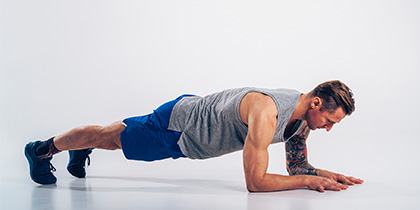
Plank
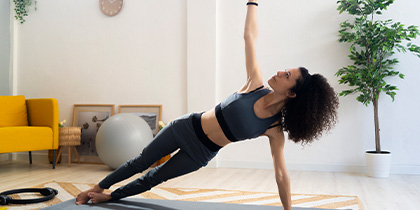
Side Plank
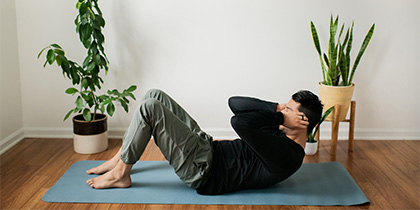
Curl-Up
- Planks: Lie flat on the floor, facing downward, keep your feet together, lift yourself to balance on your elbows and toes, and hold the position for 5-10 seconds. To challenge yourself, lift one leg for a few seconds at a time.
- Side planks: Start in the prone plank pose, turn to face one side, lift yourself on that elbow or hand while keeping your hip and knees aligned, and hold that position for 5-10 seconds.
- Curl-ups: Lie on your back with knees up and feet flat on the floor, lift your head and shoulders with arms crossed against your chest. Repeat in sets of 10.
It’s all in the hips
The muscles that make up your lumbar-pelvic region play a crucial role in all manners of movement: running, walking, and even moving your arms and upper body. The hips and the muscles around them are responsible for weight distribution and load bearing on joints. They are important for balance, posture, and stability – important areas of focus for athletes or anyone with an active lifestyle.
Research shows that the strength of your hip muscles, specifically the hip abductors and external rotators, stabilizes the knees and helps prevent leg injuries, such as hamstring or ACL tears.
“Like a strong core, strong gluteal muscles are integral for stability, posture, and power, which in turn prevent back, hip, and knee injuries and enable efficient movement for daily activities like walking and climbing stairs as well as athletic performance like running and jumping,” Dr. Kasitinon said.
Try these beginner exercises:
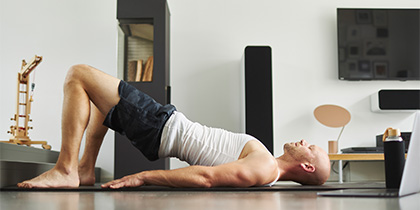
Bridge
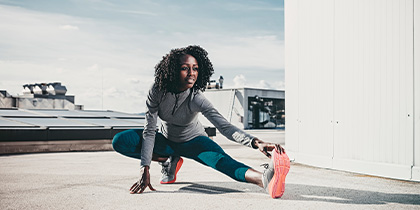
Side Lunges
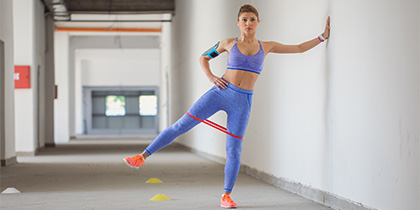
Standing Hip Abductions
- Bridge: Lie on your back with your arms by your side, keep your knees bent and feet flat on the ground, and lift your hips until they line up with your shoulders and knees; hold for several deep breaths.
- Side lunges: Take a step to the right, bend the right leg, lower your hips while keeping your left leg straight. Stand up. Repeat with the other side.
- Standing hip abductions: Stand up straight, keep your feet shoulder-width apart, and lift one leg at a time to the side while keeping your head and shoulders upright. You may hold onto a chair or wall for balance.
Perfect your balancing act
The body is like a fine-tuned machine equipped with high-tech motion sensors adapted to help navigate its surroundings. It is sometimes described as your “sixth sense” of bodily awareness, in which special sensory receptors in the muscles, tendons, and inner ear allow the brain to perceive the body’s position, movement, and balance.
This awareness creates greater coordination, speed, agility, and reflexes – traits that are valuable in competitive sports. But it is just as helpful to the average person when performing routine tasks to avoid falling, tripping, or having other minor accidents.
“Studies have shown that a good neuromuscular retraining program is one of the few interventions that has a significant effect in preventing ACL injuries,” Dr. Kasitinon said.
Try these beginner exercises:
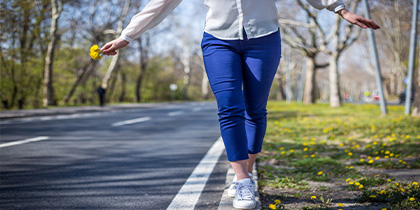
Heel-to-toe Walk
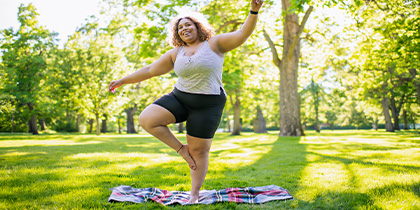
Single-leg Balance
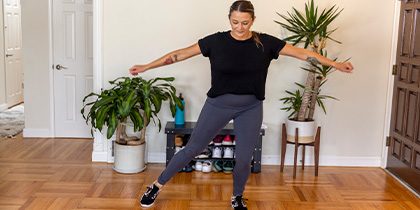
One-legged Clock
- Heel-to-toe walk: Pretend you are walking a tightrope. Place one foot in front of the other, heel to toe, in a perfectly straight line.
- Single-leg balance: Stand with feet shoulder-width apart and hands on hips. Lift one leg and hold for 30 seconds. Switch legs.
- One-legged clock: Visualize yourself standing at the center of a clock. Balance yourself on one leg that is slightly bent at the knee, and reach your other leg out, tapping your toe lightly on the floor to different numbers on the imaginary clock. For a bigger challenge, keep your leg raised as it points to each hour.
You may not always see the benefits of movements like these, but your body will feel them. Combined with other good habits – such as stretching before and after exercise, staying hydrated, and taking time to rest – these small steps will push you further ahead in your physical health journey.
“Whether you are an Olympic athlete, weekend warrior, or an active parent/grandparent, investing in your ‘small’ muscles by working on your core, hips, and body awareness will be a decision you will never regret,” Dr. Kasitinon said.
About UT Southwestern Medical Center
UT Southwestern, one of the nation’s premier academic medical centers, integrates pioneering biomedical research with exceptional clinical care and education. The institution’s faculty members have received six Nobel Prizes and include 28 members of the National Academy of Sciences, 26 members of the National Academy of Medicine, and 14 Howard Hughes Medical Institute Investigators. The full-time faculty of nearly 3,400 is responsible for groundbreaking medical advances and is committed to translating science-driven research quickly to new clinical treatments. UT Southwestern physicians in more than 80 specialties care for more than 143,000 hospitalized patients, attend to more than 470,000 emergency room cases, and oversee nearly 5.3 million outpatient visits a year.