
Focused on Patients: Bhavya R. Shah, M.D., and the Future of Ultrasound
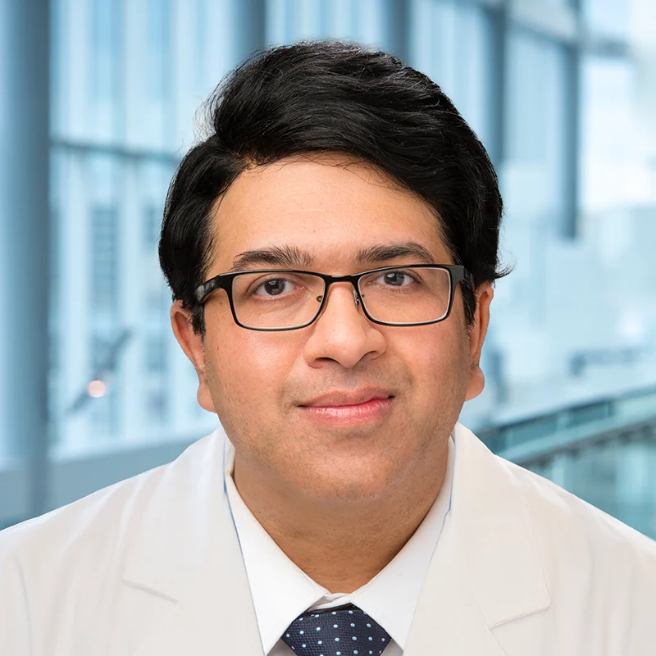
During their pre-procedure Focused Ultrasound (FUS) clinic visit, patients undergoing MRgHIFU treatment at UT Southwestern, are asked an unusual question: What is your favorite dessert?
For patients whose tremors can make everyday activities like eating difficult, it’s a meaningful question. On the day of their procedure, Bhavya R. Shah, M.D., and his team bring each patient their favorite dessert to celebrate their re-gain of function after the procedure.
“There are certain procedures that we offer that bring immediate relief,” Shah said. “The immediate post-operative results are incredibly rewarding for the patient and the treatment team.”
Shah’s career has focused on the intersection of biomedical engineering, neuroradiology and image-guided therapies, particularly the use of focused ultrasound to treat diseases of the central nervous system. But the thread connecting those disciplines began long before he entered radiology.
Medicine was part of Shah’s life from an early age. His father and grandfather are ophthalmologists, and his mother is an OB-GYN. During summer vacations, Shah and his sister worked as scribes in their father’s office.
In junior high, Shah’s father introduced him to the idea of developing a laser for cataract surgery, sparking an interest in how technology could improve patient care.
“What drew me in was the ability to use scientific principles to directly improve patient care,” Shah said.
His mother noticed something similar. Shah was interested in caring for patients, but he was also interested in developing the technologies used to care for them. That connection became clearer in college, when Shah enrolled in a biomedical engineering course called “The Physics of the Heart.” As part of the class, students had to build an artificial heart.
“It was at this moment that I understood how the interface between biomedical engineering and medicine could improve human health,” he said.
Shah initially pursued ophthalmology, completing a year of residency before switching to radiology. During his residency, he worked in a laboratory at the Brain and Cognitive Sciences Center at MIT, where investigators had developed nanoscaffold designed to enable optic nerve regeneration and wound healing.
With his background in ophthalmology and his developing focus on interventional neuroradiology, Shah chose to work on the optic tract regeneration project. One challenge was determining how to deliver the nanoparticle to the optic chiasm. Focused ultrasound offered a potential way to do that by opening the blood-brain barrier.
It also helped set the course for Shah’s future work. Today, he sees radiology itself as uniquely positioned at the center of modern medicine.
“Imaging plays a vital role in visualizing how disease affects our patients,” Shah said. “but, more importantly, it offers us the unique opportunity to enhance the outcomes of surgical and minimally invasive interventions by directly visualizing patient-specific anatomy.”
Shah was recruited to UT Southwestern to build preclinical and clinical brain focused ultrasound programs. He credits mentorship from Drs. Norbash, Maldjian, Pomper, Dauer and Diamond, along with other institutional leaders, with providing a strong foundation for that work.
The Department of Radiology has also supported his laboratory, grant applications and clinical trials, resources Shah describes as invaluable to growing both the research and clinical sides of the program.
Some patients travel to Dallas from out of town for brain focused ultrasound visits. Flight delays have occasionally pushed appointments into the following morning, when Shah is scheduled on other neuroradiology services. In those cases, his colleagues have made it possible for him to step away briefly to see the patient.
“The Neuroradiology section is a cohesive, integrated family unit where we consider each others’ successes our own,” Shah said. Collaboration also plays a role during treatment.
For high-intensity focused ultrasound treatments for movement disorders, Movement Disorder neurologists participate during the procedure, assessing tremor improvement monitoring for adverse effects. Their domain expertise in neurological examinations makes the presence an essential part of maintaining the safety and efficacy of the treatment, Shah said.
“I believe that the patient should always be at the center of healthcare delivery,” Shah said.
He describes his preferred approach as servant leadership, serving patients first and leading others through that example.
Looking ahead, Shah sees potential across a range of applications in the central nervous system, including low-intensity focused ultrasound for neuromodulation, focused ultrasound to disrupt the blood-brain barrier for delivery of molecular and genetic therapies, and high-intensity focused ultrasound to target patient-specific pathways involved in movement disorders.
He is particularly interested in his laboratory’s work in developing a molecular brain interface and the central role focused ultrasound will play in that field.
Turning those possibilities into safe, effective patient care, Shah said, will require more than technological advances alone. It will require scientists and clinicians with different areas of expertise working together.
“Strong scientific leadership and collaboration are requisites to developing new technologies that can be deployed safely and effectively,” he said.
For Shah, that combination of science, technology and medicine ultimately returns to the same idea that interested him as a child: using scientific principles to make something tangibly better for a patient.
Sometimes, the result can be seen immediately.
And sometimes, it can be celebrated with dessert.