


A legacy in art and landscape
Goldstein Sculpture Garden to inspire and enrich campus for generations

Joseph L. Goldstein, M.D., Chair of Molecular Genetics, has always been fascinated by the elegant connection between art and science and how both can captivate the imagination.
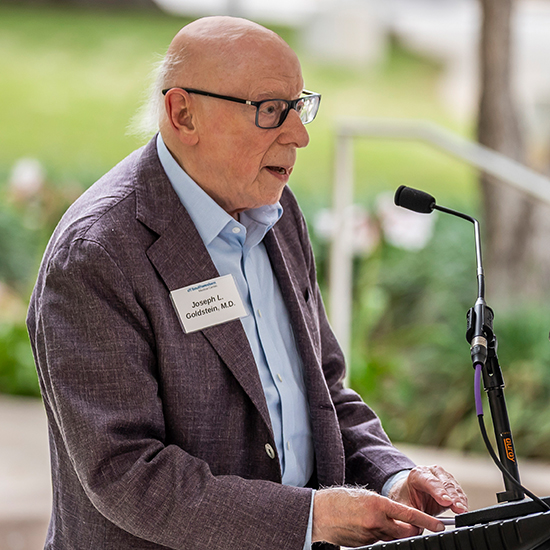
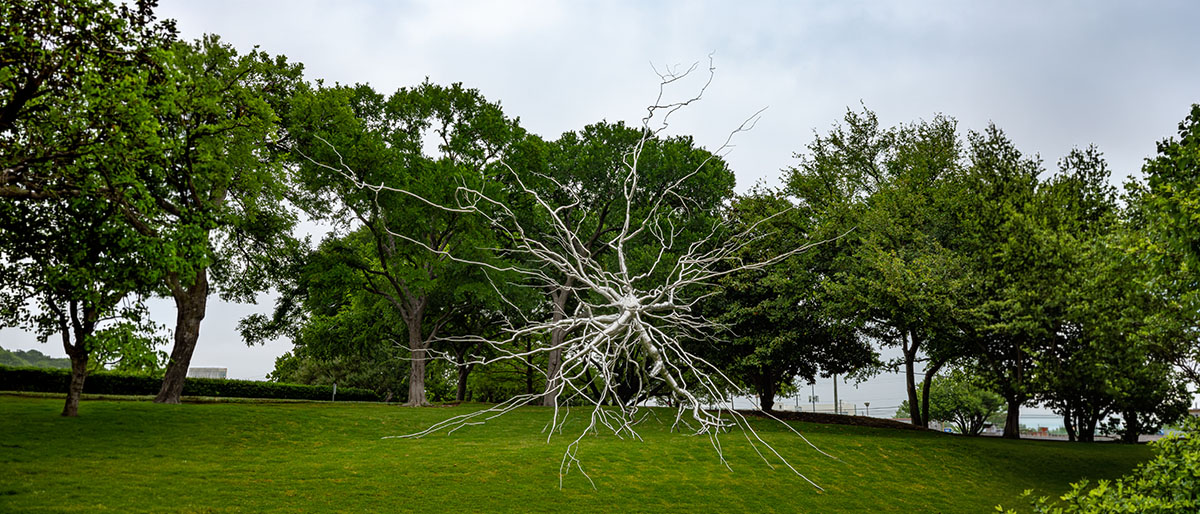
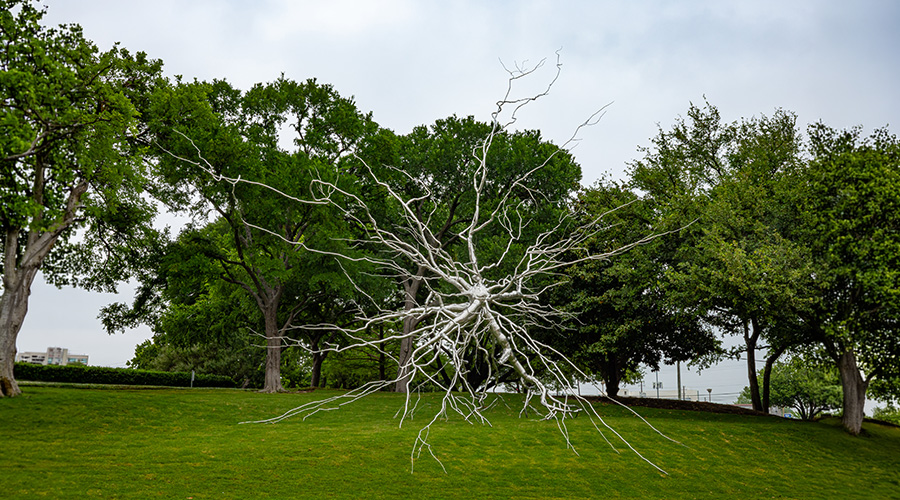
Standing in the shadow of the recently installed and nearly 50-foot-tall stainless steel Overgrown Neuron in late May, the Nobel Laureate reflected on his 50-plus years of research and his parallel passion for artistic creativity – a pursuit that has helped transform the once-blank canvas of UT Southwestern’s South Campus Plaza into a thought-provoking and dynamic sculpture garden.
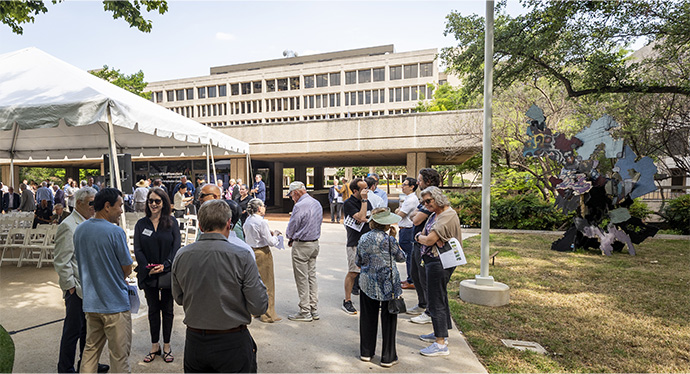
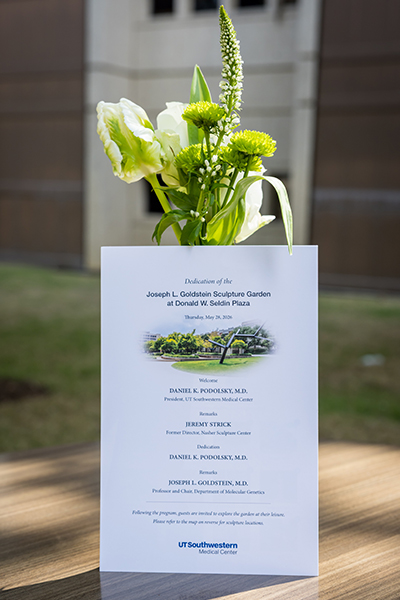
A who’s who of UTSW’s scientific community, along with friends and supporters of the institution, gathered on Thursday, May 28, to dedicate the Joseph L. Goldstein Sculpture Garden at Donald W. Seldin Plaza and pay tribute to their longtime colleague whose vision and donations made it all possible.
“Over the decades, Dr. Goldstein and his scientific partner Mike Brown, M.D., have created an indelible legacy in the example they have set through their discoveries and their standards of sustained excellence,” UT Southwestern President Daniel K. Podolsky, M.D., said during the dedication ceremony. “Today, we celebrate another way in which Dr. Goldstein has made a lasting imprint on UT Southwestern and the environment it provides for those carrying out our mission who work or learn at UTSW as well as those who visit our campus.”
Watch: Inspiration for a unique garden
An outdoor exhibition
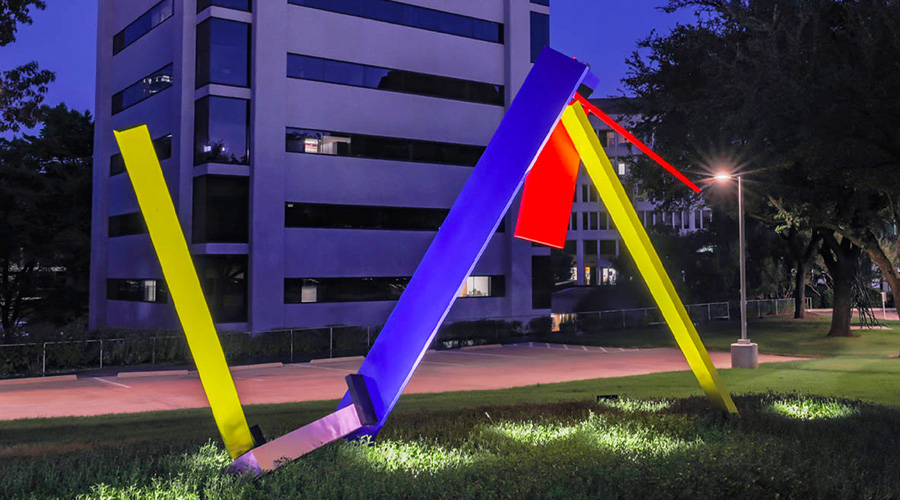
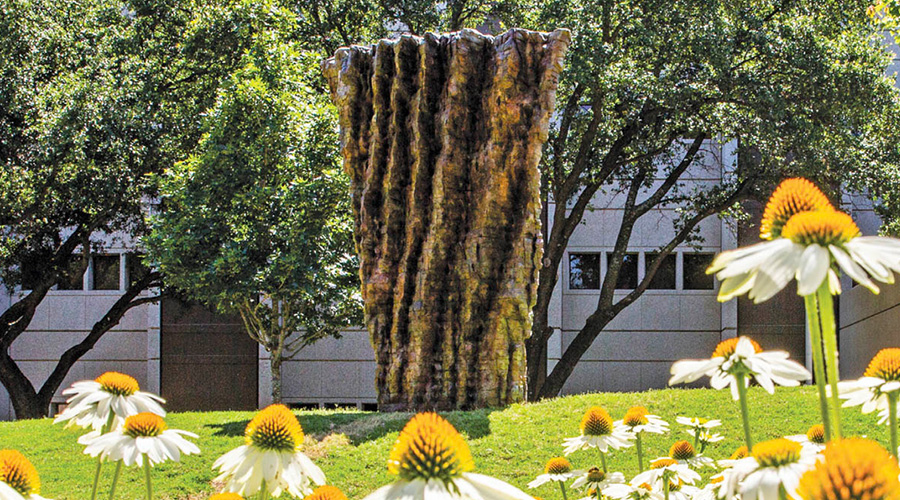
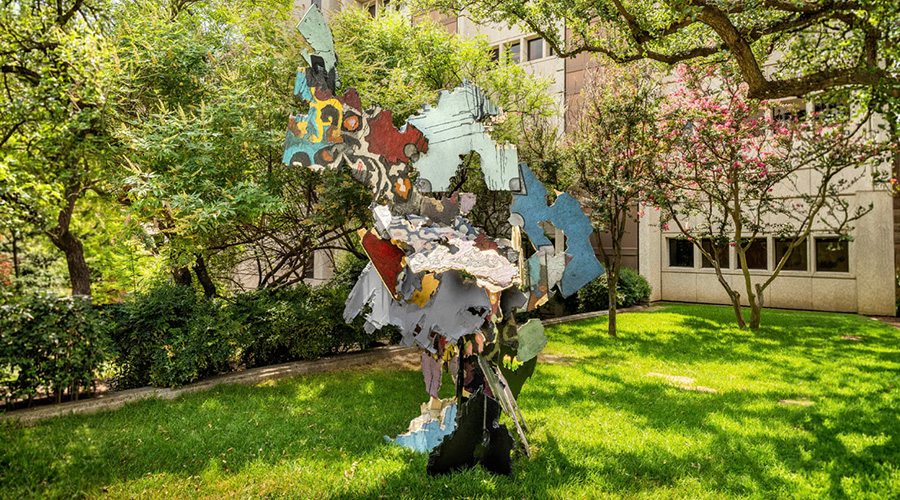
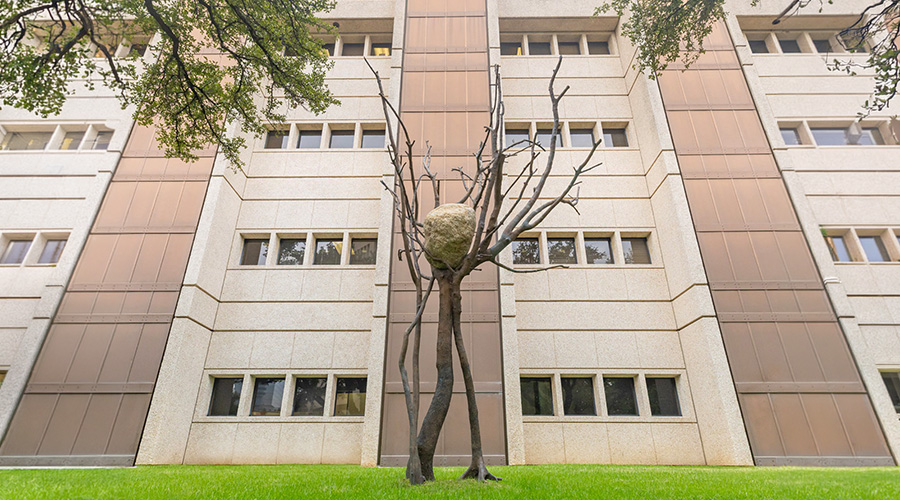
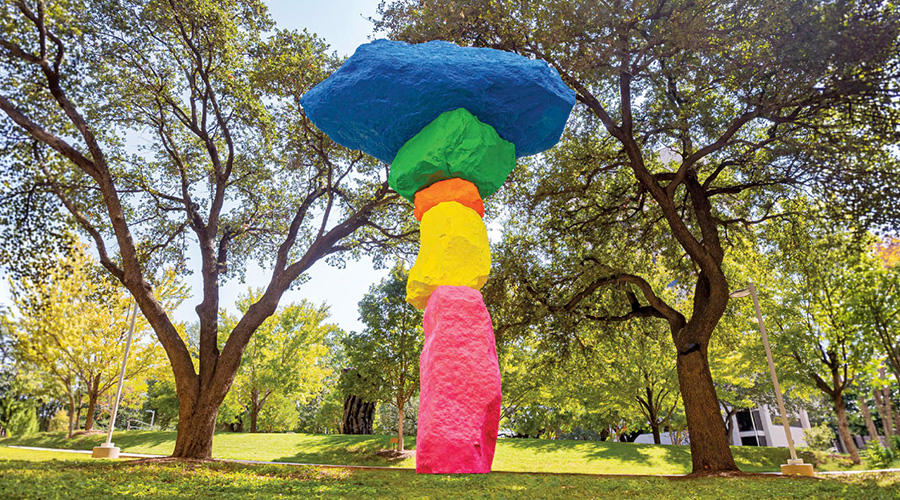
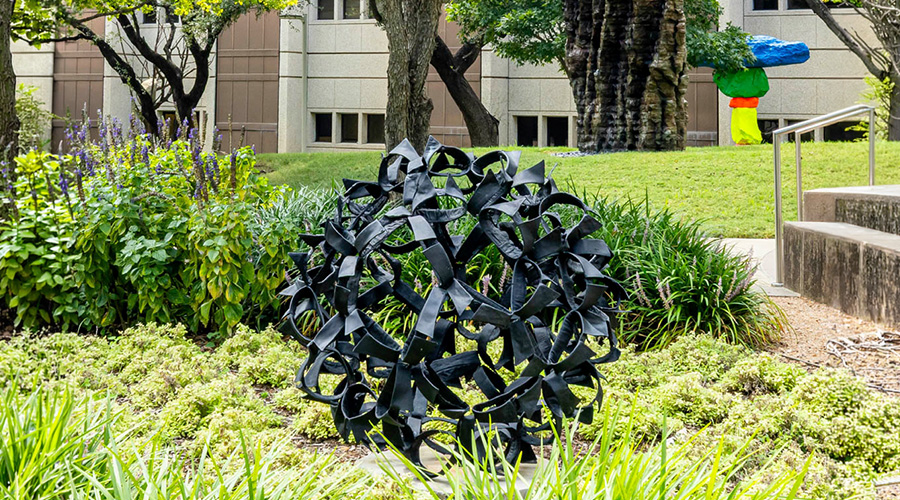
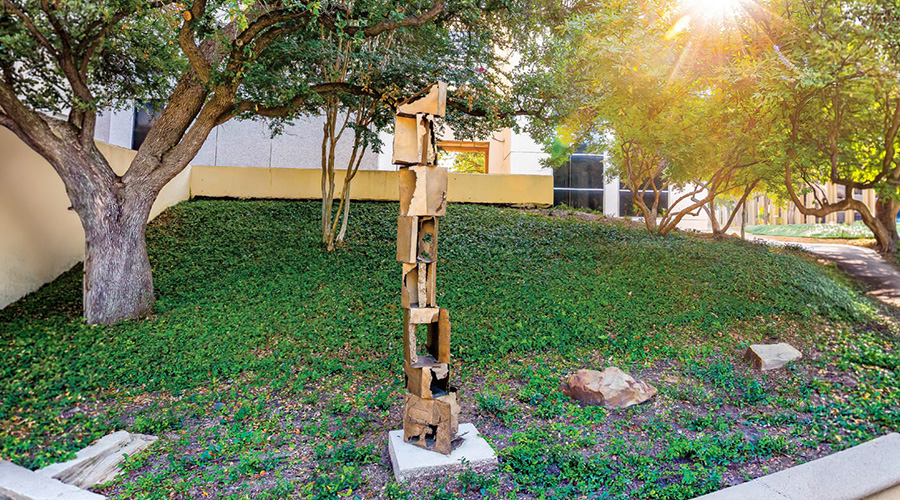
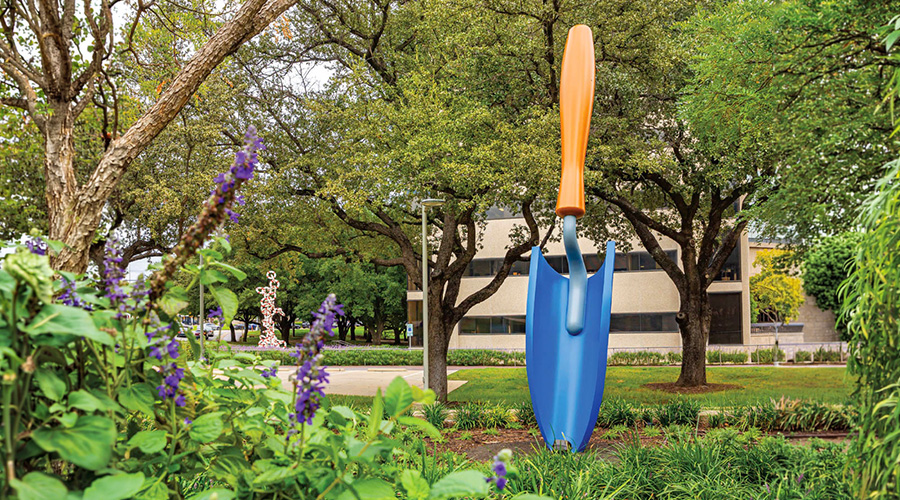
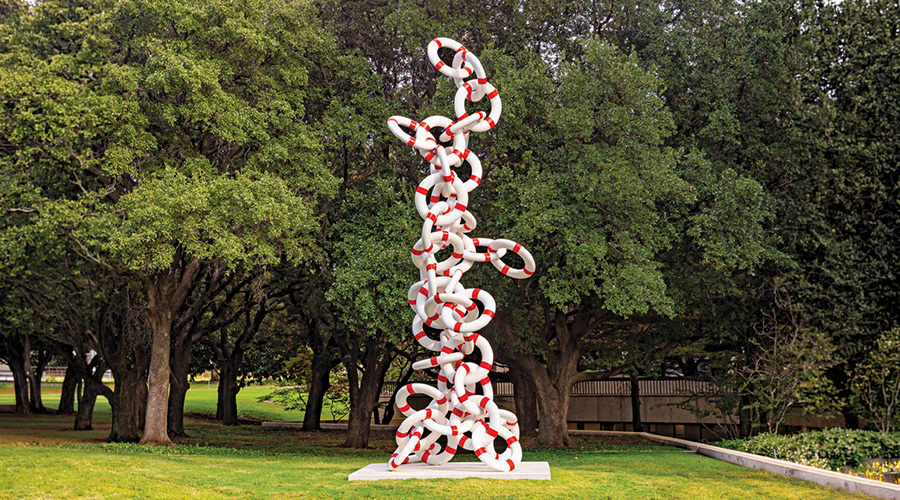
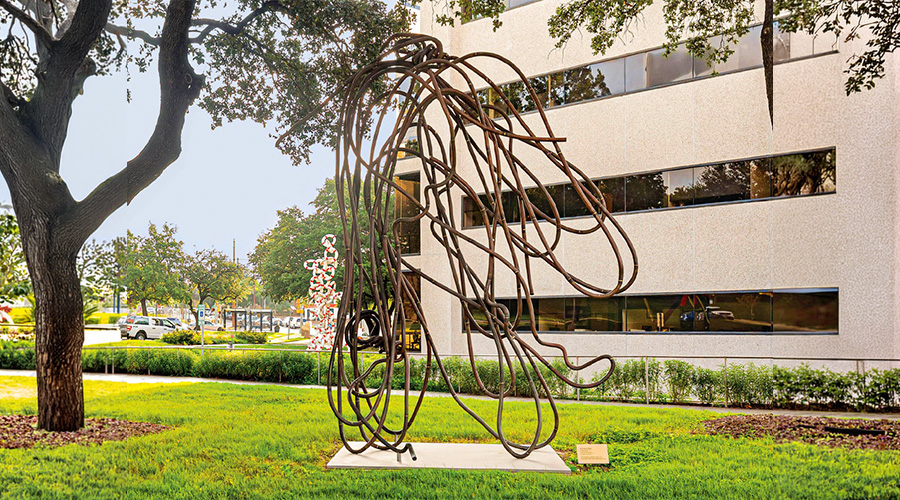
Through Dr. Goldstein’s generosity, Seldin Plaza has been refashioned over the last decade into an open-air exhibition, seamlessly integrating 12 unique and dynamic sculptures into the daily experiences of students, faculty, staff, and visitors.
“There is a distinctive story behind each of these sculptures, and each of them challenges the viewer in a unique way,” Dr. Podolsky said. “It’s been one of the most gratifying experiences of my career to witness this project as it has grown and evolved. Thank you, Joe, on behalf of everyone in the UT Southwestern community, and all those who will come to our campus in the years ahead, for these gifts that will enhance their lives as they experience these thought-provoking works of art.”
Dr. Goldstein joined Dr. Podolsky as the dedication plaque was unveiled in the middle of the Plaza. In a speech that followed, Dr. Goldstein alluded to the observations of famed architectural historian Victoria Newhouse.
“As Newhouse would say, ‘a sculpture in the right place becomes a magnetic pole that forces us to stop, to take a minute to look, and to put away our mundane thoughts,’” Dr. Goldstein said. “This brings me to the most gratifying aspect of my gift, and that’s watching our faculty, our employees, and our students who stop to take a look and put away their mundane thoughts for a minute or so. And as Picasso once said, ‘Art washes away the dust of everyday life from our soul.’”
Overgrown Neuron
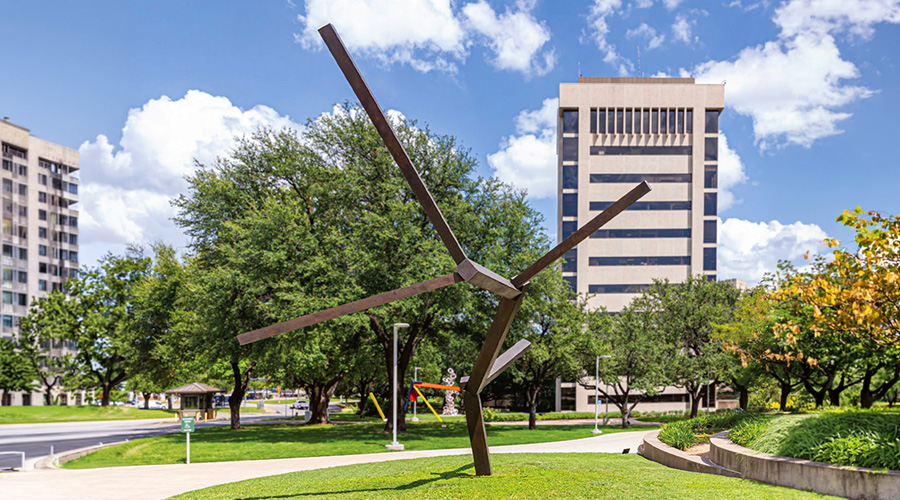
Overgrown Neuron, the 12th and final outdoor installation acquired through the generosity of Dr. Goldstein, is a monumental stainless steel sculpture by American artist Roxy Paine, who is internationally recognized for his dendroid, tree-like forms that capture the tension between nature and machinery, biology, and design. Standing over 48 feet tall, Overgrown Neuron was created specifically for UT Southwestern and conforms to the gentle berm on which it is situated, along the main thoroughfare to South Campus.
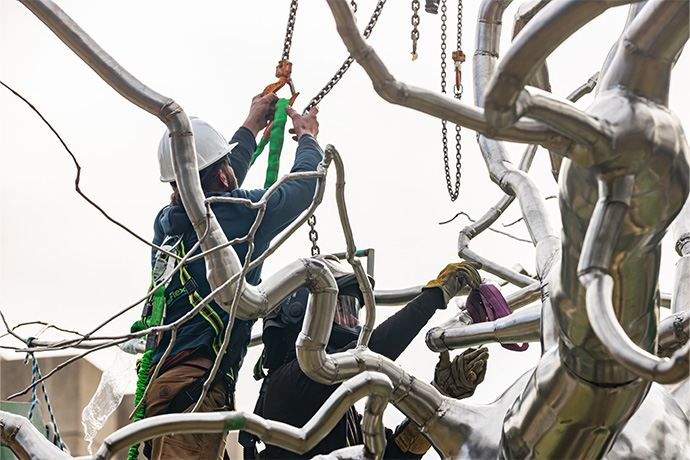
Twenty-one gleaming silver dendrites and one axon protrude from the neuron’s single cell body, forming what Dr. Goldstein described as “the world’s largest neuron.” The dendritic growth encapsulates the elegance that informs a range of natural systems, including trees and river basins, said Jeremy Strick, former Director of the Nasher Sculpture Center, whose remarks during the dedication provided an expert’s perspective that underscores the significance of Dr. Goldstein’s gifts.
Dr. Goldstein first became familiar with Mr. Paine’s work nearly 20 years ago when he saw Conjoined, 2007, one of his stainless steel, tree-like sculptures, in an exhibit at Madison Square Park in New York City. (That piece is now permanently installed at the Modern Art Museum of Fort Worth.) Several years later, Dr. Goldstein was transfixed in the presence of Maelstrom, 2009, on the rooftop of the Metropolitan Museum, which overlooks Central Park and the skyline of Manhattan. Maelstrom is a gigantic sculpture – formed from a web of stainless steel tree trunks and limbs – measuring 130 feet long, 50 feet wide, and 12 feet tall.
“That beautiful work has been permanently embedded in my memory for the last 17 years,” Dr. Goldstein said. “So, when I was thinking about sculptures for the Seldin Plaza, Roxy was high on my list, and I was delighted that he agreed to create a scientifically meaningful sculpture for us. Overgrown Neuron, with its cell body, one axon, and 21 dendrites (reaching nearly 50 feet tall and 60 feet wide) is the largest neuron in the world and a masterpiece of stainless steel.”
Dr. Goldstein and his lab partner of over 50 years, Nobel Laureate Michael S. Brown, M.D., Professor of Molecular Genetics and Director of the Erik Jonsson Center for Research in Molecular Genetics and Human Disease, shared the 1985 Nobel Prize in Physiology or Medicine for their discovery of the low-density lipoprotein receptor and its role in cholesterol metabolism.
Seldin’s tribute plants a seed
“The garden really began with a sculpture of our great hero, Donald Seldin, M.D., the intellectual father of UT Southwestern,” Dr. Brown said of the iconic former Chair of the Department of Internal Medicine who is credited by The New York Times as the physician “who put a medical school on the map.”
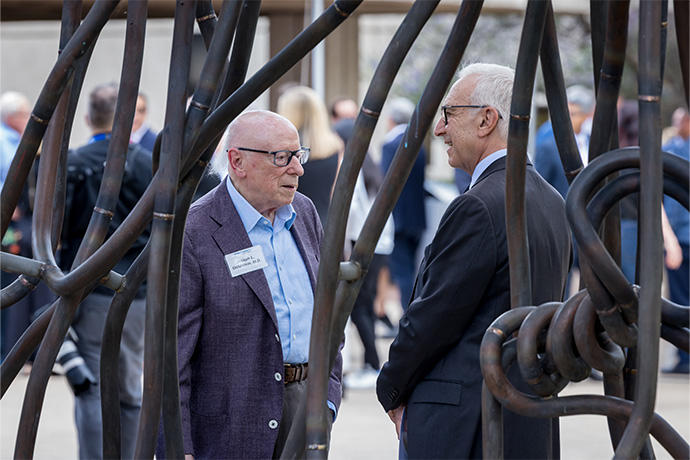
“When Dr. Seldin had retired and was in advanced years, we decided that we would honor him with a sculpture. … I don’t believe that Joe, in the beginning, envisioned anything as grand as what happened,” Dr. Brown added.
Following the installment of Dr. Seldin’s statue, Dr. Goldstein was inspired – with, he joked during the dedication ceremony, some persistent encouragement from Dr. Podolsky – to donate an untitled geometric sculpture from late American artist Joel Shapiro. It was the first of the dozen pieces that would eventually become the Joseph L. Goldstein Sculpture Garden and the “new face of UT Southwestern,” according to Dr. Podolsky.
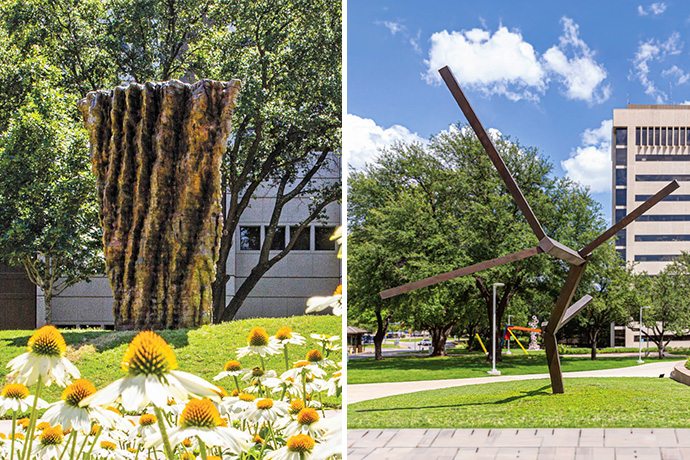
“It also illustrates this union of science and art that Joe describes so well,” Dr. Brown said. “Joe sees connections basically in the creative process. What makes originality in art? Is it the same that makes originality in science? Frankly, it is. It’s the desire to discover and create something new.”
The impact of this outdoor gallery, set in a welcoming and uplifting garden, will be enduring, shaping both the character of the UT Southwestern campus and the experiences of all who pass through it – much like Dr. Goldstein himself.
Endowed Titles
Dr. Brown, a Regental Professor, holds The W.A. (Monty) Moncrief Distinguished Chair in Cholesterol and Arteriosclerosis Research and the Paul J. Thomas Chair in Medicine.
Dr. Goldstein, a Regental Professor, holds the Julie and Louis A. Beecherl, Jr. Distinguished Chair in Biomedical Research and the Paul J. Thomas Chair in Medicine.
Dr. Podolsky holds the Philip O’Bryan Montgomery, Jr., M.D. Distinguished Presidential Chair in Academic Administration, and the Charles Cameron Sprague Distinguished Chair in Biomedical Science.