


Azab selected as NAM Emerging Leader in Health and Medicine

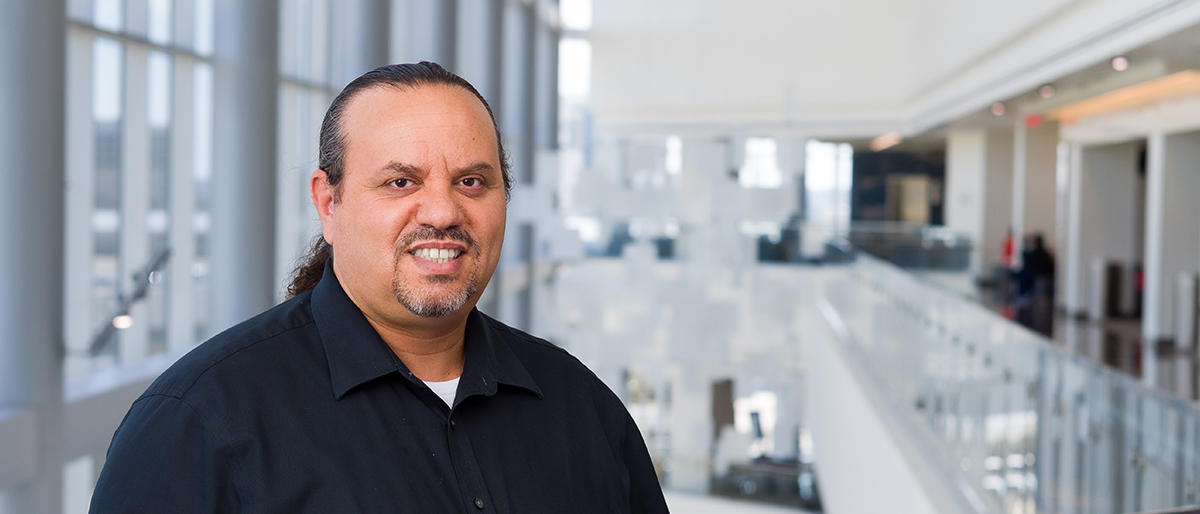
Kareem Azab, Ph.D., believes in the power of multidisciplinary collaboration.
“Some of the most impactful discoveries happen at the intersection of disciplines, so it is important to remain open to learning outside of one’s primary field,” said Dr. Azab, Associate Professor of Biomedical Engineering.
His research combines biomedical engineering, cancer biology, immunology, pharmaceutical sciences, and medicinal chemistry to develop innovative cancer therapeutics and translational nanomedicine technologies – with a particular focus on the tumor microenvironment.
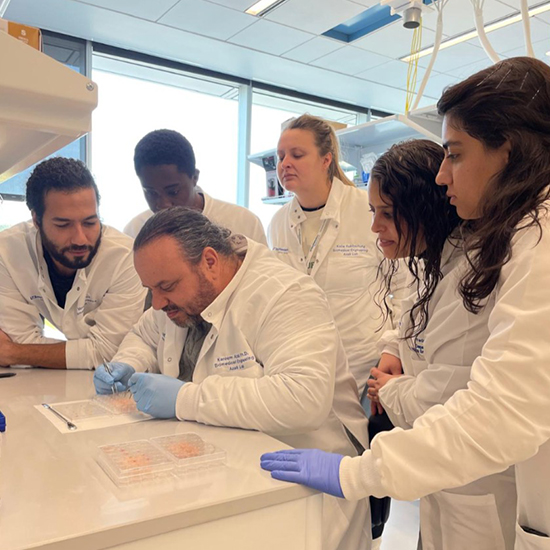
“What initially drew me to this field was the realization that many cancer deaths are not caused by the primary tumor itself, but rather by therapy resistance, metastasis, and failures in drug delivery,” said Dr. Azab, who is also a member of the Harold C. Simmons Comprehensive Cancer Center. “I became fascinated by the idea that engineering, chemistry, biology, and pharmacy could all be integrated to solve clinically relevant problems that conventional approaches struggle to address.”
In recognition of his work, the National Academy of Medicine (NAM) has selected Dr. Azab for its class of 2026 Victor J. Dzau Emerging Leaders in Health and Medicine (ELHM) Scholars. The 10 early- to midcareer professionals represent diverse disciplines – including artificial intelligence in medicine, nanomedicine, maternal-fetal health, health economics, and carceral health – and hail from such institutions as Children’s Hospital of Philadelphia, Columbia University, Duke University, Stanford University, University of Pennsylvania, and Weill Cornell Medicine.
“This recognition is deeply meaningful to me because it reflects the growing importance of translational and interdisciplinary biomedical research in shaping the future of medicine,” Dr. Azab said. “I am especially honored because the National Academy of Medicine brings together leaders across science, engineering, medicine, and policy, and being recognized among such an outstanding group is both humbling and motivating. I also see this recognition as a reflection of the incredible efforts of my students, postdocs, collaborators, and clinical partners at UT Southwestern and beyond.”
The ELHM program provides a platform for a new generation of leaders to collaborate with the NAM and its members to advance science, address persistent challenges in health and medicine, and spark transformative change to improve health. Over a three-year term, ELHM Scholars engage in activities throughout the National Academies of Sciences, Engineering, and Medicine, including meeting with NAM leadership and members; planning an annual forum; participating in National Academies convening activities; publishing NAM Perspectives; and attending the NAM annual meeting each October.
“Since joining UT Southwestern, Kareem has built an extraordinary research program spanning discovery, translation, and commercialization,” said Samuel Achilefu, Ph.D., Chair and Professor of Biomedical Engineering and a NAM member. “His science is exceptional, and his ability to rally people around bold ideas that turn into real solutions for patients is equally impressive. He is exactly the kind of leader medicine needs next.”
The Azab Lab is advancing strategies that target abnormal blood vessels and immune-suppressive components within tumors, which may enable broader and more durable therapeutic responses across multiple cancer types, Dr. Azab said. Other work includes developing targeted nanomedicine platforms that can improve drug delivery to tumors while minimizing toxicity to healthy tissues; designing immunotherapy strategies to overcome immune suppression within the tumor microenvironment; and identifying biomarkers and patient-specific therapeutic vulnerabilities that can support more personalized treatment approaches.
Long term, the goal is to develop more effective, less toxic, and applicable therapies across a range of cancers – particularly aggressive and treatment-resistant tumors.
“A major focus of our program is not only scientific discovery, but also clinical translation – advancing promising technologies toward real-world therapeutic applications through intellectual property development, commercialization efforts, and industry partnerships,” said Dr. Azab, also a Senior Member of the National Academy of Inventors. To date, he has been involved in founding four translational biotechnology startups focused on drug delivery, biomaterials, and therapeutic development.
After receiving a B.Pharm. in pharmacy, an M.Sc. in medicinal chemistry, and a Ph.D. in pharmaceutical sciences from the Hebrew University of Jerusalem, Dr. Azab completed postdoctoral training in cancer biology and immunology at Dana-Farber Cancer Institute and Harvard Medical School. He was recruited to UTSW as a Cancer Prevention and Research Institute of Texas Rising Star Scholar in 2022.
Dr. Azab encourages emerging researchers to think boldly, stay intellectually curious, be persistent, and focus on solving real-life problems that directly affect patients’ health and quality of life.
“Every experiment performed at the lab bench should be driven by a vision of the patient waiting at the bedside,” he said. “Scientific discovery becomes truly meaningful only when it has the potential to change – and ultimately save – human lives.”
Dr. Azab is the second UTSW faculty member to be selected as an EHLM Scholar. Daniel J. Siegwart, Ph.D., Professor of Biomedical Engineering, Biochemistry, and in the Simmons Cancer Center, was named to the 2024 class of Scholars.
Endowed Titles
Dr. Achilefu, also a Professor of Radiology and in the Simmons Cancer Center, holds the Lyda Hill Distinguished University Chair in Biomedical Engineering.
Dr. Siegwart holds the W. Ray Wallace Distinguished Chair in Molecular Oncology Research.