


Rising Star Award

This award recognizes exceptional early-career clinical faculty whose actions and activities consistently exemplify enthusiasm, commitment, professionalism, and leadership.
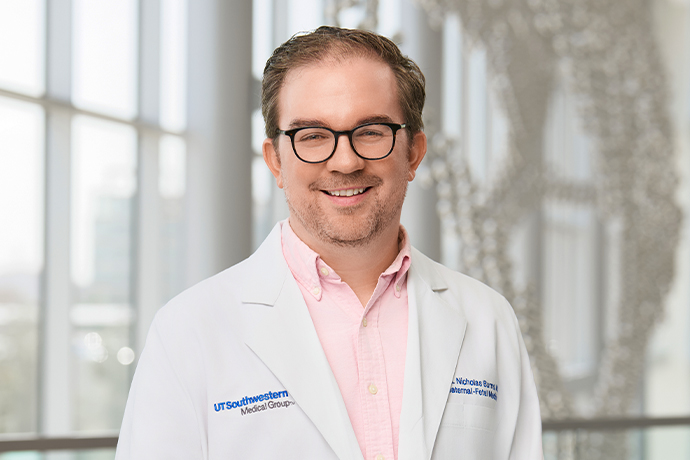
R. Nicholas Burns, M.D.
Assistant Professor of Obstetrics and Gynecology
“Those who can, do. Those who can’t, teach” is an adage that has not aged gracefully. Just ask Dr. R. Nicholas Burns, Assistant Professor of Obstetrics and Gynecology at UT Southwestern and Ob/Gyn Residency Assistant Program Director. In fact, he believes the phrase ought to be: “Those who can, should teach.”
Since joining the UTSW faculty in 2023, he has established himself as an innovative and consummate educator, mentor, leader, podcaster, and pop-quiz master. And this is on top of excelling as a maternal-fetal medicine specialist primarily based at Parkland Memorial Hospital, one of the nation’s busiest obstetrical centers. About 13,000 babies are delivered annually at Parkland – or approximately 1 out of every 250 in the U.S.
Dr. Burns’ sharp clinical judgment and knack for navigating his team successfully through tricky surgical situations earned him Parkland’s 2025 Houdini Award.
“In only a few years, he has become one of our Department’s most influential early-career faculty members,” one of his nominators wrote. “He is a trusted clinician on our highest-acuity obstetric service, and he has earned national recognition for educational innovation and established a scholarly program focused on improving physician competency and patient care.”
Using AI-driven language tools, Dr. Burns has transformed the way faculty provide guidance to residents and assess surgical skills by generating hundreds of evaluation points during a resident’s training. Faculty members are better able to monitor and track residents’ progress, close any educational gaps, and provide more constructive instructional feedback.
“We want to critically and objectively evaluate their competency every step of the way,” Dr. Burns said. “As educators, we have to ask, ‘How do I create incremental progress? How do I elevate them 1% more?’”
Remembering his experience as an ambitious resident, Dr. Burns said he found inspiration in data-driven assessments that helped him track his progress, engage in active learning, and improve educational outcomes. The most effective teaching tools, he said, meet trainees where they are – often on their digital devices. In 2018, he co-founded the CREOGs over Coffee podcast, named after the Council on Resident Education in Obstetrics and Gynecology, to help explain complex Ob/Gyn topics in simple and digestible episodes. It’s been adopted by the American College of Obstetricians and Gynecologists (ACOG) to be part of its national resident curriculum – a project on which Dr. Burns is advising.
In 2020, he followed up the podcast with the launch of a national text message-based curriculum, the OB/Gyn Intern Challenge – a daily pop quiz, of sorts – which helps incoming first-year residents prepare for their intern year. The 25-day program, which runs every summer before the academic year, is free and voluntary and was created by Dr. Burns and a group of his peers. It delivers daily texts with quiz questions, infographics, and links to curated podcast episodes to help residents brush up on key topics.
But it reaches beyond clinical education. The curriculum also includes resources for managing student loans, stress and wellness, time, and budgets. Each year, an average of 1,000 incoming Ob/Gyn residents sign up for the challenge.
Dr. Burns’ creativity and commitment to trainees is matched only by his generosity and consideration for his patients and colleagues.
“He is the physician colleagues call when help is needed because he is dependable, solutions-oriented, and always willing to put the needs of patients first,” one nominator wrote. “Equally important, Dr. Burns is universally respected for his kindness, humility, and professionalism. He treats patients, trainees, nurses, administrative staff, and faculty with the same level of respect and compassion, fostering trust and collaboration wherever he works.”
Dr. Burns earned his medical degree from the University of Texas Medical Branch at Galveston and completed his Ob-Gyn residency at the Warren Alpert Medical School of Brown University and the Women and Infants Hospital of Rhode Island. He also completed a fellowship in maternal-fetal medicine at the University of Washington in Seattle.
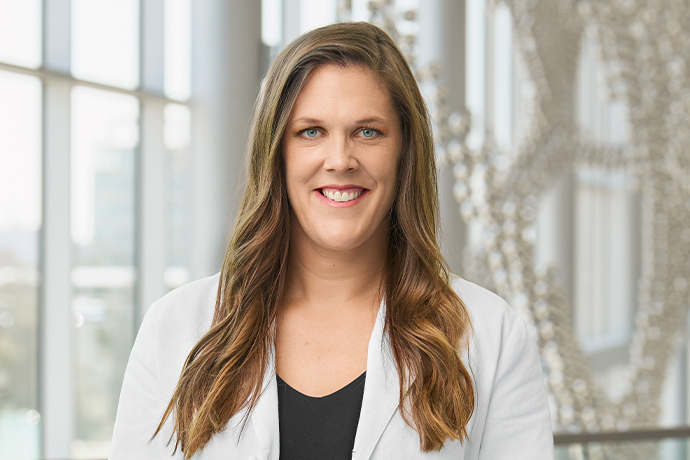
Audra Clark, M.D., FACS, FABA
Associate Professor of Surgery
Division of Burn, Trauma, Acute and Critical Care Surgery
It’s hard to believe Dr. Audra Clark once doubted whether she was “tough enough” to be a surgeon. Today, the Associate Professor of Surgery at UT Southwestern treats patients at one of the largest civilian burn units in the country at Parkland Memorial Hospital, and she is considered one of the leading surgeons in the fields of burn, trauma, acute, and critical care.
“If a member of my own family sustained a serious burn injury, Dr. Clark is the surgeon I would trust to care for them without reservation,” wrote the senior physician who nominated her. “During my career, I have trained and mentored hundreds of residents and worked closely with numerous junior faculty members at leading academic medical centers. Without hesitation, I can say that Dr. Clark is in the top 1% of early-career academic surgeons I have had the privilege to mentor.”
And it was the wisdom and guidance of several respected mentors who irrevocably changed her career trajectory, said Dr. Clark, who completed all her medical training at UT Southwestern, from medical school – when she was questioning her mettle for surgery – through residency and fellowship.
“If someone had told fourth-year medical student Audra that she would end up working and being partners with her burn attending and senior resident, she would have died of happiness,” Dr. Clark said. “And since I took over as Program Director for General Surgery Residency a couple of years ago, it has been really fulfilling to serve and give back to an institution that has meant so much to my training and career.”
Since joining the faculty in 2021, Dr. Clark has ascended through leadership positions at an extraordinary rate. For a time, she also served as the Associate Program Director of the Burn Track within the Surgical Critical Care Fellowship. Under her leadership, the program became one of the first in the country to be verified by the American Burn Association, and it is now one of the most sought-after fellowships of its kind.
“Every resident and fellow she trains will care for thousands of patients over the course of their careers, magnifying her impact far beyond the patients she personally treats,” her nominator wrote. “And I have watched Dr. Clark lead multidisciplinary teams through the care of some of the most critically ill burn and trauma patients.”
Dr. Clark said much of her success comes from emulating her own teachers and role models. Watching how they move through operating rooms, gently talk with patients and families, and instruct young trainees inspired her to become the physician she is today.
“Burn surgery is one of the most intense and amazing specialties of medicine,” Dr. Clark said. “There are a million little moments that have made an impact on me. Some of these patients are extremely sick, and we are not sure if they’re going to live. Then, a couple of years later we get to see them in clinic or at burn camp, thriving and doing amazing things. You carry these moments with you, even the bad ones, but that’s the kind of thing that keeps you going every day.
“Working in the burn ICU can be physically and emotionally exhausting, but it is extraordinarily fulfilling and continues to be the best decision I’ve ever made.”
In 2013, Dr. Clark earned her medical degree from UT Southwestern, where she also completed her residency and a burn/surgical critical care fellowship.