


Program Development Award

This award celebrates the innovation and collaboration that are foundational to the success of UT Southwestern. It recognizes a group of clinical faculty and staff who have partnered to create, develop, and sustain an innovative program that significantly advances our ability to improve patient care.
- Harold C. Simmons Comprehensive Cancer Center Community Oncology Program
- UTSW Clements University Hospital Nutrition Support Team and Enteral Access Service Program
Harold C. Simmons Comprehensive Cancer Center Community Oncology Program
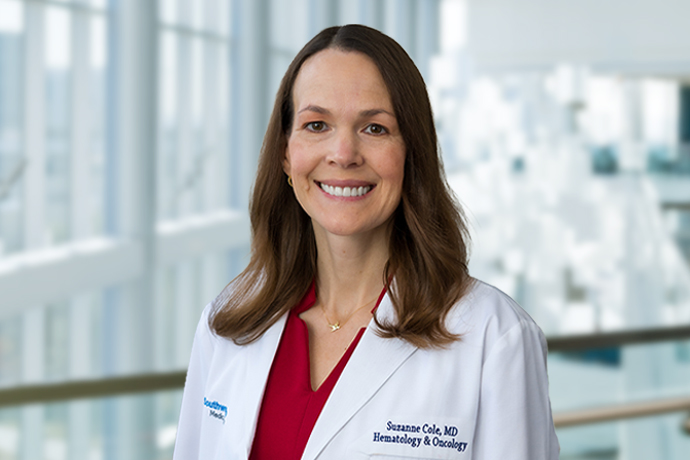
Suzanne Cole, M.D., FACP, FASCO
Associate Professor of Internal Medicine
Division of Hematology and Oncology
Regional Medical Director, Community Oncology Program
Cancer medicine has made remarkable strides in recent years, but even the most advanced treatments can only make a difference if they are within reach of more patients. That is the driving force behind UT Southwestern’s Community Oncology Program, which has dramatically expanded access to patients throughout North Texas and now serves as the starting point for more than 30% of all new visits across the Harold C. Simmons Comprehensive Cancer Center.
Developed not long after Dr. Suzanne Cole, Associate Professor of Internal Medicine in the Division of Hematology and Oncology, joined the faculty in 2018, the Community Oncology Program has transformed the region by delivering critical services and breakthrough experimental therapies at UT Southwestern clinics in Richardson, RedBird, and Fort Worth, giving cancer patients hope instead of hard choices.
“Access is everything when it comes to cancer care,” Dr. Cole said. “Sometimes patients can’t drive themselves, particularly elderly patients who are worried about navigating these Dallas-Fort Worth highways safely. The difference may be one or two hours, depending on where they live.
“I have had patients choose hospice rather than enroll in clinical trials based in Dallas, simply because they cannot travel there. It’s a sobering thought.”
The Community Oncology Program includes seven full-time general oncologists and hematologists and a team of dietitians, nurses, and social workers. Their work is supported by UT Southwestern’s robust network of subspecialists, disease-oriented teams, advanced practitioners, care navigators, radiation oncologists, and surgeons. The program also taps into a well of unrivaled academic research capabilities, as well as partnerships with community physicians, to connect patients with cutting-edge clinical trials.
In 2025 alone, the Community Oncology Program enrolled 111 patients in clinical studies – including 58 therapeutic trials – a record number since the program’s inception. In total, it has enrolled nearly 500 people in clinical trials and participated in studies that have changed the way physicians treat bladder, kidney, and lung cancers, just to name a few.
In 2020, the Richardson clinic began enrolling patients to participate in a clinical trial, EV-302, that ultimately “revolutionized the care of bladder cancer patients,” Dr. Cole said. It tested a combination of enfortumab vedotin and pembrolizumab in patients with stage 4 bladder cancer.
“At the time, their median life expectancy was around 12 to 15 months,” Dr. Cole said. “Our clinics (Fort Worth and Richardson) put 16 patients in that trial, and about one-third of them went into complete remission. I’d never seen that happen before. Those results were life-changing and life-extending.”
Championing underserved patients and humanizing the practice of medicine have been a hallmark of Dr. Cole’s career, noted the program’s physician nominator. She has built a culture of trust, compassion, and even joy in a field of medicine that greatly needs it.
Prior to joining UT Southwestern, Dr. Cole devoted nearly a decade to providing cancer care to rural and more remote communities in West Virginia and Oklahoma. She has described her work as “a calling.”
She is an advocate for her patients in the truest sense. From harnessing the power of a top-tier academic medical center to connecting them with experimental therapies to making them comfortable in their last days of life, Dr. Cole and every member of the Community Oncology Program understand the weight of their responsibility.
“In this line of work, you’re meeting people in the worst moments of their lives and what you do with that really matters,” she said. “It’s about connecting with them on a human level. Sometimes it’s enrolling them in clinical trials and sometimes it’s respecting their wishes when they decline treatment. There are so many ways for one person to take care of another, and it’s all meaningful.”
UTSW Clements University Hospital Nutrition Support Team and Enteral Access Service Program
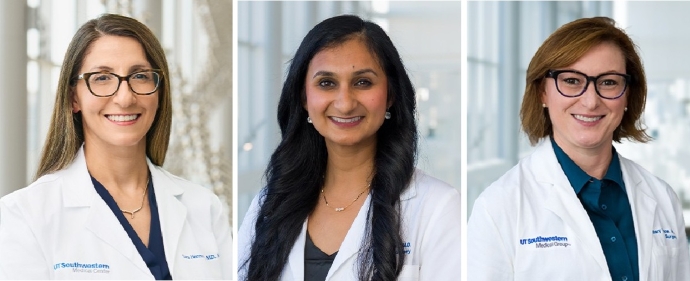
Sara A. Hennessy, M.D., M.B.A., FACS
Associate Professor of Surgery
Division of Burn, Trauma, Acute and Critical Care Surgery
Director of the Surgical Intensive Care Unit and Director of Nutrition, William P. Clements Jr. University Hospital
Sneha Bhat, M.D., FACS, CNSC
Associate Professor of Surgery
Division of Burn, Trauma, Acute and Critical Care Surgery
Hillary Prince, M.D., M.S., FACS, CNSC
Assistant Professor of Surgery
Division of Burn, Trauma, Acute and Critical Care Surgery
Exceptional patient care often begins with recognizing an unmet or unseen need.
The Clements University Hospital Nutrition Program, spearheaded by Dr. Sara Hennessy, along with Drs. Sneha Bhat and Hillary Prince, transformed a fragmented support service into a coordinated, systemwide model of care that identifies malnutrition earlier, improves recovery, and supports patients well beyond their hospital stay.
The program integrates surgeons, gastroenterologists, intensivists, interventional radiologists, pharmacists, advanced practice providers, nurses, and registered dietitians into a single coordinated system that is redefining the impact nutrition has on some of the hospital’s most complex patients.
Rather than establish traditional nutrition programs that function as isolated consult services, Dr. Hennessy, Associate Professor of Surgery and Director of the Surgical Intensive Care Unit, created the institution’s first Nutrition Committee, Nutrition Support Team, Enteral Access Service, and Comprehensive Outpatient Nutrition for Enteral Access and TPN Clinic. The result has been marked improvements in patient outcomes, quality, safety, education, operational efficiency, and financial stewardship. And the program has become a model for academic health systems nationwide.
“The mission of the CUH Nutrition Program is to ensure every patient with malnutrition or complex nutritional needs receives timely, evidence-based, multidisciplinary care – regardless of diagnosis or treating service,” said the program’s nominator. “Recognizing that nutrition is a critical determinant of recovery across every specialty, Dr. Hennessy intentionally designed the program to serve the entire institution.”
Dr. Hennessy, who specializes in minimally invasive gastrointestinal and hernia surgery as well as surgery critical care, has extensive experience counseling patients on medical nutritional care and focusing on what’s best for them.
“I started this program because I saw an opportunity to make something better for our patients,” she said. “Nutrition is critical to healing, recovery, and ultimately getting patients back to their lives – but it can easily be overlooked.”
Malnutrition is often underdiagnosed, and nutritional care can become fragmented, particularly for the most complex patients, she explained.
“We knew we could do better. By bringing together a multidisciplinary team, we could identify patients at risk earlier, coordinate their care, and make sure nutrition was treated as an essential part of their medical care rather than something addressed in isolation,” Dr. Hennessy added.
“That has been my passion for this program from the beginning. It isn’t just about nutrition or feeding access. It’s about making care safer, more coordinated, and more patient-centered – and giving our patients the best possible opportunity to heal, recover, and get back to the lives they want to live.”
The program encompasses standardized nutrition screening, physician education, multidisciplinary consultation, enteral and parenteral nutrition management, feeding tube placement and longitudinal management, quality improvement initiatives, outpatient transition of care, and continuous monitoring of nutrition related outcomes. By embedding nutrition into institutional quality, safety, and operational priorities, the program has elevated it into a cornerstone of patient care at UT Southwestern.
And the results underscore that the program is having a widespread impact.
The rate of screenings identifying patients at risk for malnutrition increased from 10% to 30%, while documented malnutrition diagnoses rose from 14% to 19%. Recognition of malnutrition as a serious condition that could complicate a patient’s care increased from 6.2% to 7.5%, and the readmission rate among patients with malnutrition declined from 23% to 19%.
More importantly, the program has significantly improved the patient experience, reducing complications and length of stay, preventing emergency department visits and readmissions, and providing continuity of care for nutrition services after discharge.
“It is exceedingly rare to encounter someone who not only recognizes an unmet clinical need but possesses the vision, persistence, and leadership to transform an entire health system around a better model of care. Dr. Hennessy has accomplished exactly that,” said the program’s nominator. “She has built a multidisciplinary program that has changed our culture and established an initiative that is poised for expansion across the UT Southwestern Health System.”