


The President’s Award for Humanism in Clinical Care

This award honors clinical faculty who exemplify the humanistic spirit of patient-centered medicine, both through clinical excellence and in outstanding compassion in the delivery of care.
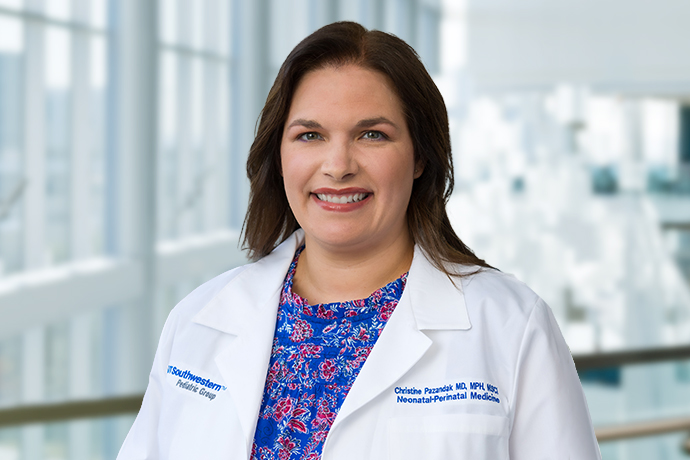
Christine Pazandak, M.D., M.S.C.I., M.P.H.
Assistant Professor of Pediatrics
When Dr. Christine Pazandak noticed a gap between the medical care her patients received and the challenges their families faced after leaving the hospital, she didn’t stop at recognizing the need.
Instead, she worked to build a bridge across it.
Thanks to several years of Dr. Pazandak’s advocacy, Parkland Health and the Dallas Volunteer Attorney Program launched a medical-legal partnership in 2026 that helps families access legal support and public benefits that can influence a child’s health long after discharge. The initiative reflects her broader commitment to her patients.
“She has reminded me that caring for a critically ill infant also means caring for the family who will love and care for that child after they leave the NICU. In doing so, she has raised the standard for what compassionate neonatal care can look like.”
That praise comes from one of 11 colleagues who nominated Dr. Pazandak for The President’s Award for Humanism in Clinical Care. Their nominations repeatedly commend her compassion, respect, kindness, and advocacy for families and her efforts to reduce health disparities.
An Assistant Professor of Pediatrics at UT Southwestern since 2021, Dr. Pazandak specializes in neonatal-perinatal medicine and cares for premature and critically ill newborns in the neonatal intensive care units (NICUs) at Parkland Memorial Hospital, Children’s Medical Center Dallas, and Texas Health Presbyterian Hospital Dallas. Her conversations with families have shown her how access to health insurance, stable housing, nutritious food, transportation, and language services can affect a child’s health once the family returns home.
“Dr. Pazandak has fundamentally altered our institutional culture, inspiring our staff to view health equity through a broader lens and setting a powerful example of what it means to practice medicine with true compassion, dignity, and justice,” a colleague said.
She also strives to ensure that every parent is informed, heard, and respected throughout their child’s hospitalization. After one family received difficult news over a poor phone connection with a language interpreter, Dr. Pazandak successfully championed the return of Parkland’s in-person Spanish interpreter services.
Her investment in the next generation of clinicians extends to mentoring NICU fellows at Parkland through challenging situations. Her guidance is “thoughtful, honest, and delivered with kindness,” a nominator said, “allowing learners to grow while preserving their confidence and sense of belonging.”
Dr. Pazandak also helped create the NICU Fellow Health Disparities and Advocacy Lecture Series and has invited fellows to advocacy days in Austin and Washington, D.C., demonstrating the role physicians can play in shaping policies that affect children’s health.
Helping families navigate uncertainty and find hope is the most fulfilling part of her work, she said.
“It is extremely rewarding to walk with a family through an experience of unexpected, preterm birth and see them through to discharge,” Dr. Pazandak said. “Some of the best days are when families bring their happy, healthy children to the NICU to say ‘hi’ years later.”
Since 2023, Dr. Pazandak has participated in the Academic Pediatric Association’s Health Policy Scholars Program, which prepares physicians to advocate for policy change. She has been active in the American Academy of Pediatrics (AAP) Advocacy Conference, where she has met with legislators to urge the expansion of vaccination programs and coverage for children enrolled in Medicaid and the Children’s Health Insurance Program (CHIP). She is also co-Vice Chair for AAP’s Training and Early Career Neonatologists national advocacy campaign.
Dr. Pazandak earned her medical degree at the University of Texas Health Science Center at San Antonio and simultaneously completed a master’s degree in public health through a collaboration with the UT Health Science Center at Houston. Following her residency in pediatrics at UTSW and Children’s Medical Center Dallas, she pursued advanced training in neonatal and perinatal medicine through a fellowship at Washington University in St. Louis, where she also received a Master of Science in Clinical Investigation.