The Cancer Biology Program provides interdisciplinary training for the student interested in pursuing a research career in most areas of Cancer Biology. The themes of the Cancer Biology faculty are related to the four well organized scientific programs in the Simmons Cancer Center: Chemistry and Cancer, Molecular Therapeutics of Cancer, Cancer and Development, and Cancer Cell Networks. In addition, there are emerging programs in DNA Repair and Radiation Oncology, and Cancer Prevention and Control.
The formal coursework for Ph.D. students are quite flexible permitting a wide range of choices depending on the individual needs for each student. In general, courses are taken as necessary to provide sufficient background in the biological sciences to permit the development of 'breadth of knowledge' before specializing in a particular area of cancer research. Since cancer research as a discipline is unusually broad - encompassing a wide variety of approaches to the biology, biochemistry, and genetics of various diseases that make up cancer - the curriculum requirements are designed to be flexible and provide students with a maximal opportunity for specialization within this multidisciplinary field.
Cancer Degree Plan
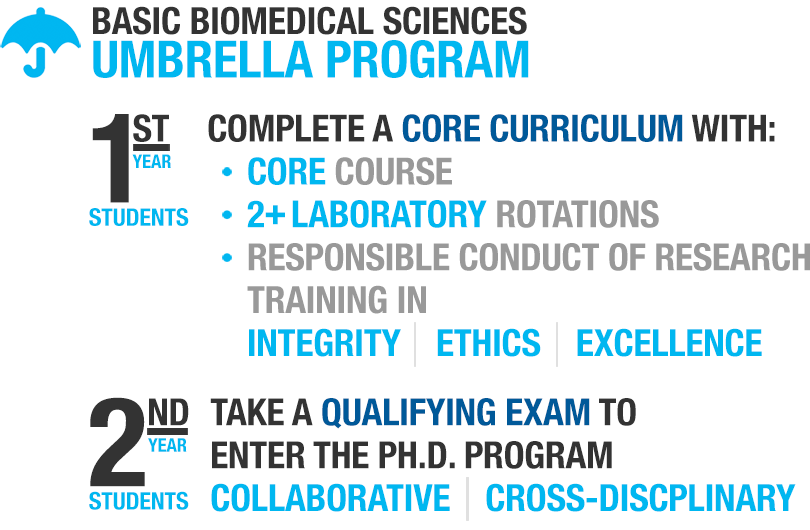
All students within the Cancer Biology Program are required to take 9 units of classes by the end of their second year in the
Division of Basic Science (DBS), which is their first year in the Program. This includes two requisite Cancer Biology courses [
Cancer Biology I (Molecular Mechanisms in Cancer Biology) and
Cancer Biology III (Hypothesis-Driven Grant Writing)]. Additional courses offered by the Cancer Biology Program and other DBS Program courses can also be taken to fulfill some of the required units. For current class descriptions of the Cancer Biology Program courses please click
here.
Works-in-Progress (WIPs)/ Journal Club (5097-01):
Works-in-Progress meets weekly from September through May each year except once a month when Cancer Center Grand Rounds is scheduled. Works-in-Progress is designed to provide a format in which students are encouraged to think critically about their research and how it relates to a broader area of biology. Many of the Faculty in the Cancer Biology Program attend. Journal Club is student run with the objective to familiarize students with the lecture subject of the upcoming visiting Cancer Center Grand Rounds outside speaker. All students within the Cancer Biology Program are expected to participate in a weekly WIPs/monthly Journal Club, and will present their on-going research at least once a year. Students are required to attend WIPs, Journal Club, and Cancer Center Grand Rounds each year.
Qualifying Examination:
Students in the Cancer Biology Program submit their Qualifying Exam abstract on or around February of their second year as part of the Cancer Biology III required course. Oral defense of the proposal will be scheduled for that May. The Cancer Biology Program Student Handbook outlines the process, key milestones, and expected timeline.
Dissertation Research and Committees:
The Cancer Biology Program requirements including time frame for the dissertation process is described in detail in the Cancer Biology Student Handbook.
Program Chair: Jerry Shay
John M. Abrams -- Molecular genetics of cell death in cancer.
James Amatruda -- Defining novel cancer genes and understanding the developmental biology of tumors using the zebrafish system.
Robert Bachoo -- Molecular mechanisms underlying brain tumors
David Boothman -- Low dose radiation and cancer.
Rolf A. Brekken -- Tumor-host interactions in pancreatic cancer.
Kathlynn Brown -- Development of tumor targeting reagents for drug delivery and molecular imaging.
James Brugarolas -- Molecular mechanisms of cell growth and proliferation control.
Richard Bruick -- Regulation of the mammalian hypoxic response pathway in cancer.
Sandeep Burma -- DNA damage by gamma rays and galactic cosmic rays - signaling, repair and the cancer connection.
Scott Cameron -- Cell lineages and programmed cell death.
Diego Castrillon -- PI3K / PTEN / AKT / FoxO pathways in cancer biology.
David Chen -- Radiation biology and DNA damage signaling.
Melanie H. Cobb -- Function and regulation of protein kinases in signal transduction pathways in breast cancer.
David R. Corey -- Cancer therapeutics: Engineering proteins and nucleic acids for novel function.
Jef De Brabander -- Synthesis of natural products and other molecular architectures and interrogation of their mode-of-action using molecular pharmacology and biochemistry for the development of novel cancer therapeutics.
Beatriz Fontoura - Nuclear transport pathways as regulators of cell cycle, cancer and antiviral response.
Errol C. Friedberg -- Cellular responses to DNA damage in eukaryotic cells with emphasis on cancer-prone human hereditary diseases.
Jinming Gao -- Nanoparticles for cancer therapeutic drug delivery.
Harold R. (Skip) Garner, Jr. -- Automation and instrumentation for genomics research; DNA sequence analysis; computational biology.
Robert Gerard - Targeting of recombinant adenovirus vectors to tumors.
Robert E. Hammer -- Transforming growth factor beta signaling.
Jer-Tsong (J.T.) Hsieh -- Human cancer gene therapy; signaling defects in urogenital cancers.
Lily Huang -- Cytokine receptor; signal transduction; hematopoiesis; structure-function analysis of protein; cancer.
Jin Jiang -- Signal-transduction pathways in development and human disease; genetic control of organ growth and patterning; tumor suppressor genes.
Beth Levine -- Role of autophagy in tumor suppression.
Qing Richard Lu -- Neural stem cell differentiation in CNS; glial development in CNS; oligodendrocyte myelination and neurological diseases.
Lawrence Lum -- How information from multiple signaling molecules, including Hh and Wg, integrate in development and cancer.
Ralph Mason -- Animal imaging in cancer.
John Minna -- Molecular pathogenesis of human cancer; signal transduction in human tumors; cancer stem cells; targeted cancer therapy.
Jerry Y. Niederkorn -- Immune surveillance of intraocular tumors; immune modulation of cancer metastases.
Chaitanya Nirodi -- The role of receptor tyrosine kinases in the repair of radiation-induced DNA damage
Luis F. Parada -- Mechanisms of neural development; trk receptors and neurotrophins; mouse models of neurological tumors.
Gray Pearson -- The molecular regulation of breast cancer progression using in vitro and in vivo models.
Alexander Pertsemlidis -- MicroRNA regulation of lung cancer pathogenesis and genetic determinants of cardiovascular disease.
Matthew Porteus -- Regulation of DNA double-stranded break repair; regulation of homologous recombination in cancer.
Michael Roth -- High throughput screening for novel cancer therapeutics; recognition and sorting of cell-surface glycoproteins.
Pier Paolo Scaglioni -- Characterization of the function of the PML tumor suppressor, mechanisms of K-RAS induced tumorigenesis, role of oncogene induced replicative senescence in tumor suppression, mouse models of lung cancer.
Nima Sharifi -- Mechanisms of androgen receptor gain-of-function in “hormone refractory” prostate cancer and novel therapies designed to target the androgen receptor in prostate cancer.
Jerry Shay -- Molecular mechanisms of human cellular aging and immortalization; the role of telomeres and telomerase in cancer.
Michael Story -- Radiation biology/oncology, cancer genomics, intrinsic radiosensitivity.
Philip Thorpe -- Development of novel angiogenesis inhibitors and agents for inducing thrombosis of tumor blood vessels for cancer treatment.
Carlos Tirado - Cytogenetics of cancer.
Jonathan Uhr -- Improving cancer treatment through: diagnosis at an earlier stage; analysis of cancer dormancy at the cellular and molecular levels; and targeted killing of human cancer cells in SCID mice by treatment with cell reactive monoclonal antibodies.
Ellen S. Vitetta -- The targeting of cytotoxic reagents to lymphoid cancers.
Xiaodong Wang -- Biochemistry of mammalian apoptosis, chemical synthesis of inhibitors of apoptosis for cancer therapy.
Michael White -- Molecular mechanisms for control of cell growth and differentiation.
Woodring E. Wright -- The role of telomeres and telomerase in cellular senescence and cancer.
Chun-Li Zhang - Role of neural stem cells in brain tumor development.
Hui Zou -- Misregulation of chromatid cohesion and separation in cancer.