Internal Medicine
Divisions
- Allergy & Immunology
- Cardiology
- Clinical Genetics
- Digestive & Liver Diseases
- Endocrinology
- Epidemiology
- General Internal Medicine
- Hematology-Oncology
- Hypothalamic Research
- Hospitalist Program
- Infectious Diseases
- Mineral Metabolism
- Nephrology
- Nutrition and Metabolic Diseases
- Pulmonary & Critical Care Medicine
- Rheumatic Diseases
- Touchstone Diabetes Center
Information for Applicants
Program Structure
At UT Southwestern Medical Center, our philosophy is that the intern is the patient’s doctor. Interns have primary responsibility for patients on the wards and in the ICUs, and work in a supportive environment that emphasizes teamwork with supervising residents, fellows, attending physicians and consultants, outstanding nurses, and other medical personnel to promote optimal care of each patient.
Interns help develop the plan of care, write orders and—under appropriate supervision—perform the majority of invasive procedures. Residents in UT Southwestern’s Internal Medicine training program rapidly become adept at a wide variety of procedures, including (but not limited to) central line placement, intubation, thoracentesis, paracentesis, arterial blood gas, minor biopsy, and lumbar puncture. By the end of the first year, residents are fully confident and competent to take on the challenges of leading a team and caring for even the most critically ill patients.
Educational Conferences
The UT Southwestern Internal Medicine training program takes pride in a rich tradition of teaching that spans the continuum from bedside to classroom and medical student to the senior faculty. Rigorous training in scientific principles and pathophysiology of disease lays the foundation for excellence as a clinician, physician-scientist, or both. And if that isn’t enough, lunch is provided at daily noon conference.
Ambulatory Care Morning Report: A weekly, interactive case-based conference covering important ambulatory topics led by general medicine faculty.
Behavioral Medicine: An interactive weekly conference covering various topics in residency including teaching skills, health policy, balancing stress, giving bad news, professionalism, and other challenges in modern medicine.
Clinicopathologic Conference: A stimulating, bimonthly case-based conference led by faculty experts from Internal Medicine, Pathology, and Radiology. Recent cases include neurocystericosis menigoencephalitis, Goodpasture Disease, Churg-Strauss vasculitis, von-Hippel Lindau syndrome, Creutzfeldt-Jakob disease, and thyrotoxic periodic paralysis to name a few.
Intern Chart Conference: Exclusive to interns, this weekly conference is led at Parkland Memorial Hospital by Daniel Foster, M.D., and Donald Seldin, M.D., two of our chairmen emeriti, at UT Southwestern University Hospital by Jonathan Weissler, M.D., and at Dallas Veterans Affairs Medical Center by Daniel Goodenberger, M.D. These conferences focus on the art of differential diagnosis and provide valuable time with some of the giants in medical education.
Internal Medicine Grand Rounds: Our flagship conference is a weekly lecture featuring both internal and visiting experts, who address a broad range of topics.
Journal Club: A weekly, resident-led, in-depth analysis and critical appraisal of important articles in various fields of medicine features teaching from experts in clinical research and evidence-based medicine.
Medicine Core Lecture Series: A weekly conference, which includes topics from all disciplines of internal medicine and other subspecialties important to internists.
Patient Safety Conference/Morbidity and Mortality Conference: A constructive multidisciplinary review of cases that highlight teaching points in patient safety and quality improvement.
Potpourri: Unique to UT Southwestern and a house staff favorite, this weekly conference comprises residents presenting recent interesting cases. Each patient is presented as an unknown to audience members. The faculty, students, and interns help make the diagnosis.
Race Case/Quiz Bowl: New conferences to UT Southwestern University Hospital this year that occur weekly; residents split into teams and race to find the diagnosis in a cost-effective manner. In Quiz Bowl, the teams are split to play our own version of Family Feud.
Resident Report: Exclusive to second- and third-year residents, this daily conference is moderated by our chairman, David Johnson, M.D., and other select senior attendings at Parkland Memorial Hospital and by Daniel Goodenberger, M.D., at Dallas Veterans Affairs Medical Center. Cases admitted the night before are discussed with a focus on disease pathophysiology and patient management.
Resident Update Conference: Each second-year resident presents a recent literature review on a clinical topic of interest, usually arising from a personal patient interaction.
Simulation Training
UT Southwestern residents become proficient in a terrific number of procedures, and the first step in that process is training in our innovative simulation lab. Under the guidance of Won Lee, M.D., as well as other pulmonary/critical care and cardiology attendings and fellows, interns and residents are provided with high-tech simulation training with models and simulated environments to prepare for the various procedures of internal medicine and for ACLS mega-code situations in a controlled setting prior to taking their skills to the bedside.
Curriculum by Year
Program Year 1

Program Year 2

Program Year 3

More Information about the Curriculum
Firm System
Learn more about our New 4+1 Firm system
The three years of residency allow for consolidation of skills introduced during internship and reinforced during the next two years with the opportunity for more extensive exposure to selected subspecialties and more time to pursue extracurricular activities. The residency experience itself can be loosely grouped into four types: wards, ICUs, clinics, consults, and electives.
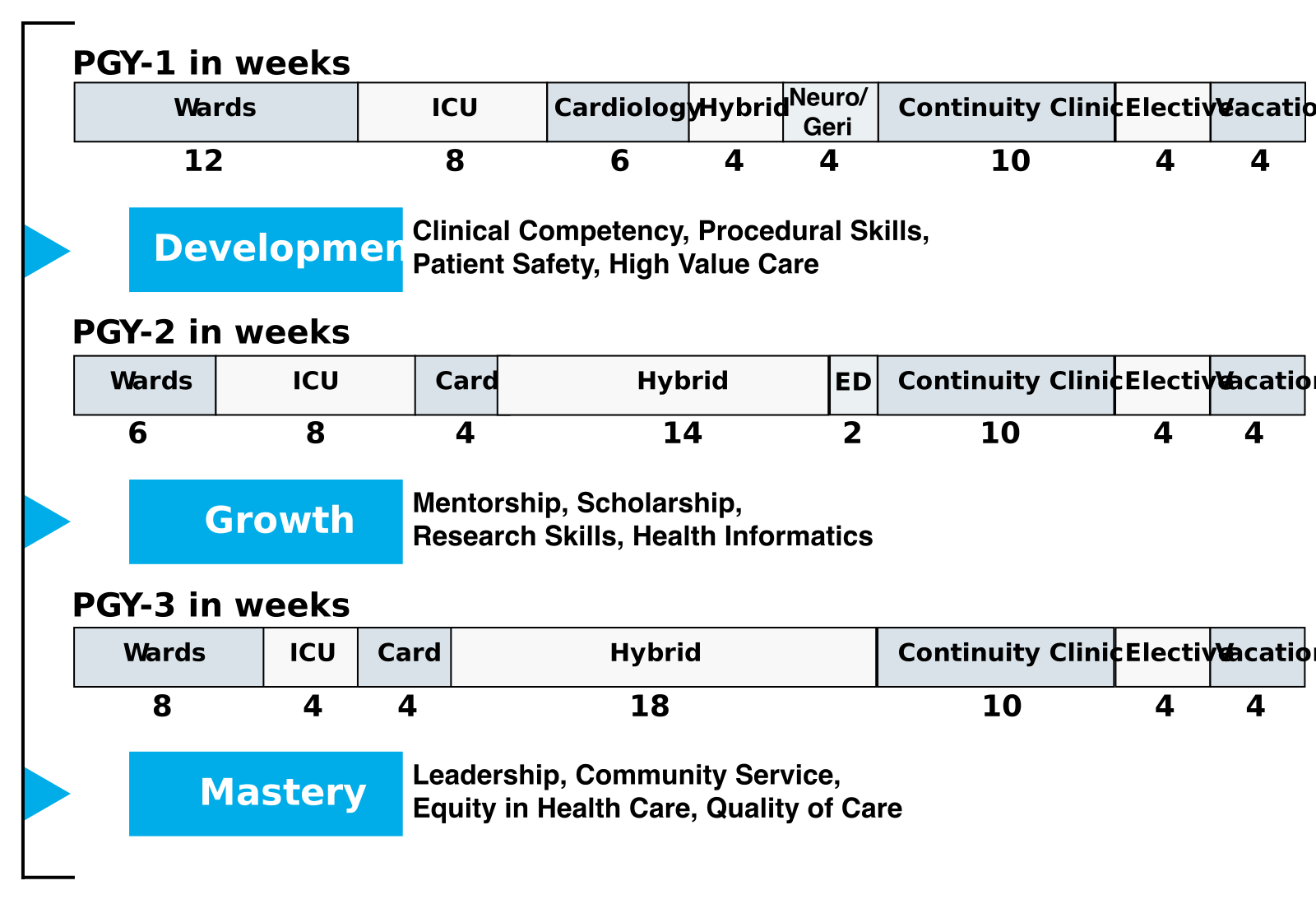
Wards: The resident is the team leader on the wards, responsible not only for advising interns and working with the team to generate plans for the care of each patient, but also for educating the interns and students and working with consultants. Ward months are the heart and soul of our internal medicine training program, and our residents have a tremendous deal of autonomy. However, autonomy does not mean “abandonment.” Our faculty take great pride in being always available to assist and instruct when difficult cases are encountered, no matter the time of day or night.
The level of responsibility and patient ownership, coupled with the complexity and diversity of the patients at our hospitals and excellent faculty teaching, guarantees that every graduate will fully grasp the skills required to be an excellent physician, and leave leaners prepared for careers in academics, primary care, or a medical subspecialty.
In addition to general medicine wards, UT Southwestern offers multiple subspecialty ward experiences including cardiology, hematology/oncology, pulmonary, and transplant nephrology. Each of these rotations provides insight into these subspecialties and additional experience for those interested in fellowships.
Fellowship Match
Check out our Fellowship Match List
Intensive Care Units: The ICUs at UT Southwestern have a high level of acuity and provide care for patients with diverse and complex disease processes. Residents in the ICUs work closely with the fellows and faculty from our nationally renowned training programs in Cardiology and Pulmonary/Critical Care Medicine. In addition to teaching rounds, there are daily didactic teaching conferences, presented by outstanding clinical faculty in areas that include sepsis, pulmonary hypertension, ventilator management, and much more. Residents in the ICU are responsible for managing cardiac and respiratory arrests and helping ward teams manage seriously ill patients. These experiences are so positive that many residents ultimately choose to pursue a fellowship in Cardiology or Pulmonary/Critical Care Medicine.
Continuity Clinics: Our ambulatory practice continues to grow. Every resident has a continuity clinic, either at the VA Medical Center or Parkland Memorial Hospital. With the 4+1 system, residents have clinic only during their +1 week – 10 weeks a year. The structure is arranged to optimize continuity of care and make sure that each resident is fully trained in primary care internal medicine.
Subspecialty Clinics: We have expanded our focus on outpatient subspecialty medicine, adding ambulatory rotations with designed curricula in hematology/oncology, rheumatology, and endocrinology. There are weekly subspecialty clinic experiences for each +1 ambulatory week. These clinics have been chosen based on resident feedback and to provide a wide variety of clinic experiences through UT Southwestern University Hospital, Parkland Memorial Hospital, and Dallas Veterans Affairs Medical Center.
Consult Rotations: In the last two years of residency, about half the time is spent on subspecialty, ambulatory, and consult rotations. The resident, working closely with attending faculty, handles most of the consultations on each service. Popular consult rotations include nephrology, infectious disease, hematology, gastroenterology, and a multitude of other available fields.
Electives: Our residents have 12 weeks of elective time over three years to gain further experience in subspecialties of their choosing or to enhance their research experience. UT Southwestern is internationally renowned for its innovative research, and boasts 5 Nobel Prize winners from the Department of Internal Medicine. The opportunities of residents to participate in exciting clinical and laboratory research are virtually limitless. Residents often continue their research past their elective time and produce clinically significant publications. Recent resident research projects include collecting data from the Dallas Heart Study to extrapolate lipid profile role in determining QTc interval, predicting in-hospital cardiac arrest using the electronic medical record, studying the relationship between acute blood loss anemia, transfusions required, and the degree of multiorgan dysfunction in GI bleeding, analyzing the relationship between non-Tuberculous mycobacteria and COPD, and many other exciting areas.