


Innovation Hub unveils new ways for faculty to bring big ideas to life

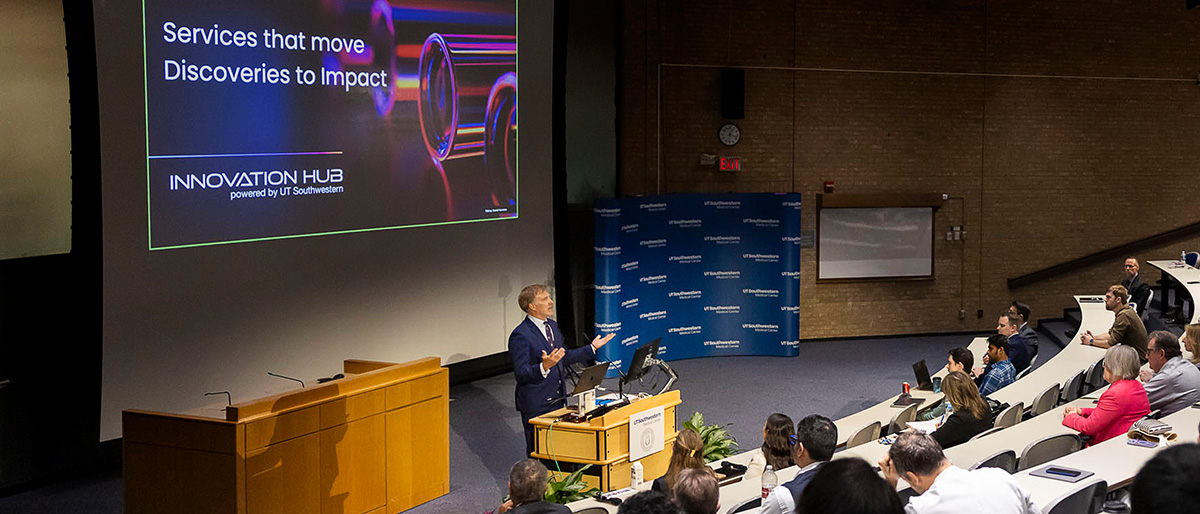
With more than 500 laboratories producing some of the most impactful biomedical research in the world, UT Southwestern is a hotbed of scientific discovery, providing countless opportunities to turn innovative ideas into products that can advance medicine.
To capitalize on the breadth of creative activity, the institution has launched its Innovation Hub, designed to help bridge the gap between potential breakthroughs and viable solutions for patients.
“Beyond the important mission we have to heal, to educate, and to discover, we want to do everything we can to make sure our best ideas get out into the world and have the maximum impact possible,” said Daniel K. Podolsky, M.D., President of UT Southwestern, speaking at a May 7 event to introduce the Innovation Hub and its sophisticated new digital, artificial intelligence (AI)-driven tools to the campus community.

While UT Southwestern has a history of licensing discoveries and launching startup companies through its Office for Technology Development, Dr. Podolsky said the growth of the campus and its clinical enterprise have increased the potential for innovation that can impact patients through commercial development, requiring a broader approach to nurture and develop marketable projects. As he visited innovation hubs at other institutions to learn best practices, he became convinced that UTSW has all the ingredients needed for success.
Last year, he recruited Daniel Hommes, M.D., Ph.D., as Vice President and the institution’s first Chief Innovation Officer to establish the Hub, which will take a more strategic approach to business creation and partnerships with investors or pharmaceutical companies. “Tech Dev,” now integrated into the Hub under Dr. Hommes’ leadership, continues to help faculty members with patents, licenses, and other intellectual property issues.
At the event, Dr. Hommes demonstrated a new online portal called DIMS, or Discovery Information Management System, which any faculty member can access to provide information on their discoveries or innovations that could be developed into novel drugs, devices, or diagnostic tools. DIMS is designed to provide transparency internally for researchers and externally for investors, who will be given the opportunity to register and get a window into investments at UTSW. The site also uses AI to search for public funding sources for each project.
Already, more than 80 projects have been identified for commercialization, including novel drugs to treat cancer and neurodegenerative diseases; AI-powered solutions to help doctors prescribe the right antibiotic or clear overcrowding in the emergency department; and new technologies to improve brain imaging or cancer surgery. Each has been placed on a “discovery track,” which lays out the many steps needed to validate the innovation’s efficacy and provide the data needed by investors before they decide whether to put money behind it. The goal is to “de-risk,” or develop the assets far enough so a fair valuation can be made before the discoveries are licensed to private industry.
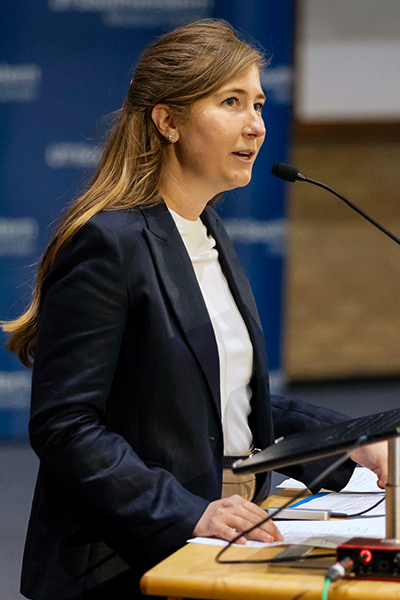
In January, the Hub took its show on the road, attending the J.P. Morgan Healthcare Conference in San Francisco, the country’s biggest annual gathering of industry leaders, biotech companies, and investors. It was the first time UT Southwestern had a presence at the conference, and Dr. Hommes said the response was “very positive.”
In addition, the team is reaching out to the Dallas investment community to raise awareness about biotech opportunities in their backyard. UT Southwestern can also provide seed funding to get projects started.
Dr. Hommes encouraged UTSW faculty members to engage with the DIMS site and share their ideas for solving some of the toughest challenges in healthcare.
“We are in an institution that provides exceptional care, but we have to look at the problems around us in terms of metabolic health, obesity, and an alarming increase in the incidence of cancer in young people,” Dr. Hommes said. “That is the reason we need your brilliant ideas and to move quickly to impact. That is our North Star.”
Over the years, more than 110 startups have been launched based on discoveries made at UT Southwestern. Success stories include Peloton Therapeutics, which developed a kidney cancer drug and was acquired by Merck for more than $1 billion, and Exonics Therapeutics, which created a gene-editing therapy for Duchenne muscular dystrophy and was purchased by Vertex Pharmaceuticals for more than $245 million. The Office for Technology Development has helped scientists secure nearly 500 U.S. patents and over 900 licenses. Last year alone, UTSW obtained 45 patents and executed 44 licenses and options.
David Greenberg, M.D., Professor of Internal Medicine and a Distinguished Teaching Professor, said the abundance of remarkable science underway at UTSW attracted him to the institution in 2010 and continues to impress him today. He helped to launch Solenic Medical to market alternating magnetic fields technology he developed to remove infections on metallic prosthetics, such as hip and knee replacements, and is working with the Innovation Hub to find partners to develop new medicines to treat antibiotic-resistant infections.
“There is so much untapped potential, even at the metroplex level, in nurturing investments in the biotech space,” he said. “I feel very confident that the Innovation Hub will drive more innovations out of this University.”
Endowed Titles:
Dr. Podolsky holds the Philip O’Bryan Montgomery, Jr., M.D. Distinguished Presidential Chair in Academic Administration, and the Charles Cameron Sprague Distinguished Chair in Biomedical Science.