


Going the extra mile to advance biomedical innovation
Researchers whose projects to diagnose preeclampsia early and combat prostate cancer share 2025 Milestone Award

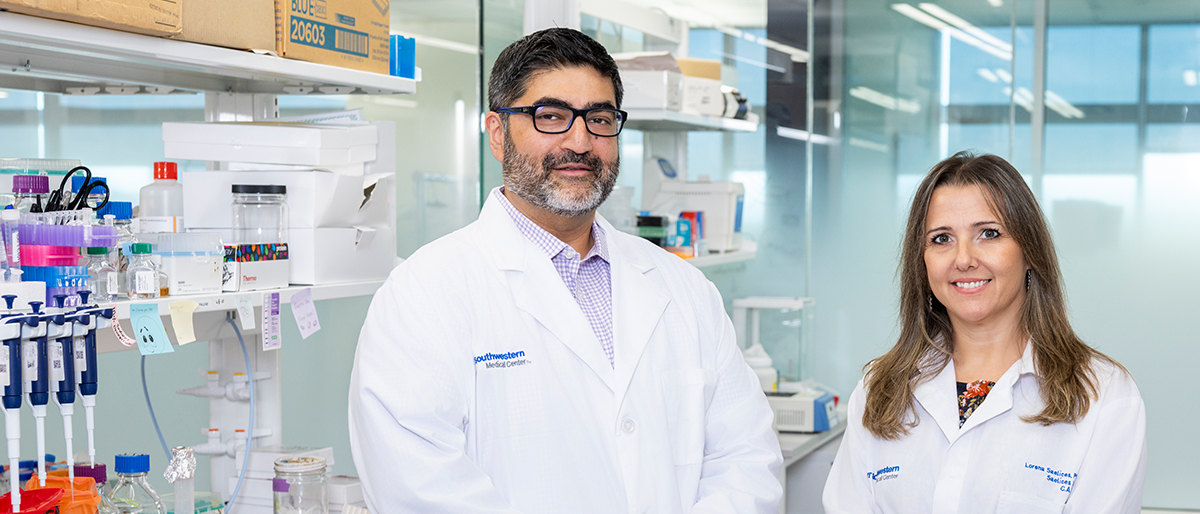
A researcher who developed a test to diagnose preeclampsia and an investigator who is advancing a novel way to treat drug-resistant metastatic prostate cancer have received a UT Southwestern Milestone Award designed to move innovative technologies to market.
Lorena Saelices, Ph.D., Associate Professor in the Center for Alzheimer’s and Neurodegenerative Diseases and of Biophysics, and Uttam Tambar, Ph.D., Professor of Biochemistry, are sharing this year’s UTSW Biotech+ at Pegasus Park Commercialization Milestone Award. The $100,000 prize was created to accelerate the preclinical development of UTSW technologies.
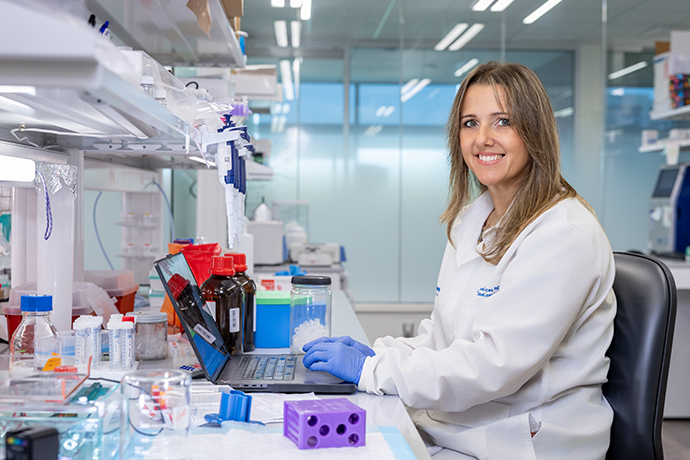
Dr. Saelices said the simple blood test she is developing could someday be used to detect preeclampsia, a serious pregnancy complication characterized by high blood pressure. Unlike traditional diagnostic methods that rely on late-stage symptoms, this test will enable earlier preeclampsia detection using a structure-based peptide probe targeting a novel biomarker – transthyretin aggregation – in the blood.
“With just a few drops of blood, we will be able to detect preeclampsia early enough – before it actually happens – to take precautions to prevent it,” she said.
Her lab originally developed the blood test for ATTR amyloidosis and has validated it in more than 500 individuals, including patients and healthy controls, Dr. Saelices said. She now aims to adapt this simple test for early detection of preeclampsia. The award will support materials and data analysis for pilot testing and validation, she said.
“My hope is we are able to create a test that one day will routinely be used in clinics,” she said.
Dr. Saelices is a founder of AmyGo Solutions, which was created to continue this work. She also reports research funding from the National Heart, Lung, and Blood Institute, UT Southwestern, and AstraZeneca, along with advisory board, speaker, and consulting fees from Pfizer.
Targeting prostate cancer
Dr. Tambar’s pioneering approach to prostate cancer addresses a critical gap in the treatment of metastatic, or spreading, prostate cancer.
Androgen receptor (AR) agonists are medications that mimic the effects of certain hormones. Although AR agonists have revolutionized prostate cancer treatment, drug resistance often presents a clinical challenge, he said. That is especially true for metastatic castration-resistant prostate cancer in which these agents are ineffective for nearly a third of patients, Dr. Tambar said.
To fill this need, Dr. Tambar is developing a therapy that combats prostate cancer with targeted glucocorticoid receptor (GR) degraders. By leveraging the body’s own cellular machinery, the GR degraders effectively eliminate the proteins that block drugs, offering a more sustainable and effective treatment strategy.
“The idea is to get rid of the resistance-driving protein,” Dr. Tambar said.

Although Dr. Tambar is focusing on prostate cancer, targeted protein degraders also show promise for treating breast, kidney, and other cancer types. The Milestone Award plays a significant role in giving new options like this to patients with metastatic cancer, he said.
“A grant like this really helps us get the data that is needed to eventually get investors and start a company,” Dr. Tambar said. “It makes it possible to apply research to real life.”
The Milestone Award helps overcome a critical funding barrier by providing targeted support to derisk early-stage technologies – support often unavailable through traditional academic grants, said Cara Forsberg, Ph.D., Director of Commercialization Business Development in the Office for Technology Development at UT Southwestern.
“This award not only highlights high-potential discoveries but also strengthens opportunities for industry partnerships and accelerates their path to real-world impact,” she said.
The award is made possible through the generosity of Lyda Hill Philanthropies and additional philanthropic contributors. Lyda Hill Philanthropies is a key supporter of various initiatives at UT Southwestern, such as the Lyda Hill Department of Bioinformatics and Biotech+ at Pegasus Park, a life sciences hub that serves as a center for biotech companies and collaborations with UTSW.
Enhancing lung cancer therapy
Last year, the Milestone Award was presented to two recipients focused on lung cancer, one researching ways to improve treatment and the other developing better ways to diagnose the disease.
Kathryn O’Donnell, Ph.D., Associate Professor of Molecular Biology, was awarded a $75,000 grant to support her work on a novel lung cancer treatment. Her research involves developing monoclonal antibodies that target the protein PCDH7, which plays a significant role in non-small cell lung cancer. Dr. O’Donnell is a scientific co-founder of ProtomAb Therapeutics Inc., a company created to continue this work.
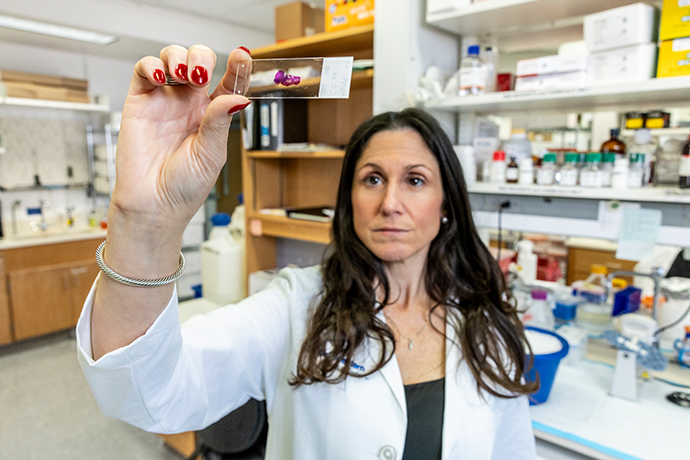
“Our lab is one of the first to investigate the role of the cell surface protein PCDH7 in lung cancer development,” Dr. O’Donnell said. “PCDH7 represents an attractive target for treating lung cancer for several reasons.”
The protein is seen at higher levels in lung cancer cells, she explained. Elevating or reducing PCDH7 levels in human lung cancer cells strongly increases or decreases their tumor-forming ability. Elevating PCDH7 in mouse models enhances lung tumor development, while removal of the protein significantly minimizes tumor growth and extends survival.
“By inhibiting this protein, antibodies can effectively reduce tumor growth and enhance the efficacy of existing cancer therapies,” Dr. O’Donnell said. “We believe this protein is an attractive target. By blocking it, we can reduce tumor burden and boost the immune system.”
Dr. O’Donnell said she appreciates the award and the support she has received from UT Southwestern and Lyda Hill Philanthropies.
“I feel incredibly lucky to be able to work with a talented team of trainees, collaborate with scientists focused on lung cancer biology and antibody engineering, and partner with clinicians who can help us translate our basic science discoveries to the clinic,” she said.
A new diagnostic test
Jeffrey SoRelle, M.D., the second recipient who received a $25,000 award last year, was recognized for his innovative Lung-FAST diagnostic test designed to improve lung cancer treatment.

Lung-FAST offers a more precise and faster alternative to existing genetic testing methods, said Dr. SoRelle, Assistant Professor of Pathology and Pediatrics. Patients with lung cancer have multiple precision therapies to choose from, but genetic testing methods are limited, he said. Matching the right therapy to the individual’s cancer can be challenging.
“The problem is the biopsy that is currently done only tests a very small tissue amount,” Dr. SoRelle said. “The FAST-PCR (Fragment Analysis and SNP Testing) efficiently analyzes up to 100 gene targets.”
The diagnostic test requires less DNA and reduces the need for repeat biopsies. It also reduces patients’ waiting time by several weeks compared with traditional approaches, he said.
“A lot of these lung cancer patients are in stage 4, and they can’t wait,” Dr. SoRelle said. “They need to be able to start treatment quickly.”
The Milestone Award has helped fund clinical testing. Already, 80% of the lung cancer mutations that can be targeted with therapy have been identified and plans are to license the technology for commercialization, said Dr. SoRelle, who co-founded a company, Cereus Diagnostics, to continue this work.
“We are at the 10-yard line as far as doing everything we need to do,” he said. “I’m motivated to not just make new discoveries, but I really want to affect as many people as possible, and commercialization is a way to do that.”
Endowed Titles
Dr. Tambar holds the Bonnie Bell Harding Professorship in Biochemistry and is a W.W. Caruth, Jr. Scholar in Biomedical Research.