


Liver disease expert Lee named Professor Emeritus of Internal Medicine

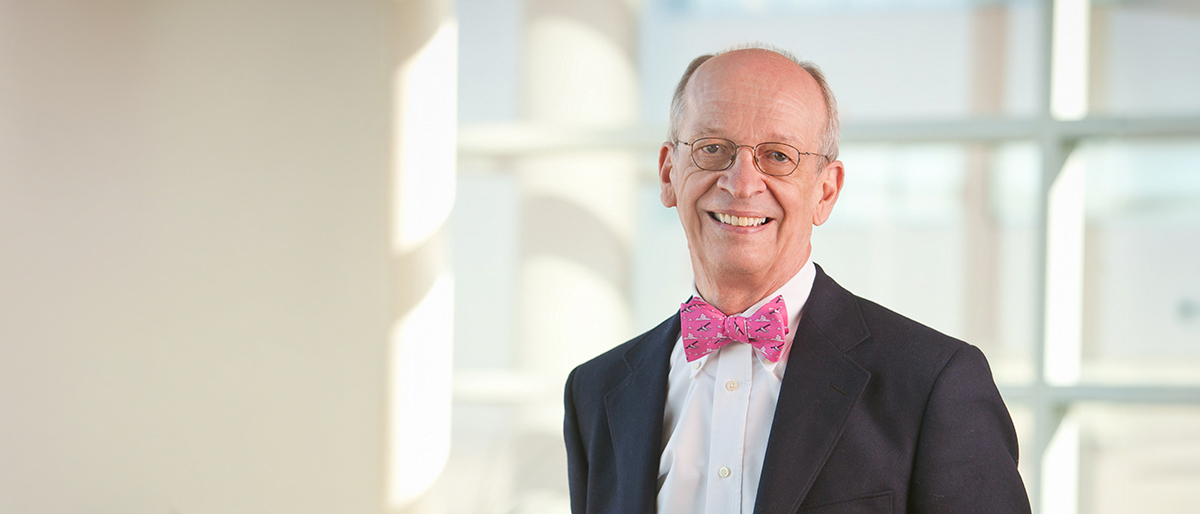
When William M. Lee, M.D., joined UT Southwestern in 1990, he immediately went to work in a tiny campus clinic treating liver disease patients. In the decades that followed, Dr. Lee’s practice grew as his research raised awareness about acute liver failure and new lifesaving therapies.
Through the years, his commitment to clinical research and teaching has been matched by his dedication to patients. “I love taking care of people,” Dr. Lee said. “Patients are so grateful and appreciative of what you do.”
Following 35 years of distinguished service and a career characterized by groundbreaking investigations, Dr. Lee has been appointed Professor Emeritus of Internal Medicine. Additionally, in honor of his work and to further the research he specialized in, the Will and Liza Lee Center for Liver Disease and Transplant Research recently launched at UT Southwestern.
Findings on drug-induced liver injury
Of his discoveries, Dr. Lee is best known for bringing attention to the dangers of the pain reliever acetaminophen, which when misused through accidental overdose can be fatal. For more than two decades he led the landmark National Institutes of Health (NIH)-supported multicenter Acute Liver Failure Study Group that enrolled 3,300 patients. The study group was funded by the NIH from 1997 to 2023.
“It really was one of the most gratifying experiences for me,” Dr. Lee said of the liver failure study.
Prior to the 1990s, acute liver failure was almost uniformly fatal. Today, with liver transplantation and improved intensive care, these patients have a 65% survival rate, Dr. Lee said.
Over his career, Dr. Lee served as site investigator for four NIH-sponsored research networks: the Acute Liver Failure Study Group, the HALT-C Trial, the Drug-Induced Liver Injury Network, and the Hepatitis B Research Network. He also directed NIH-funded studies on hepatitis B and drug-induced liver injury alongside numerous industry-sponsored clinical trials.
“Will has left an indelible mark on hepatology, as a pioneer of clinical care in our Division, a prolific investigator with multiple NIH grants, and an extraordinary mentor to house staff and faculty,” said Amit Singal, M.D., M.S., inaugural Director of the Lee Center, Professor of Internal Medicine, and Interim Chief of the Division of Digestive and Liver Diseases.
Dr. Lee’s medical journey
The seeds of Dr. Lee’s impressive career in medicine were planted when he was a child observing a family physician.
“My uncle was a general practitioner, and I remember he made house calls carrying his black bag,” Dr. Lee said. “That got me interested.”
Originally a literature major at Amherst College in Massachusetts, Dr. Lee shifted focus to earn his medical degree from Columbia University College of Physicians and Surgeons. He furthered his training in internal medicine at The Presbyterian Hospital, New York City (Columbia-Presbyterian Medical Center) and served as Chief Resident in internal medicine.
After a year of hepatology research at King’s College Hospital in London, Dr. Lee returned to New York, initially as a faculty member at Columbia University College of Physicians and Surgeons. He later served as Director of the Gastroenterology Division at the Medical University of South Carolina.
Dr. Lee and wife Liza Lee, M.A., both New Yorkers, moved to Dallas in 1990 when she accepted a position as Headmistress of The Hockaday School and Dr. Lee joined the faculty at UTSW.
Reflecting on the past and future
Dr. Lee embraced the many opportunities he had at UT Southwestern to not only provide clinical care but also teach and conduct valuable research.
“Liver disease has always been fascinating and unique because it has a lot of mysteries surrounding it,” Dr. Lee said.
He has also been recognized as a dedicated mentor who trained generations of residents, fellows, and junior faculty. Dr. Lee tells his mentees to find an area of medicine they enjoy and stay with it.
“Find a niche – a small one that you are in command of,” he advises. “That’s what launches your career.”
As for his own dreams, he is thrilled to see the Lee Center come to life and watch UTSW grow in size and stature.
“UT Southwestern has evolved in the best of ways, such that the strong emphasis on research remains central to the mission,” he said. “But we have broadened our scope tremendously and wisely under superb and consistent leadership.”
Endowed Titles:
Dr. Singal holds the Willis C. Maddrey, M.D. Distinguished Chair in Liver Disease and is a Dedman Family Scholar in Clinical Care.