


President’s Lecture Series: Innovating to advance breast cancer care

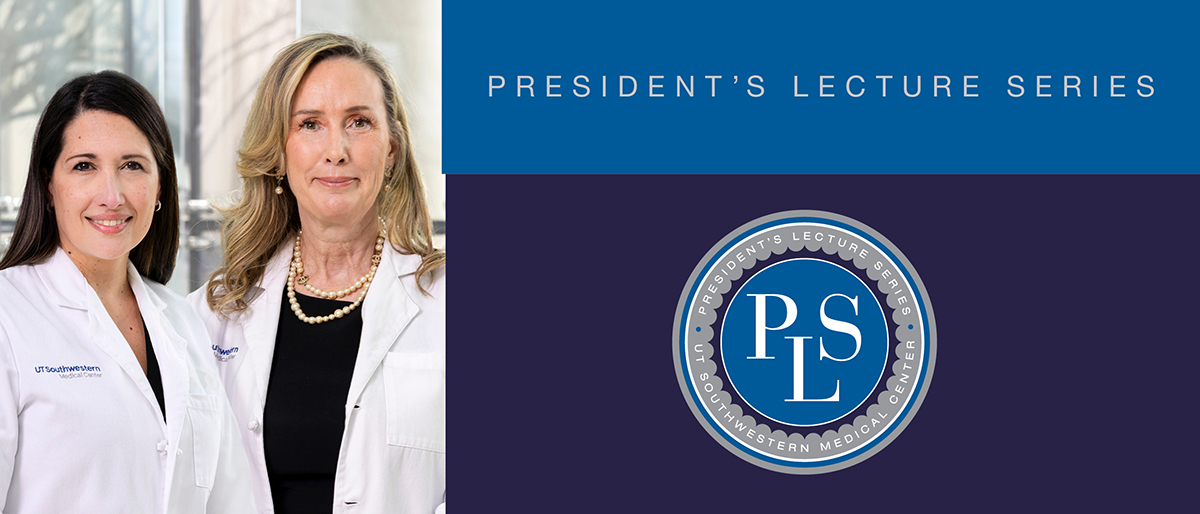
Two UT Southwestern cancer researchers – one who led a groundbreaking robotic surgery, the other a pioneer in the development of novel immunotherapy strategies – will talk about their internationally recognized work at the spring installment of the 2026 President’s Lecture Series.
Deborah Farr, M.D., and Heather McArthur, M.D., M.P.H., will present “Innovations in Breast Cancer Care: Advancing the Future of Medicine and Surgery, Today” at 4 p.m., April 16, in the Tom and Lula Gooch Auditorium. A livestream will also be available.
In 2020, Dr. Farr, a surgical oncologist and Associate Professor of Surgery, performed the first robotic nipple-sparing mastectomy in the U.S. One year later, Dr. McArthur, Professor of Internal Medicine in the Division of Hematology and Oncology and Clinical Director of the Breast Cancer Program at the Harold C. Simmons Comprehensive Cancer Center, joined UT Southwestern, bringing an expertise in immunotherapy and tumor freezing (cryoablation) to improve breast cancer outcomes.
Together, the two physician-scientists are changing the breast cancer treatment landscape and offering new hope to patients.
Overcoming obstacles to robotic mastectomy
After years of planning the surgery and receiving approval from UTSW’s Institutional Review Board and a special license from the U.S. Food and Drug Administration, Dr. Farr was ready to enroll patients in a clinical trial. But it would not be easy. The pandemic and limits on prophylactic surgery (surgery to prevent cancer) made patient recruitment difficult.
Another challenge was that robotic surgery requires two surgeons – one at the bedside and one controlling the robot from a console in the operating room. For the early clinical trials, Dr. Farr operated the robot while Herbert Zeh III, M.D., Chair of UTSW’s Department of Surgery, was at the bedside. After several surgeries, during which he and Dr. Farr developed the optimal technique, he taught a physician assistant to serve in this role.
Despite the obstacles, Dr. Farr moved forward. “It really has been a constellation of incredible luck,” she said. “It was a small miracle.”
The results have been promising. A study published in JAMA Surgery in early 2024 reported excellent results among the first 20 patients who underwent the procedure.
When she presented the outcomes data nationally for the first time, many surgical oncologists were baffled that a mastectomy could be performed through such a small incision, Dr. Farr said.
“While modern mastectomy and breast reconstruction have made great strides, most approaches still result in loss of full sensation in the nipple and breast due to nerve damage from large incisions and excessive retraction,” Dr. Farr said. “Almost all patients in the initial study retained sensitivity in their breasts.”
Since the first surgery, more than 100 have been performed as part of the clinical trial. Half of the patients had early-stage cancer or were at elevated risk for the disease and reported still having sensation, which is key to maintaining their quality of life after treatment.
In recent years, Dr. Farr has traveled worldwide, giving lectures on the surgery with Nicholas Haddock, M.D., Professor of Plastic Surgery and Orthopaedic Surgery, who worked closely with Dr. Farr to develop the robotic nipple-sparing mastectomy (rNSM) and reconstruction procedure. Making the surgery accessible to more patients is one of their goals.
“The robotic surgery was originally controversial, but now it is largely accepted and has FDA approval,” said Dr. Farr, adding that the single port robotic platform obtained clearance from the FDA in December 2025.
Immunotherapy to treat breast cancer
Dr. McArthur is addressing breast cancer by using immunotherapy to improve patient outcomes.
Dr. McArthur is a Principal Investigator on various national and international clinical trials whose research has focused on the impact of immunotherapy to stimulate tumor-specific immunity and improve breast cancer-specific outcomes.
In one trial, she used the preoperative immunotherapy medication pembrolizumab to stimulate the immune system in combination with chemotherapy and HER2-targeting therapy to treat patients with early-stage HER2-positive breast cancer. The results have been significant. About 50% of patients respond to standard preoperative treatment. But when immunotherapy was added to the regimen before surgery, the percentage of patients who responded positively increased by 20%.
“What we’re trying to do is generate tumor-specific immune response to create a vaccine-like effect and thereby improve cure rates,” Dr. McArthur explained.
Dr. McArthur and her team are also investigating a strategy that freezes tumors with cryoablation while simultaneously activating the immune system. By exposing the immune system to tumor cells in this way, they hope to train the body to recognize and fight triple-negative breast cancer (TNBC) more effectively, potentially creating long-lasting protection against cancer recurrence.
With cryoablation, probes apply extreme cold directly to cancer cells, which then die. The destruction of tumor tissue by cryoablation induces activation and maturation of critical immune cells and activation of tumor-specific immune cells.
“Freezing the tumor breaks it down into tiny pieces that might be more easily digested by immune cells and attracts critical immune cells to the tumor,” Dr. McArthur said.
Her current clinical trial has shown promising results for TNBC, which has a high risk of recurrence. Three years after the novel treatment was evaluated in the first cohort, the percentage of patients who did not relapse improved by 10%.
Dr. McArthur said she feels a sense of urgency because she has seen the impact this disease has on patients, especially those with TNBC.
“These are young patients in their 20s and 30s who often have young children,” she said. “They need to become grandmothers one day.”
Endowed Titles
Dr. McArthur holds the Komen Distinguished Chair in Clinical Breast Cancer Research.
Dr. Zeh holds the Hall and Mary Lucile Shannon Distinguished University Chair in Surgery.