


‘Fearless’ postdoc receives Brown-Goldstein Award for enzyme discoveries

Through a wonderfully efficient process called the mevalonate pathway, the body makes building blocks called polyisoprenyl diphosphates that are necessary for generating a wealth of essential molecules. These include the cholesterol that composes cell membranes, a critical iron-carrying molecule called heme found in blood, and the vitamin K responsible for clotting. Polyisoprenyl diphosphates can also be formed in a different way, by salvaging precursors of polyisoprenyl diphosphates, known as polyisoprenyls, from foods such as nuts and seeds, fruits and herbs, and plant oils.
To access this alternate diet-based pathway, two enzymes must place phosphate groups on these precursors. But despite decades of research, the identity of the enzymes had remained a mystery.
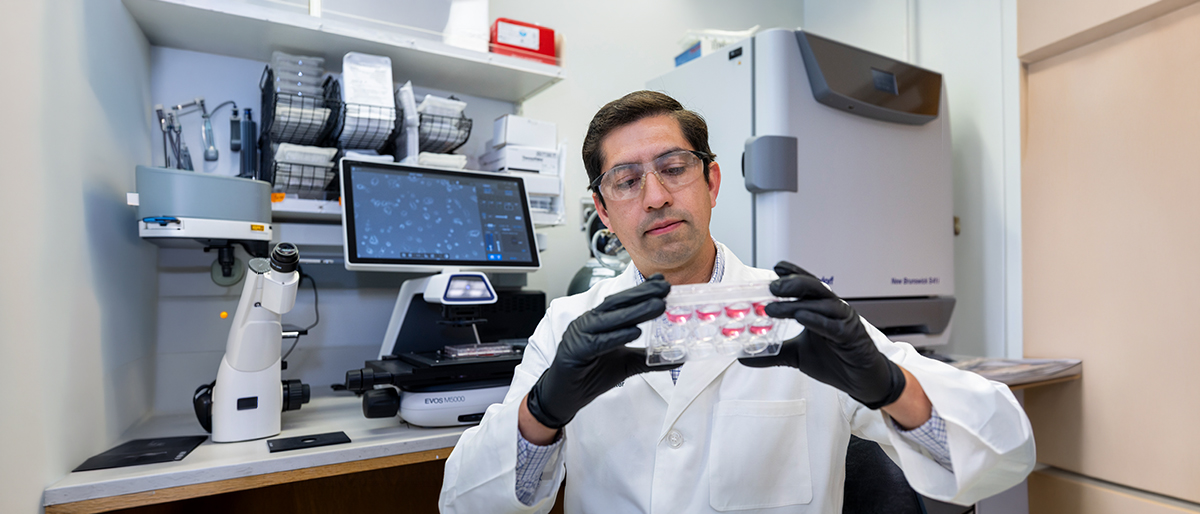
Over the last five years, Victor López, Ph.D., a Howard Hughes Medical Institute (HHMI) Hanna H. Gray postdoctoral scholar in the laboratory of Vincent Tagliabracci, Ph.D., worked to identify the causative enzymes. Defining these enzymes could possibly lead to new ways to treat conditions – such as cancer or statin-induced myopathy – in which portions of this pathway go awry. In addition, the innovative way Dr. López and his colleagues found these enzymes could serve as a blueprint for discovering others.
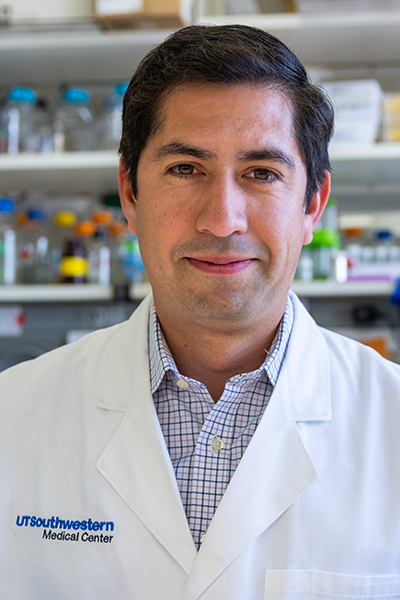
Dr. López’s bold research has been recognized with the Brown-Goldstein Award for Excellence in Postdoctoral Research, given annually by the UT Southwestern Graduate School of Biomedical Sciences in honor of the contributions of UTSW Nobel Laureates Michael Brown, M.D., and Joseph Goldstein, M.D., to training future scientists. Accompanied by a $6,500 prize and the opportunity to present a University Lecture, the award is the highest recognition the Graduate School bestows on postdoctoral trainees. Dr. López will deliver his lecture on Wednesday, Sept. 23, at 4 p.m. in the T. Boone Pickens Medical Education & Conference Center (NG3.112).
“Victor is one of the most fearless and creative scientists I have worked with,” said Dr. Tagliabracci, Associate Professor of Molecular Biology and an HHMI Investigator. “He has an exceptional ability to recognize important biological questions and pursue them with the rigor and persistence needed to make transformative discoveries, including uncovering the long-sought enzymes of the polyisoprenyl salvage pathway. I have no doubt that he will become a successful independent investigator and a leader in biomedical research.”
While growing up just north of San Diego, Dr. López developed an interest in chemistry. He knew he wanted to pursue a research career after joining a biochemistry lab as an undergraduate student at the University of California San Diego. He earned a dual degree in biochemistry and chemistry, then came to UT Southwestern for graduate school and rotated in the Tagliabracci Lab. Dr. López was drawn to its novel focus – the lab’s webpage describes its research as “demystifying weird proteins” – and Dr. Tagliabracci’s empowering mentoring style.
“He treats everyone in the lab more like peers than trainees, which encourages independence,” Dr. López said. “He’s given me freedom to pursue my own goals and ambitions.”
While earning his Ph.D., Dr. López identified unrecognized kinases – enzymes that transfer a phosphate group from adenosine triphosphate (ATP), the molecule that supplies energy for all cellular activities, to other molecules including proteins, lipids, and carbohydrates. He discovered previously unknown kinases in a plant pathogen called Pseudomonas syringae and a human pathogen called Legionella pneumophila before graduating with his doctoral degree in 2022.
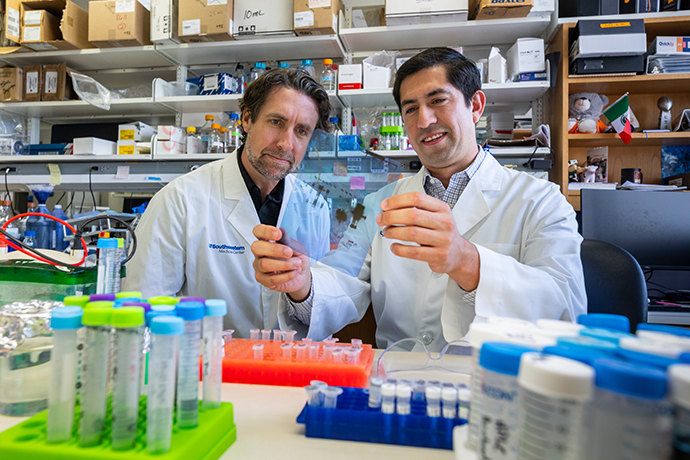
He chose to stay at UTSW for his postdoctoral fellowship, switching gears to work on a different family of enzymes known as ATP grasp proteins that facilitate the formation of high-energy bonds between molecules. To find previously unrecognized enzymes of this type, his team developed a strategy of looking for genetic sequences similar to those of known ATP grasp proteins – but different enough that they were missed by algorithms built for this purpose – then determining if the proteins produced by these genes were indeed enzymes in the ATP grasp family.
The team reversed this strategy to find the missing enzymes in the polyisoprenyl salvage pathway: Knowing that two missing enzymes were necessary to place phosphate groups on polyisoprenyl diphosphate precursors, Dr. López and his colleagues looked for proteins that played a similar role in plants. Then, using an artificial intelligence program called AlphaFold that predicts proteins’ structures from their genetic sequences, they sought out genes that produced proteins similar to the plant proteins’ shapes in humans. This approach led them to identify proteins known as DOLK and TMEM19 as the missing kinases in this pathway – solving a long-standing scientific mystery.
Through a collaboration with Russell DeBose-Boyd, Ph.D., Professor of Molecular Genetics and Assistant Dean for Research Advancement, Dr. López and his colleagues confirmed their findings in animal models. These models also suggested that hindering the activity of these kinases caused muscle problems when taking the cholesterol-lowering drugs statins, potentially explaining the muscle pain that some patients on statins experience. Research by Dr. Brown and Dr. Goldstein led to the creation of statins, work that earned the pair the 1985 Nobel Prize in Physiology or Medicine. Dr. DeBose-Boyd was a postdoctoral fellow in their laboratory before joining the UTSW faculty in 2003.
“Our bodies can synthesize polyisoprenyl diphosphates, so it’s unclear why we need this salvage pathway,” said Dr. DeBose-Boyd, a member of the National Academy of Sciences. “Victor’s discovery of these two enzymes can now allow us to study why this pathway exists and when it’s activated. It helps complete the puzzle.”
Dr. López plans to seek a faculty position where he can lead his own lab, using this strategy to search for enzymes missing in other critical biomolecular pathways.
Endowed Titles
Dr. Brown, a Regental Professor, holds The W.A. (Monty) Moncrief Distinguished Chair in Cholesterol and Arteriosclerosis Research and the Paul J. Thomas Chair in Medicine.
Dr. DeBose-Boyd holds the Beatrice and Miguel Elias Distinguished Chair in Biomedical Science.
Dr. Goldstein, a Regental Professor, holds the Julie and Louis A. Beecherl, Jr. Distinguished Chair in Biomedical Research and the Paul J. Thomas Chair in Medicine.
Dr. Tagliabracci is a Michael L. Rosenberg Scholar in Medical Research.