


School of Health Professions prosthetic-orthotic alumnus dares to dream

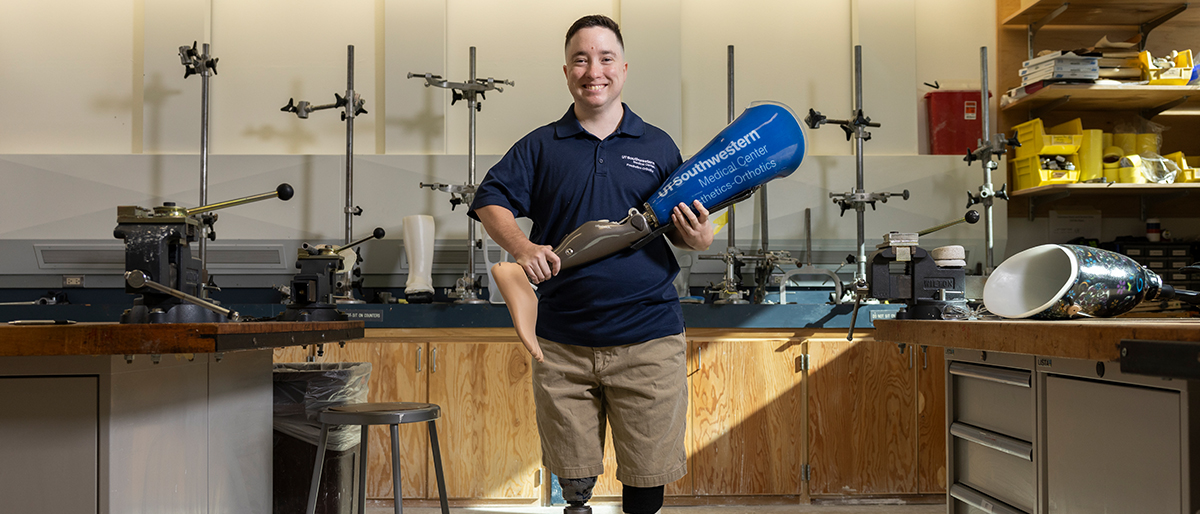
Adversity has not prevented Riley Phipps from answering his calling; it has prepared him for it. He was born with a severe form of club foot, a birth defect of unknown cause that affected the bones, muscles, tendons, and blood vessels in his feet and legs. As a double leg amputee, he has devoted his life to helping others just like himself.
“As far as what drives me, I’m pretty sure I’m just too stubborn to quit,” said Mr. Phipps, who earned his Master of Prosthetics-Orthotics from UT Southwestern’s School of Health Professions in December 2024. “Nothing has ever been easy for me, so at this point challenges are just expected.”
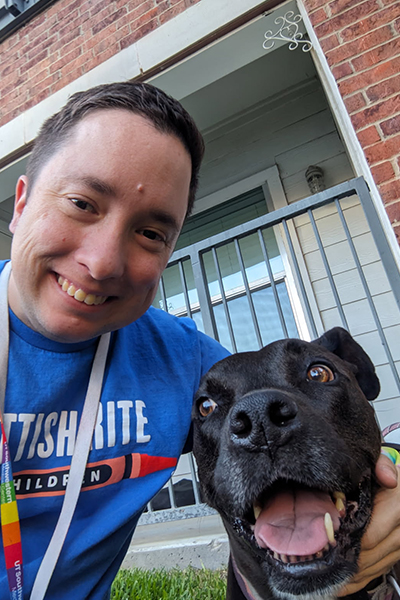
His unwavering determination has helped him push the boundaries of what is possible. With the help of prosthetic legs and running blades, he enjoys rock climbing, hiking, running, backpacking, and scuba diving and uses a “sit ski” designed for people with limited mobility to experience the thrill and freedom of skiing. He also kayaks with his best friend and adventure buddy, Bonnie, a three-legged Labrador pit bull mix.
“The way I see myself, I feel incredibly fortunate. Being born this way has opened doors that would never have opened,” Mr. Phipps said. “I have met incredible people, made amazing friends, and done things that most people only dream of. On the surface, being a double amputee may look like it’s terrible, but for me, it’s a blessing.”
A born fighter
Mr. Phipps’ health struggles began at birth. He and his twin sister, Lyndsey, were born prematurely and spent their first weeks fighting for their lives in a Fort Worth neonatal intensive care unit. When he was a toddler, the family moved to the Amarillo, Texas, area where he underwent numerous surgeries and was treated with serial casts, a nonsurgical orthopedic treatment that involves applying casts to improve range of motion and enable better use of the legs.
“I was always in pain and didn’t participate in sports, so I dove headfirst into the brainy stuff. I was bookish and read every textbook I could get my hands on,” he said. “I loved math, learning, and watching documentaries and was obsessed with dinosaurs, space, and bull riders.”
His condition worsened in high school. Although he was able to walk using orthotics, it was very painful. Mr. Phipps began relying on a wheelchair for mobility.
“Everyone was always willing to lend a hand to open a door or give me a boost up a curb. I had to learn how to let things go and allow people to help me, which for me was a big challenge,” he said.
Before Mr. Phipps started college, doctors amputated both legs. “By this time, my physicians had hit their limits on what they could do surgically with my legs. My feet were incredibly painful, and I had frequent infections, so my surgeon amputated my legs to give me more mobility. It was a relief to get my legs amputated. I had some rough days, but I am even-tempered and easygoing, and I don’t let most things upset me,” he said.
After surgery, Mr. Phipps experienced severe spasticity, and his residual limbs became tight and difficult to move. Over time, he adapted to prosthetic legs, which restored his mobility and helped him regain independence. Determined to continue his education, he began studies at Amarillo Community College, where counselors and professors encouraged him to pursue an advanced degree.
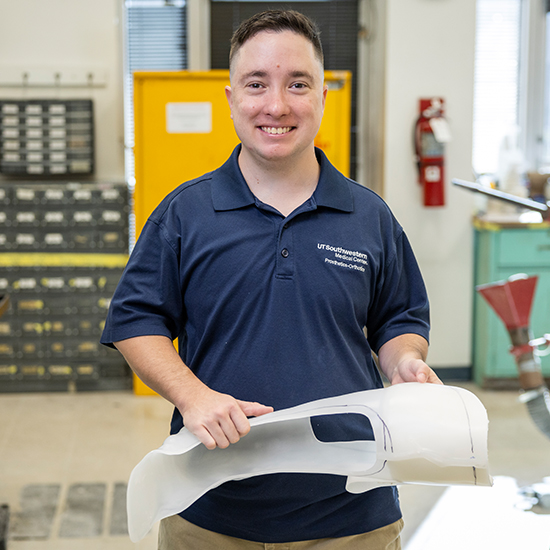
Initially, he considered careers in aerospace engineering or orthopedic surgery. While working as an assistant to a prosthetist in the office where he received his care, he discovered his true passion.
“I fell in love with the field,” Mr. Phipps said. “It was a career that would enable me to help people as well as incorporate my love for building things.”
Following his spark
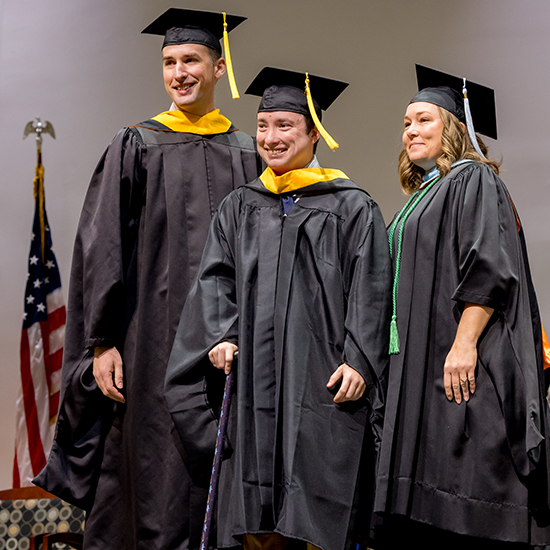
After graduating from West Texas A&M University in 2023 with a bachelor’s degree in sports and exercise science, Mr. Phipps chose UTSW because of its excellent reputation for prosthetic and orthotic education. Alisa J. Winkler, Ph.D., Associate Professor of Surgery in the Department’s Section of Anatomy and a Distinguished Teaching Professor, described Mr. Phipps as a kind, outgoing, hardworking individual with a tremendous drive to succeed.
“The laboratory section of our anatomy course requires teamwork, and Riley was always ‘all in,’ contributing to the success of his interprofessional team,” Dr. Winkler said. “He has excellent social skills and a positive attitude, and everyone from our teaching team to his peers thoroughly enjoyed being with him. These skills and attributes, as well as his passion to help others, will contribute to his becoming a leader in prosthetics and orthotics.”
When the Anatomy faculty designed a new laboratory, they turned to Mr. Phipps for his perspective. “We problem-solved together with Riley on how to best deal with physical obstacles to succeed in our lab,” Dr. Winkler said. “When talking with him about his challenges, he opened our eyes to many things about our prior lab space that we just took for granted, such as gaining access to secure areas or working at tables that weren’t too low or too high. His insights were invaluable to the design of our lab.”
Another mentor, Gary Iwamoto, Ph.D., Professor of Surgery, was impressed by Mr. Phipps’ strong work ethic.
“Riley brings a unique perspective to his work in that the challenges of learning to live with lower limb prosthetics are nothing new to him. His patients will often be at the beginning of their lives with prosthetics. Having been there himself, he knows what to say and do. This will be a big plus for his future patients,” Dr. Iwamoto said.
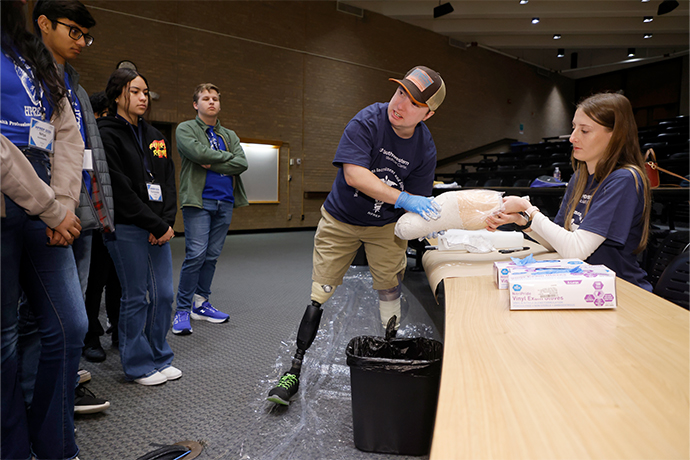
Mr. Phipps served as the outreach coordinator for his prosthetics-orthotics (P&O) cohort and enjoyed the opportunity to connect with students from kindergarten through college about the School of Health Professions’ P&O program. He also served as a peer visitor in a prosthetist’s office to help guide people through their journeys as amputees.
Triumph over challenge
In November, Mr. Phipps began a residency at Hanger Clinic in St. Louis, Missouri, where he is focused on learning and growing as a clinician. He currently provides acute care for patients of all ages who are recovering from injuries and amputations. When he completes his residency in 18 months, he hopes to become a Certified Prosthetist Orthotist (CPO) and specialize in pediatric prosthetics and orthotics, working in a children’s hospital where he can help young patients achieve mobility and confidence.
Life hasn’t been easy, but Mr. Phipps lives it with pride, gratitude, and a quiet sense of purpose that inspires everyone he meets.
“I use my prosthetics to do some incredible things that I never imagined I could do when I was a child,” he said. “When you’ve handled hardship and come out the other side, you can’t help but have a heart for those who are struggling. My whole goal in life is to reduce suffering as much as I can, and I will do everything possible to make sure my patients know I’m their biggest advocate.”