


Sankaranarayanan inducted into ACS Academy of Master Surgeon Educators
Faculty member is among 103 worldwide recognized for innovation and excellence in surgical teaching

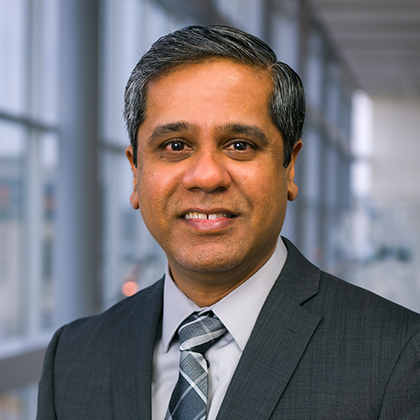
Ganesh Sankaranarayanan, Ph.D., Associate Professor of Surgery and Biomedical Engineering, was among 103 esteemed surgeon educators inducted into the American College of Surgeons (ACS) Academy of Master Surgeon Educators at a ceremony in September in Chicago. Following a stringent peer review process, individuals are selected as Members, Associate Members, or Affiliate Members. Dr. Sankaranarayanan is one of five new Affiliate Members, nonsurgeons who are experts in various disciplines that positively impact surgical education.
The ACS Academy of Master Surgeon Educators works to advance the science and practice of education across all surgical specialties. Since 2018, it has grown to 458 members representing 13 surgical specialties (other than general surgery) from 26 countries.
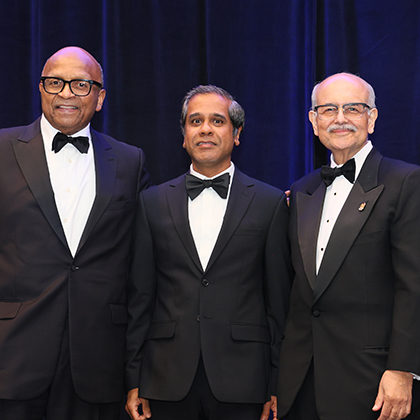
“This year, we celebrate another cohort of distinguished surgeon educators who are pushing the frontiers of surgical education and making outstanding contributions to our field,” said Ajit K. Sachdeva, M.D., FACS, FRCSC, FSACME, Senior Vice President of the ACS Division of Education and co-Chair of the Academy. “As we welcome these new members, we are excited to continue fostering innovation, collaboration, and excellence in surgical education.”
Dr. Sankaranarayanan described his selection as a tremendous honor and a deeply meaningful milestone.
“It reflects the collective efforts of my mentors, colleagues, and trainees who have shaped my journey as an educator,” he said. “This recognition strengthens my commitment to advancing surgical training through innovation, simulation, and data-driven learning aimed at reducing errors and improving patient outcomes.”
Dr. Sankaranarayanan is co-Director of UTSW’s Center for Assessment of Surgical Proficiency and Director of the Artificial Intelligence and Medical Simulation (AIMS) Lab, where his team is creating novel methods for objective performance measurement, video-based feedback, and automated assessment of surgical skills. His work focuses on integrating artificial intelligence (AI), simulation, and performance analytics to improve how surgeons are trained and assessed. He has led initiatives, funded by the National Institutes of Health and the Agency for Healthcare Research and Quality (AHRQ), that use high-fidelity simulation and real-world performance data to enhance skill acquisition and patient outcomes.
To date, Dr. Sankaranarayanan has developed assessment tools that have led to measurable improvements in surgical performance, created virtual simulation platforms with custom haptic interfaces to train both technical and cognitive skills, and designed immersive virtual simulation systems for nontechnical skill development such as leadership, communication, and decision-making. He also has built AI-based models for automated activity recognition, performance assessment, and outcome prediction.
“Looking ahead, my goal is to continue bridging technology and surgical education using AI, interactive multimodal simulation, and real-world data to personalize training and accelerate the path from competence to mastery,” he said. “I also aim to develop and validate frameworks that ensure these technologies are evidence-based, equitable, and scalable across institutions worldwide.”
After earning his Ph.D. in electrical engineering from the University of Washington in Seattle, Dr. Sankaranarayanan completed postdoctoral research at the Advanced Computational Research Laboratory at Rensselaer Polytechnic Institute.
In 2021 he joined UT Southwestern, which offered an ideal environment where innovation, clinical excellence, and education intersect, he said.
“I was drawn by the opportunity to collaborate with visionary leaders in surgery and simulation science, and to contribute to a program that values both rigor and creativity in surgical education,” Dr. Sankaranarayanan said. “The institution’s commitment to multidisciplinary collaboration and mentorship aligned perfectly with my goal.”
He is grateful for the ACS recognition as well as for incredible colleagues and trainees who make his work meaningful every day.
“Surgical education is evolving faster than ever, and it is a privilege to be part of a community shaping that future not only through technology and innovation, but through shared purpose, mentorship, and human connection,” Dr. Sankaranarayanan said.