


Girotra, Turer elected to esteemed honor society for researchers

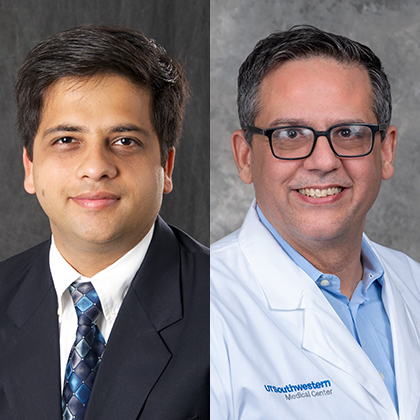
In honor of their outstanding scholarly achievements, Saket Girotra, M.D., Professor of Internal Medicine in the Division of Cardiology, and Emre Turer, M.D., Ph.D., Associate Professor of Internal Medicine in the Division of Digestive and Liver Diseases and of Immunology, have been elected to the American Society for Clinical Investigation (ASCI), one of the nation’s oldest medical honor societies. Drs. Girotra and Turer were among 100 physician-scientists – all age 50 or younger – recommended for election this year.
Founded in 1908, ASCI is composed of more than 3,000 physician-scientists representing all medical specialties. It focuses on the pivotal role of physician-scientists in research, clinical care, and medical education, as well as leadership positions in academic medicine and the life sciences industry. The society publishes the Journal of Clinical Investigation and JCI Insight.
Saket Girotra, M.D.
Dr. Girotra is an interventional cardiologist specializing in complex coronary interventions.
“I am deeply grateful for the recognition of the value and impact of our work. At the same time, I feel humbled, as ASCI’s membership includes many leaders in the field whom I deeply admire,” he said. “I am excited to join the ASCI community and look forward to the opportunities for collaboration and engagement it will bring.”
Throughout his career, Dr. Girotra has focused on improving health care delivery for patients with cardiovascular disease and reducing health care disparities. His work has resulted in more than 200 papers in such publications as the New England Journal of Medicine, JAMA, JAMA Internal Medicine, Circulation, and the Journal of the American College of Cardiology.
Improving survival after cardiac arrest has been a central focus of his research.
“I am particularly excited about our ongoing work partnering closely with emergency medical services agencies across the country to identify characteristics of agencies serving predominantly Black and Hispanic communities, which historically have lower survival rates. Our goal is to identify strategies that can help close these gaps,” he said.
Dr. Girotra also recently launched a multicenter study of peripheral artery disease (PAD) to investigate how traditional risk factors, such as blood pressure, influence long-term patient outcomes. The Peripheral Artery Disease: Long-Term Survival (PEARLS) study includes more than 100,000 veterans with new-onset PAD, making it one of the largest PAD registries in the world.
“Research gives me the opportunity to pursue questions that arise while I am caring for patients in the hospital or clinic. As a result, my work has direct relevance to how we deliver care,” he said.
After earning his medical degree from the All India Institute of Medical Sciences, New Delhi, Dr. Girotra completed his internal medicine residency at the Medical College of Wisconsin followed by fellowships in cardiology and interventional cardiology at the University of Iowa, where he served as Chief Fellow. He also received a master’s degree in epidemiology from the Harvard T.H. Chan School of Public Health. He joined the UTSW faculty in 2022.
“I was drawn to UTSW because of its strong commitment to clinical excellence, scientific innovation, and improving population health,” he said. “The institution’s collaborative environment and depth of expertise across disciplines create an ideal setting for advancing health services research.”
Emre Turer, M.D., Ph.D.
Dr. Turer specializes in inflammatory bowel disease, ulcerative colitis, and Crohn’s disease.
“Election to the American Society for Clinical Investigation is deeply meaningful to me because ASCI represents physician-scientists who are committed to medical discovery and understanding,” he said. “It reflects not only my own hard work and dedication, but also the strong mentorship and support that I have received over the years.”
Dr. Turer’s research is focused on discovering new genes involved in maintaining intestinal homeostasis. He has published numerous articles on intestinal inflammation in such journals as Immunity, Nature, Nature Communications, Nature Immunology, and the Proceedings of the National Academy of Sciences.
The Turer Lab studies how the intestine maintains a healthy balance between the immune system and the microbes of the gut. The team has used forward genetics to discover previously unknown contributors that help intestinal cells sense stress, secrete protective mucus, and regulate immune responses.
“The goal is to understand the fundamental biology that keeps the intestine healthy and ultimately identify new therapeutic pathways for inflammatory bowel disease,” Dr. Turer said.
He is especially excited about his lab’s current work investigating the spatial segregation of host and microbe at the mucosal surface.
“In particular, we are interrogating specialized intestinal cells called goblet cells, which produce the mucus layer that protects the gut,” he said.
ASCI membership provides access to a community of physician-scientists dedicated to investigation – a connection Dr. Turer expects will lead to new collaborations, broaden scientific exchange, and help amplify his lab’s work.
“I have always been attracted to solving problems, and the moment of discovery – finding something nobody has seen before – is especially gratifying,” he added. “It’s especially rewarding when basic scientific insights begin to explain diseases I see in patients and suggest entirely new ways to treat them.”
After earning his medical degree and doctoral degree in biological sciences at the University of Chicago Pritzker School of Medicine, Dr. Turer completed his residency in internal medicine and a fellowship in digestive and liver diseases at UT Southwestern as part of the Internal Medicine Physician Scientist Training Program. He joined the UTSW faculty in 2015.
“UT Southwestern attracted me because of a unique culture supporting physician-scientists,” he said. “The strength of the basic science divisions coupled with the robustness of the clinical training made it an ideal place for my training and the subsequent launching of my independent career.”