


Improving prevention and treatment of maternal and congenital syphilis
Translational research program tackles the infection from three angles: clinical care, research, and public health

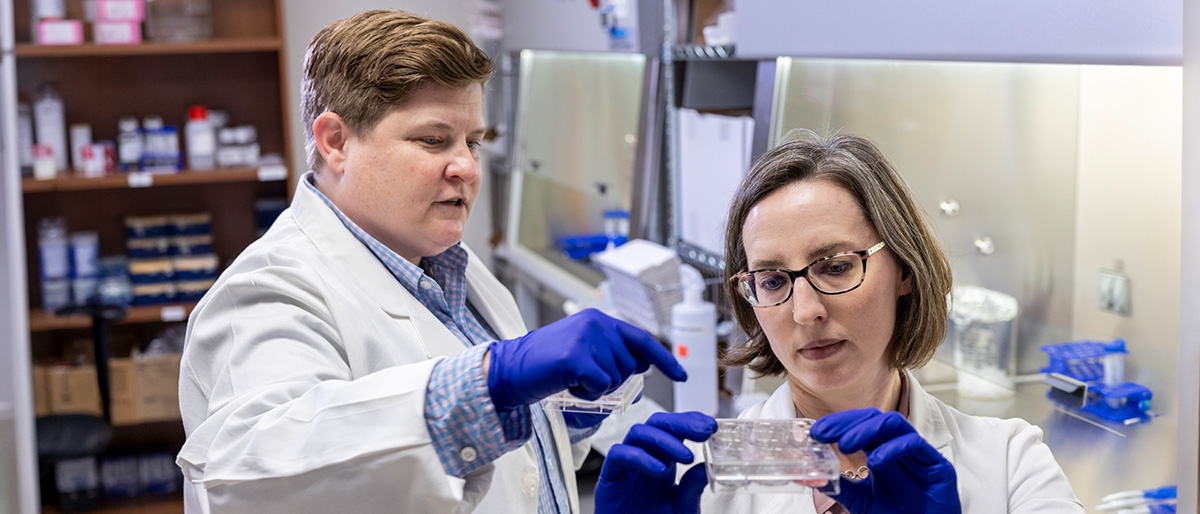
The symptoms of syphilis are often so mild and vague that a woman can be chronically infected for years without ever knowing it – until she delivers a baby.
It’s called the great imitator because the infection is difficult to detect and it mimics viral illnesses before it quickly goes away, said Emily Adhikari, M.D., Associate Professor of Obstetrics and Gynecology at UT Southwestern and the Medical Director of Perinatal Infectious Diseases at Parkland Health.

Symptoms often disappear, but when left untreated, this bacterial infection that is typically transmitted through sexual contact can lead to miscarriages, stillbirth, and neonatal complications. Treponema pallidum, the bacterium that causes syphilis, can be passed through the placenta during pregnancy or through direct contact with infected ulcers during delivery, resulting in congenital syphilis infection in the infant.
“In the worst cases of early maternal infection that are undetected throughout early pregnancy, it can be fatal to the fetus,” Dr. Adhikari said. “This disease doesn’t usually cause fatal illness in immunocompetent adults but can certainly be fatal for an affected neonate.”
To combat this emerging health threat, Dr. Adhikari has launched a translational research program that focuses on the centuries-old infection. This research is critically important because it addresses the fundamental biological and public health gaps that allow the infection to persist, said W. Lee Kraus, Ph.D., Director of the Cecil H. and Ida Green Center for Reproductive Biology Sciences.
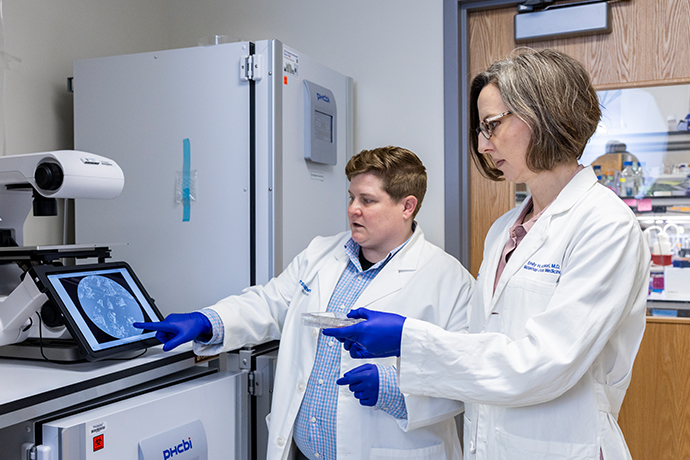
“Her work has the potential to directly inform better screening, prevention, and treatment strategies that can save lives,” Dr. Kraus said.
Cases of congenital syphilis are growing in the U.S. The rate has risen over 700% since 2015, with more than 4,000 cases reported in 2024, according to the Centers for Disease Control and Prevention, which has declared the infection a national crisis.
Dr. Adhikari’s team is taking a three-pronged approach to addressing the problem from the angles of research, clinical care, and public health.
“To do public health and clinical science is important, but if we don’t pair science with outreach and access, I feel like we’d be doing a disservice,” Dr. Adhikari said.
Research

Historically, there has not been significant basic or translational research on congenital syphilis, said Ashley Solmonson, Ph.D., an Assistant Professor in the Green Center and of Obstetrics and Gynecology, who is collaborating with Dr. Adhikari to study the placenta.
“Little is known about syphilis biology because T. palladum is difficult to grow in the lab, and it hides from the immune system,” Dr. Solmonson said.
A biorepository at the Green Center opened this year to store specimens donated by consenting pregnant patients to facilitate translational research that will advance understanding of pathological conditions in human pregnancy. About 50 women with syphilis as well as those who never had the disease have voluntarily donated their blood, placentas, and umbilical cord blood to be studied.
“We are indebted to our pregnant patients who consent to participate in current and future studies to improve what is known about syphilis during pregnancy,” Dr. Adhikari said.
“By studying placentas from women diagnosed with syphilis, we can understand how the disease influences placental development and function,” Dr. Solmonson added. “These samples will also help us understand how T. palladum infects the placenta and how it can get past the placental barrier to infecting the fetus to cause congenital syphilis. This information can be used to help prevent fetal infection and mortality.”
Clinical care
To advance clinical care, Dr. Adhikari is seeking ways to improve diagnosis and treatment. Since the infection can lie dormant for decades, it is difficult to detect, with 70%-80% of patients being asymptomatic.
“Preventing congenital infection begins with identifying the infection earlier so that the mother can be treated before she passes it to her baby,” she said, “but until the woman is tested, the baby is at risk.”
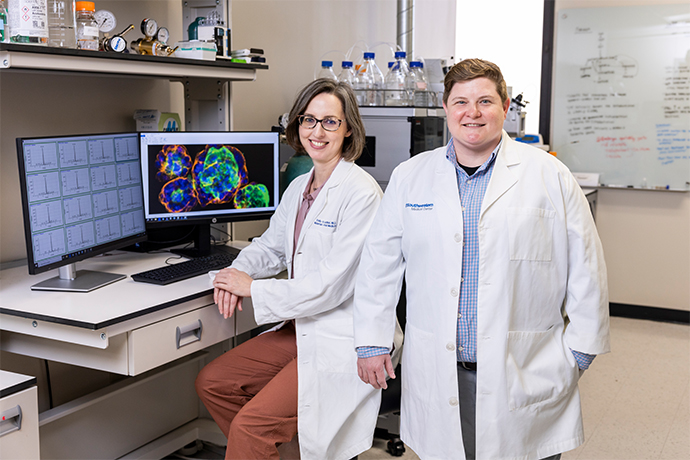
Interpretation of tests can be tricky, and Dr. Adhikari provides clinical guidance to physicians for diagnosis and management of syphilis through articles in scholarly journals. She also serves as an expert for the Texas Congenital Syphilis Hotline.
When the mother is tested early in pregnancy, congenital syphilis is preventable. Syphilis testing is routine in Texas during a prenatal checkup, but women who do not receive care in the first trimester unfortunately can pass the infection to their babies. When syphilis is diagnosed later, treatment may not be successful.
Penicillin shortages have also made it difficult to treat syphilis. (Penicillin is the only recommended treatment for pregnant women.) Treatment of early infection is generally highly effective with a single dose of penicillin, but late-stage syphilis requires more doses. Left untreated, syphilis can cause damage to the heart, brain, nerves, eyes, skin, and bone years after infection.
Public health
Early in pregnancy, numerous factors may stand in the way of diagnosis and treatment – financial barriers, language obstacles, substance abuse, and social stigma can make it challenging for some women to access prenatal care and get tested for syphilis, Dr. Adhikari said. The pandemic also took a toll, she said, leaving more patients without income or insurance.
To improve healthcare access, Stamp Out Syphilis was established in 2023 as a collaboration among UT Southwestern, Dallas County Health and Human Services (DCHHS), Parkland Health, and Owenwood Farm and Neighbor Space in East Dallas. Funding for the program is provided through a community-based research award and in-kind contributions to support testing and education.

Dr. Adhikari also collaborates with Amanda Evans, M.D., Associate Professor of Pediatrics at UTSW and Medical Director of the Congenital Infectious Diseases clinic at Children’s Health, to lead public awareness and education efforts about congenital syphilis. Together, they participate as clinical experts and reviewers for a quarterly Fetal Infant Mortality Review (FIMR) conference led by DCHHS and Texas Department of State Health Services congenital syphilis surveillance teams. At this quarterly conference, local congenital syphilis cases are reviewed by Drs. Adhikari and Evans and public health staff for prevention opportunities. As a result, DCHHS has increased targeted syphilis testing in areas where congenital syphilis cases have been identified, and Drs. Evans and Adhikari and DCHHS Disease Intervention staff have provided outreach for Dallas area clinics and hospitals.
“Our Dallas County colleagues have tried to reach the hardest-hit places where there are patients living in homeless encampments who do not have access to regular healthcare or prenatal care,” Dr. Adhikari said.
Tackling this public health issue could enhance patient outcomes with improved access to prenatal care, better screening protocols, and more timely treatment, said Catherine Y. Spong, M.D., Chair of Obstetrics and Gynecology.
Dr. Adhikari is targeting congenital syphilis from every angle, Dr. Spong said.
“It is vital to better understand and develop more effective diagnostic tools,” she said. “By understanding the biologic mechanisms that drive adverse pregnancy outcomes and congenital infections, as well as understanding the mechanisms for preterm birth in the case of congenital infection, we could use this information in vaccine development to target these pathways and develop more effective vaccines and interventions tailored to pregnancy.”
Endowed Titles:
Dr. Kraus holds the Cecil H. and Ida Green Distinguished Chair in Reproductive Biology Sciences.
Dr. Spong holds the Paul C. MacDonald Distinguished Chair in Obstetrics and Gynecology.