


A spinal emergency changed her life: UTSW rehab program helped restore it

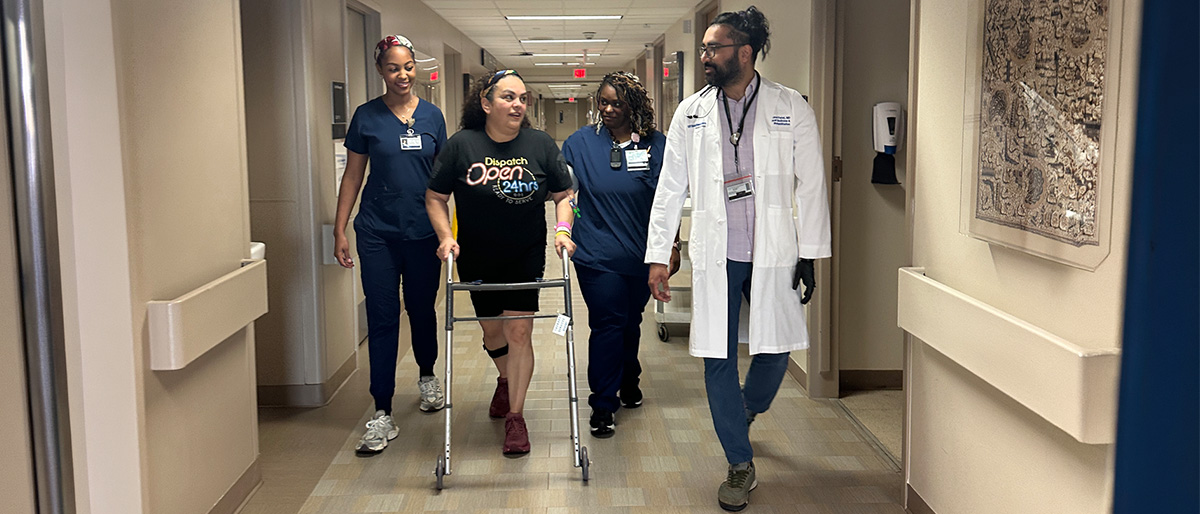
It felt like someone was playing drums on her back.
What began as a trip to a Tarrant County emergency room for excruciating pain that struck without warning quickly became even more alarming for Veronica Luna. Suddenly, the stabbing sensation was accompanied by a loss of feeling and strength in her legs.
Within seconds, she could no longer stand or walk. Desperate for answers, she found herself facing the possibility of permanent paralysis.
“It was very scary,” said Mrs. Luna, 51, a 911 dispatcher from Bedford. “The pain was so intense. Then, suddenly, you don’t know if you’re ever going to be able to walk again. I ended up spending seven days in the ICU while my situation just seemed to get worse.”
The diagnosis wasn’t a ruptured disc or torn muscle – the kind of condition many people associate with severe back pain. Instead, doctors discovered an abscess of unknown origin pressing against her spinal cord. The infection was growing rapidly, threatening permanent damage.
Her only option was emergency surgery. During the procedure, surgeons performed a laminectomy – an operation that relieves pressure on the spine – and removed portions of her T6, T7, and T8 vertebrae. Once the pressure was relieved, the abscess was drained and Mrs. Luna began a course of antibiotics.
Although she was relieved to finally have an explanation for her symptoms and to have the condition stabilized, her prognosis remained uncertain. She knew recovery would be a long process and that regaining her independence would require intensive rehabilitation.
UTSW rehab fast-tracks recovery
“I had a friend who went through something similar,” Mrs. Luna said. “She went to several places before she found UT Southwestern. She told me she had the most amazing experience – that the hospital truly works as a team – and she insisted I come here for rehab.”
From the moment she arrived at Zale Lipshy Pavilion for inpatient rehabilitation on Feb. 25, Mrs. Luna felt she had made the right decision.
“I was really impressed by how well everyone communicated with each other and with me,” she said. “They were honest and told me it was going to take a lot of work. But I could also see how confident they were in my recovery. That allowed me to relax, knowing I was in good hands.”
Unable to stand or dress herself when she arrived, Mrs. Luna began making steady progress with the support of a coordinated team of physicians, nurses, therapists, and technicians. Day by day, she regained strength, mobility, and fine motor skills.
Her therapy program included body-weight supported treadmill training using a robotic support system. The technology allowed her to safely practice walking while supported by an overhead harness that automatically prevented falls and stopped the treadmill if she stumbled.
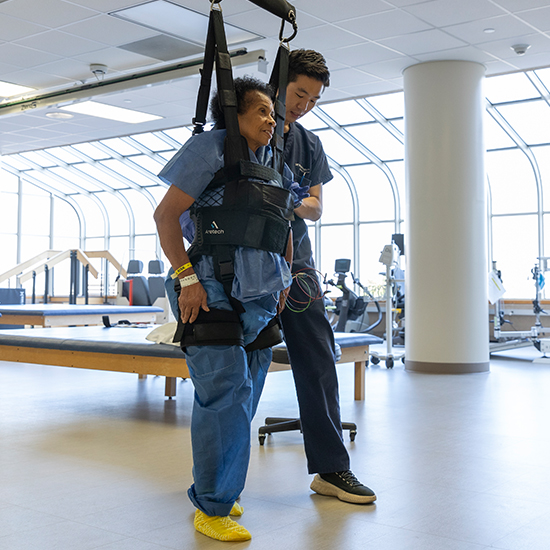
As her strength returned, so did her confidence. Before long, she was walking again and continuing to build endurance and independence.
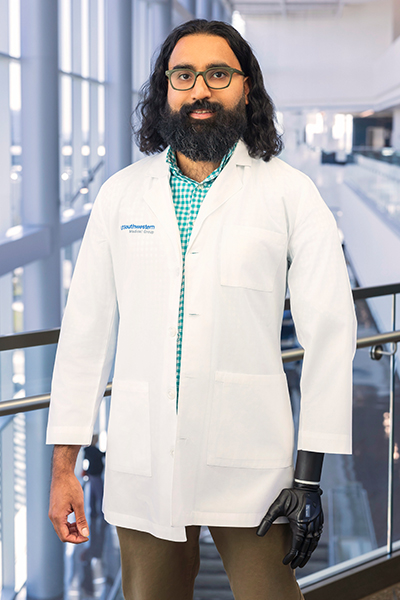
Her primary physician was Amar Patel, M.D., Assistant Professor of Physical Medicine & Rehabilitation and Medical Director for Inpatient Rehabilitation, who specializes in caring for patients recovering from traumatic injuries and complex surgeries. Dr. Patel understands the healing journey on a deeply personal level.
“While I was in dental school, I was in a car accident and lost my arm, so I use a prosthesis,” he said. “Along the way, I was introduced to physical medicine and rehabilitation. I went back to dental school for a while, but I kept thinking about what I could do as a physician.
“I find that while I may not have the exact same impairments or challenges as my patients, sharing those experiences builds rapport immediately. There’s no comparison between people’s lives or disabilities, but there is common ground.”
Mrs. Luna said Dr. Patel’s approachable nature and bedside manner motivated her to keep pushing forward. Supported by the entire rehabilitation team, she steadily worked toward her goals.
Multidisciplinary approach is the key
Because every case is unique and affects each patient differently, access to both rehabilitation psychologists and psychiatrists is available to assist with emotional support, coping, adjustment, and mood disorders that may develop due to change in function, medical status, or independence, the physician added.
“It takes a village,” Dr. Patel said. “This work is never about one individual. We come together to address not only the physical challenges, but also the mental and emotional toll that comes with losing function and independence. Our approach is holistic, and every team member plays an essential role.”
Today, Mrs. Luna is back to many of the activities she enjoys most. Swimming has become her favorite way to continue building strength and endurance, and she is grateful to once again cook and bake for her family, work in her garden, and return to her job.
“I’m so glad I came to UT Southwestern,” Mrs. Luna said. “When something is going on with your spine, it’s serious. You don’t want to take any chances. You need the best people taking care of you, and I’m so grateful to be able to count on them.”