


Rogers appointed Chief of Division of Pulmonary and Critical Care Medicine

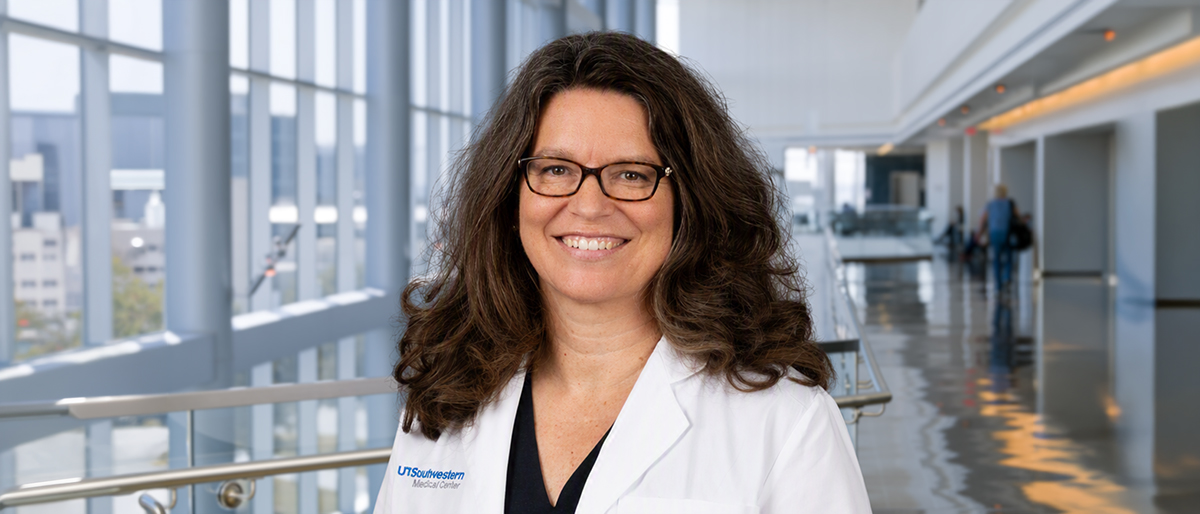
As a pulmonologist, Angela Rogers, M.D., M.P.H., has always embraced the dual challenge of caring for critically ill patients and pursuing discoveries to improve treatment of sepsis, acute respiratory distress syndrome (ARDS), and other critical illnesses.
“In the ICU you sometimes have minutes to help the patient that is right in front of you,” she said. “But with research, you also are more broadly able to help the next patient and the one after that.”
As the new Chief of the Division of Pulmonary and Critical Care Medicine at UT Southwestern, Dr. Rogers plans to combine all three pillars of academic medicine – clinical care, research, and education – to move the field forward. She began her role Sept. 1 and is eager to start encouraging more students to choose the physician-scientist path.
“Developing people builds the future and is a big part of my excitement of coming to UT Southwestern,” she said. “We’re already starting in a good place building the clinical science pipeline, but I want to help with career development and make it easier for people.”
Dr. Rogers’ journey to become a physician-scientist began as a philosophy major at Manchester College. She then earned her medical degree from Harvard Medical School and finished a residency in internal medicine at Brigham and Women’s Hospital. She also completed a fellowship in pulmonary and critical care medicine at Harvard and earned a master’s degree in clinical effectiveness from the Harvard T.H. Chan School of Public Health. Dr. Rogers joined the Stanford University School of Medicine as a faculty member in 2013 and was promoted to Professor in 2025.
In the intensive care unit, she found caring for patients with sepsis to be especially challenging, with treatments limited.
“My clinical passion is working with people who are increasingly sick and often need machines to stay alive as their body fights off an infection,” she said. “But so often when you have two equally sick patients, one may recover and the other does not.”
The mystery surrounding variations in the way patients respond to treatment has driven Dr. Rogers’ research.
“Part of the problem is we have been treating everyone with the same therapies we used 40 years ago,” she said. “Our field has yet to find a therapy that treats each patient in a unique way.”
Dr. Rogers formerly served as Professor of Medicine in the Division of Pulmonary, Allergy, and Critical Care Medicine at Stanford, where she also helped lead the Pulmonary and Critical Care Fellowship as Associate Director and the Internal Medicine Residency as Associate Program Director.
Her research has contributed to major advances in the field, including studies of immune responses in sepsis and COVID-19, biomarker discovery, and clinical trials exploring innovative therapies for ARDS, said Ezra Burstein, M.D., Ph.D., Professor of Internal Medicine and Director of the Inflammation and Digestive Diseases Research Center. Dr. Rogers has helped identify biomarkers and molecular “endotypes” that predict outcomes and therapeutic responses, toward the goal of advancing personalized medicine in critical care, he added.
As Dr. Rogers continues her research, treating patients for challenging infections and guiding their families remains an important part of her work.
“The ability to help families through difficult times is an incredible honor,” she said. “Patients and families put tremendous trust in you.”
Endowed Title:
Dr. Burstein holds the Berta M. and Cecil O. Patterson Chair in Gastroenterology.