


Surgical specialist Turner appointed Professor Emeritus of Surgery

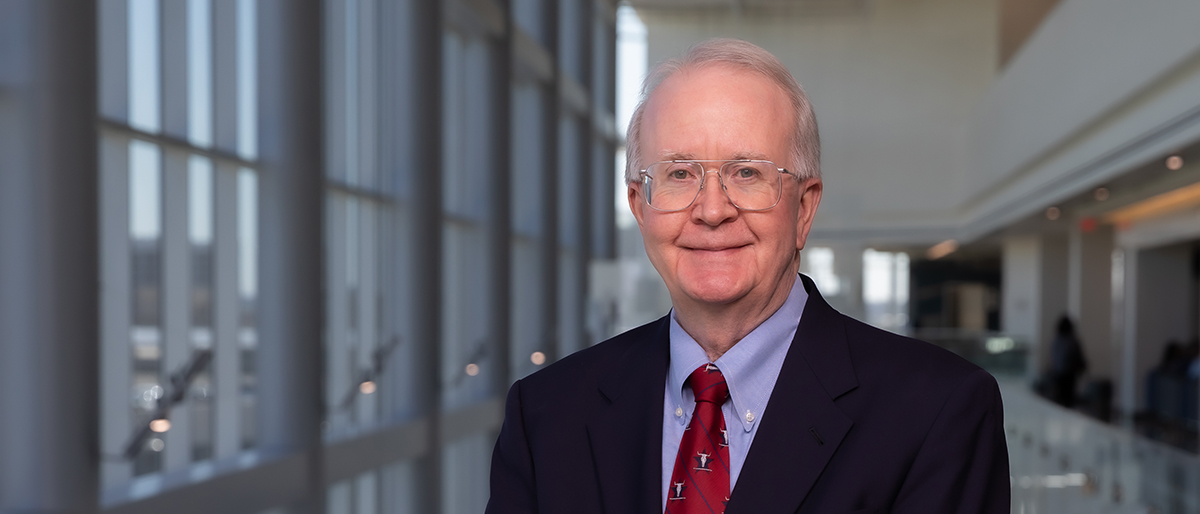
The year was 1972, and William W. Turner Jr., M.D., freshly graduated from Tulane University School of Medicine, had narrowed his surgical internship choices to three: Emory University, the University of Alabama, and UT Southwestern/Parkland Memorial Hospital.
“I was at Parkland for 10 minutes and I knew this was where I wanted to be,” Dr. Turner said. He recently retired as Professor of Surgery from UT Southwestern and was named Professor Emeritus of Surgery – only the third Professor in the 82-year history of the Department of Surgery to receive this honor.
“Matching for that internship,” said Dr. Turner, who started working in the newly created Parkland Burn Service, “was one of the greatest things that ever happened to me. Everything attracted me. The faculty included physicians who were still within the shadow of the Kennedy assassination, which had always fascinated me. You can imagine me as a young intern, talking to everyone who was there, and hearing them talk about it as if it had happened yesterday.”
That internship led to residency, and he was further hooked.
“We were given so much responsibility so fast,” he said. “These people opened the door for me. I couldn’t get enough.”
A Louisiana farm boy, he grew up surrounded by horses and cattle, by shades of green, and by an unwavering independence that can only be found in nature.
From his father, he learned patience: how to make things and how to fix things. “I had tools before I could even stand up,” Dr. Turner said.
From his mother, a teacher, he learned how to formulate ideas, and the art of eloquence in how he expressed them.
As a child, these gifts were omnipresent, interwoven into his very being. But the older he got and the more ensconced in medicine – “a perfect marriage between my love for biology and my love of helping people” – the more he appreciated them and how they set and enhanced his career path.
How that journey veered into surgery had everything to do with “my loving wife, Toni,” he said. “She listened to me talk about how much I liked internal medicine, puzzling, and academics. She said I should become a surgeon, ‘because I don’t know anyone who likes to fix things as much as you do.’”
At UTSW, Dr. Turner has been known as an expert in surgically treating abdominal disorders and benign soft tissue diseases. He is skilled in laparoscopic and open techniques, and some of his most common procedures include gallbladder removal and inguinal and abdominal wall hernia repair.
In 1977, Dr. Turner left UT Southwestern for two years to serve in the U.S. Air Force. He returned to UTSW afterward, then left in 1992 for Indiana University, where he held faculty positions at the Indiana University School of Medicine and the Butler University College of Pharmacy and Health Sciences and as Director of Surgery at the Clarian Methodist Hospital in Indianapolis. Six years later, he accepted a position at the University of Mississippi Medical Center as Chair of the Department of Surgery, then returned once again to UT Southwestern in 2007.
“People like me are programmed to climb up the academic ladder, to become a Chief or Chairman,” Dr. Turner said. “It’s a huge administrative job. I was hoping for a way to get the Chairman stuff out of my head and that was to come back to Dallas and to UT Southwestern. I wanted to be back to be a surgeon, to be an academician, to be a teacher.”
He came back to his beloved UT Southwestern to do all of those. That included spending substantial time as a mentor at the school’s Academic Colleges, and he was later appointed Head of Sprague College.
Third-year surgery resident Paige DeBlieux, M.D., trained under Dr. Turner, who received a Mentoring Award at the Leaders in Clinical Excellence Awards in 2021. From him, she learned much more than surgical techniques.
“He teaches you to operate and he teaches you to think,” said Dr. DeBlieux, who performed her first gallbladder surgery with Dr. Turner. Early in her training, they shared childhood memories of growing up on farms in Louisiana.
“We often talked about the transition between farm work and work in an operating room,” she said. “With both, you’re working with your hands and have the satisfaction of being innovative and solving a problem right then and there.”
Her mentor, she said, is totally in tune with residents as people as well as physicians. “He prioritizes our education and our wellness, and that’s a big thing coming from an old-school surgeon. I had a hurt knee when I was working with him, and he made sure that when I wasn’t operating, my knee was propped up and I was eating properly.”
Additionally, she said, Dr. Turner is very good about reminding his residents to “always stay humble, keep learning, and stay curious. Those things help you be a better doctor every day.”
Being a surgeon involves putting things together, sometimes in unique ways, Dr. Turner said. It also entails doing what younger residents often have trouble recognizing is not a sign of weakness: to ask for help.
“I began to aggressively call colleagues from the operating room and discuss cases with them,” said Dr. Turner, who performed the first surgery, an appendectomy, at William P. Clements Jr. University Hospital. “It’s a teaching exercise, and I wanted my residents to see me doing this. If a resident can see you uncertain and needing to work your way out of the uncertainty, they’ll be much better prepared to do that themselves.”
Over more than five decades, he’s left those students as well as colleagues with countless lessons; from all of them, he’s learned as well. UT Southwestern is, after all, a collaboration of ideas, knowledge, courage, and friendship.
The farm boy who left Louisiana decades ago still gets emotional when he thinks of how proud his father, who started him on his lifelong quest to fix things, was of him.
“In my third year as a resident, someone took a picture of me in the OR at Parkland, which was very unusual to do, and I sent it to my dad,” Dr. Turner said. “He kept that picture right by his bed until the day he died. He used to tell me he’d wake up at night, look at that picture, wonder what I was doing, and remember me as a little boy.”